The Foundations of Japanese Martial Arts: Understanding the Chinese Roots Before Training at the Dojo
A dojo founder traces his personal path from Chinese boxing to Shinkyokushin Karate, exploring the historical links between Fujian martial arts, Okinawan Tode, and the naming of karate itself.
By
 Thaninpong Supapitakpong (Phoenix)Founder and instructor at IMAC Dojo
Updated 19 Sept 2026
- Author
- Thaninpong Supapitakpong (Phoenix)
- Published
- Last updated
- Sources
- 5
- Reading time
- 11 min
Short Answer
Karate genuinely has roots in Chinese boxing, particularly Southern boxing from Fujian province, which spread into the Ryukyu Kingdom (Ryukyu — the ancient kingdom on Okinawa island) and became the art known as "Tode" (Tode — meaning "hand of the Tang people"), before being renamed and severed from its Chinese roots during Japan's pre-war nationalist era. The clearest piece of evidence is the name of the Shorin-ryu school, founded by Chibana Choshin in 1933, which uses kanji characters whose meaning is directly linked to the word Shaolin. For anyone who wants to understand this foundation before beginning to train seriously, learning karate at a dojo in Bangkok still holds to the same basic stances, breathing, and energy cultivation that master practitioners of earlier generations once trained in.
Key Takeaways
- The word karate originally meant "palm of the Tang Dynasty," referring to Chinese boxing, before being changed to "empty fist" in a later era.
- The Sanchin Dachi and Hiba Dachi stances share the same roots as the goat-stance and horse-stance of Chinese boxing.
- The Shorin-ryu, Matsubayashi-ryu, and Shorinji-ryu schools all use names directly linked to Shaolin.
- Japan itself has as many as approximately 1.5 million practitioners of Chinese boxing or wushu, according to JWTF data.
- Kenichi Sawai, founder of Taikiken, once trained in Chinese boxing and passed it on to Masutatsu Oyama, founder of Shinkyokushin Karate.
- Shinkyokushin Karate at IMAC Dojo still holds correct fundamental stances as the core of training, no different from how Chinese boxing emphasizes foundational work.
I am Chinese, and I began my life in the martial arts world with Chinese boxing before walking seriously onto the path of Japanese-style karate for the first time through Shinkyokushin Karate (Kyokushin Karate — a karate style focused on full-contact fighting). As I studied more deeply into the history of karate and Shaolin, I came to understand that the word "karate" originally meant "the palm of the Tang Dynasty," referring directly to Chinese boxing, not "empty fist" as most people understand it today. This is not merely my own personal feeling — there are historical traces that Japanese scholars themselves have recorded, from monks who traveled to the Shaolin Temple as early as the 14th century, to the names of Okinawan karate schools that still use kanji characters directly linking them to the word Shaolin.
In this article
From Chinese Boxing to Okinawa: A Forgotten Origin
When I began training in Chinese boxing as a child, I never thought that one day I would discover the very same techniques hidden within the karate I teach today. Research I have read clearly states that the transmission of Chinese martial arts to Japan was not a single event, but a process that flowed continuously across many centuries. The most clearly documented point is the period spanning the Kamakura era into the Muromachi era, when a Japanese monk named Daichi traveled to the Shaolin Temple (Shaolin Temple — the famous temple on Mount Song, the legendary birthplace of Shaolin boxing) in the year 1321, followed by the monk Shogen, who traveled to reside at the Shaolin Temple in the 1330s and is believed to have received martial arts teachings from the abbot of that era. Even though the evidence that he systematically opened a school to teach the art in Japan remains unclear, this is still considered the first door that opened.
For me, what is even more interesting is the transmission that can actually be verified historically, through Chen Yuanyun, a scholar from the late Ming Dynasty who had studied martial arts at the Shaolin Temple. He traveled to Japan with a diplomatic delegation in 1619 and decided to remain there, passing on boxing arts to the Japanese, to the point that a stone monument called "Kito-ryu Kenpo" (Kito-ryu Kenpo — the name of a kenpo school that was influenced by Chen Yuanyun) was erected in 1779, with an inscription confirming that boxing arts in Japan began with this man from the Ming dynasty. Some historians have even observed that Jujutsu, and the Judo that Kano Jigoro founded in the late 19th century, also carry part of their roots from the Shaolin tradition that Chen Yuanyun brought in. This is why I often tell my students that the idea of Judo's origin tracing back to Chinese boxing is not an exaggeration, but an observation genuinely supported by historical evidence.
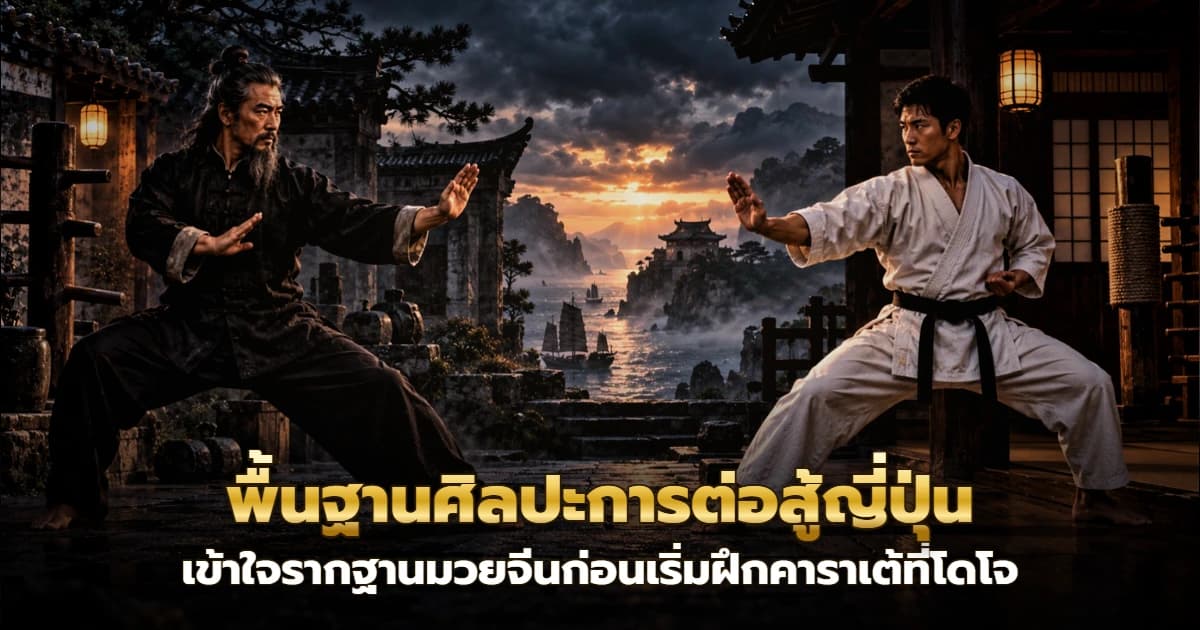
The influence of Chinese boxing did not stop at the main islands of Japan, but extended all the way to the Ryukyu Kingdom, present-day Okinawa, which became an important foundation of karate. The art there was originally called "Tode," meaning "hand of the Tang people," or a science coming directly from China. The Shorin-ryu school, which Chibana Choshin named in 1933, uses kanji characters linked to the word Shaolin, as do Matsubayashi-ryu and Shorinji-ryu, which reflect the influence of Southern boxing from Fujian province. The fact that Okinawan masters used the word Shaolin to name their schools reflects that, in East Asian society, the word Shaolin served as a kind of symbol guaranteeing strength and authority within the martial arts world.
Why Japan Changed the Name of Karate from "Tang Palm" to "Empty Fist"
This is the point I feel is most important from my personal perspective, because it explains why later generations of Japanese people have been reluctant to accept that karate came from Chinese boxing, even though the stance for storing energy at the Tanden (Tanden — the point of concentrated energy below the navel, according to East Asian martial arts belief), the goat-stance called Sanchin Dachi, and the horse-stance called Hiba Dachi, nearly all share the same roots as stances in Chinese boxing. The research I am referencing points out that in the period before World War II, martial arts exchanges between China and Japan were heavily dominated by nationalist context. There were sparring matches between Chinese fighters such as Huo Yuanjia, Li Shuwen, and Wang Ziping against Japanese judoka and soldiers in Shanghai and Manchuria, many of which were not held in a spirit of friendship, but rather to demonstrate ethnic superiority.
In an atmosphere like that, admitting that one's own martial art had Chinese roots would naturally conflict with national pride. I see this as the point where the word "Kara" was changed in meaning from "Tang" (the Chinese dynasty) to "kong," meaning empty, combined with the word "te," meaning fist, becoming "empty fist" as it is known today. But what is interesting is that even though the name changed, the fundamental techniques never did. I once visited an old dojo in Okinawa that still holds the tradition of bowing to Master Bodhidharma (the legendary master figure linked to the Shaolin Temple) as a patriarch. This is cultural evidence just as powerful as any academic document.
The Person Who Directly Connects Chinese Boxing with Shinkyokushin Karate
Every time I teach my students, I often tell the story of Kenichi Sawai (1903–1988), because he is a tangible bridge between Chinese boxing and Shinkyokushin Karate. Sawai once traveled to China and trained with Wang Xiangzhai, the master who founded Yiquan (Yiquan — the "boxing of intent," emphasizing standing still to build internal power), until he came to deeply understand the principle of releasing power from within. When he returned to Japan, he founded Taikiken (Taikiken — a martial art combining Yiquan principles with a Japanese approach), and he maintained a close relationship with Masutatsu Oyama, founder of Shinkyokushin Karate, to the point that many karate historians believe the principle of standing still to accumulate power in Shinkyokushin Karate was influenced by Yiquan directly through Sawai.
This makes me feel that I am not at all a stranger to the lineage I am studying, because the path I walked from Chinese boxing to Shinkyokushin Karate is the very same path that Oyama and Sawai once walked nearly a hundred years before me. Data from the Japan Wushu Taijiquan Federation, or JWTF, indicates that Japan today has as many as approximately 1.5 million practitioners of Chinese boxing or wushu in various forms, reflecting that even though history was somewhat obscured during the nationalist era, the cultural foundation never actually disappeared from Japanese society.
Comparison Table of Basic Stances: Karate and Chinese Boxing
| Stance | Name in Karate | Name in Chinese Boxing | Main Focus |
|---|---|---|---|
| Goat stance | Sanchin Dachi | Jia Ma stance (Fujian Southern boxing) | Storing energy at the Tanden |
| Horse stance | Hiba Dachi | Ma Bu (Northern boxing) | Stable lower base |
| Front-back stance | Zenkutsu Dachi | Gong Jian Bu | Projecting force forward |
| Triangle stance | Neko Ashi Dachi | Xu Bu | Preparing to shift rhythm |
Training Shinkyokushin Karate at a Dojo in Bangkok: Building on This Foundation
For me, knowing the roots of karate is not merely a matter of academic knowledge — it changed the way I teach every single student at IMAC Dojo. Because once you understand that each stance originates from the energy-storing methods of Chinese boxing, I always emphasize to my students that they should not rush to skip over the fundamentals, whether it is standing, breathing, or balance. These are the roots on which the entire tree must stand. Training in Shinkyokushin Karate at our dojo is therefore not merely about imitating movements to look beautiful, but about cultivating discipline and patience at the same time.
I often tell parents who bring their children to enroll that the karate taught here does not emphasize violence or aimless clashing, but places correctness of form as the top priority, because this is what master practitioners of earlier generations, from the Okinawan era through to the era of Masutatsu Oyama, have always upheld. Our Shinkyokushin Karate course is open to ages 7 through 60, because we believe that this correct foundation can be trained at any age, whether it is a child just starting out or an adult who wants to return to disciplined physical care. Those interested can view further course details at the Shinkyokushin Karate course page.
Another thing I try to pass on to every student is the understanding that each branch of martial arts is not as separate from the others as most people think. Judo itself also has part of its roots connected to Shaolin through Chen Yuanyun. Although IMAC Dojo does not teach Chinese boxing or Taiji as a public course, this kind of historical knowledge helps students understand why certain movements in karate look so familiar to what one sees in wuxia films, and why disciplined training is the heart of every school, regardless of which nation it comes from.
A Lesson I Want to Pass On from a Journey Across Two Cultures
Looking back to when I began training in Chinese boxing as a child, I never imagined that one day I would become the founder of a dojo teaching Shinkyokushin Karate in Bangkok. But looking back now, I feel that this path was very natural, because the foundations of both arts are barely different at all — differing only in name, uniform, and the surrounding cultural context. What I want every student to understand is that studying martial arts is not about choosing one side over another, but about opening one's mind to learn that every school shares philosophical common ground deeper than what meets the eye.
I believe that understanding this historical foundation will help every practitioner — whether a young child just starting out, a working adult who sits at a desk all day, or an older person who wants to take care of their body — appreciate the value of foundational training even more. Because once you know that a seemingly simple stance has actually been refined from centuries of wisdom crossing two cultures, repeating it again and again is no longer boring, but becomes a way of following in the footsteps of the master practitioners who once crossed the sea to exchange their arts. I myself try to pass this perspective on to every student at IMAC Dojo — not so that everyone becomes a historian, but so that everyone trains with understanding and respect for what they are doing. This, to me, is just as important as any striking or kicking technique.
Conclusion
Throughout the path I have walked, from Chinese boxing in my childhood to becoming the founder of a dojo teaching Shinkyokushin Karate in Bangkok, I have learned that every branch of martial arts carries deep threads connecting them to one another — whether in stance, breathing, or the philosophy of storing internal energy — which traveled across borders and through time over many centuries before becoming what we know today. Understanding these roots does not diminish the value of karate in any way. On the contrary, it makes practitioners appreciate even more the discipline and patience that earlier generations of masters accumulated and passed down. If you are looking for a place to train in Shinkyokushin Karate that places importance on correct and safe fundamentals for all ages, my team and I at IMAC Dojo welcome everyone who is ready to begin this path together with us.
Sources and further reading
- Karate — WikipediaCommunityAccessed 19 Sept 2026
- Kyokushin — WikipediaCommunityAccessed 19 Sept 2026
- Mas Oyama — WikipediaCommunityAccessed 19 Sept 2026
- Kenichi Sawai — WikipediaCommunityAccessed 19 Sept 2026
- Yiquan — WikipediaCommunityAccessed 19 Sept 2026
Frequently Asked Questions
How is karate different from Chinese boxing in practice?
The main difference lies in the training system and the surrounding culture, but the foundations of stance, breathing, and storing energy at the Tanden are highly similar, because karate developed directly out of Fujian-lineage Chinese boxing that spread into Okinawa.
Why do some karate schools still bow to Master Bodhidharma?
Because traditional Okinawan schools have preserved the customs linked to Shaolin roots, even though mainland Japan later changed the names and severed this connection during the nationalist era.
Is Judo really related to Chinese boxing?
Some historians have observed that Jujutsu, which forms the foundation of Judo, was partly influenced by Shaolin through Chen Yuanyun, who traveled to Japan in 1619. However, it must be understood that this process passed through many centuries of development before becoming its own distinct identity.
At what age should a child begin training in Shinkyokushin Karate?
The Shinkyokushin Karate course at IMAC Dojo is open to ages 7 through 60, because we believe that correct fundamental form can be trained at any age, and no prior background is required.
Do I need prior martial arts experience to study karate at a dojo in Bangkok?
No, it is not necessary. The teaching approach at IMAC Dojo emphasizes laying a foundation in fundamental movements from the very beginning, suited to each person's own capability, whether an adult who has never exercised before or an older person — both can join the training.
Where can I find more details about the Shinkyokushin Karate course?
You can view further details at the [Shinkyokushin Karate course](/en/courses/shinkyokushin-karate-thailand) page, and see the dojo's class schedule and fees at the schedule and pricing page of the dojo.
Ready to start martial arts?
Message IMAC Dojo to ask which course fits your age, goals, and training background.
Ask on LINE Official