Learn Shinkyokushin Kyokushin Karate at IMAC Dojo Bangkok for Self-Defense Training
Explore Shinkyokushin Kyokushin Karate at IMAC Dojo Bangkok, including Budo principles, progressive full-contact practice, and disciplined training.
By
 Thaninpong Supapitakpong (Phoenix)Founder and instructor at IMAC Dojo
Updated 24 Jun 2026
- Author
- Thaninpong Supapitakpong (Phoenix)
- Published
- Last updated
- Sources
- 1
- Reading time
- 5 min
Short Answer
Shinkyokushin Kyokushin Karate at IMAC Dojo uses progressive full-contact practice under instructor supervision. Training develops Kihon, Kata, Kumite, body control, and discipline, with beginners starting from fundamentals and increasing intensity according to their readiness.
Key Takeaways
- Progressive full-contact practice introduces pressure in a controlled training setting.
- Conditioning focuses on balance, strength, endurance, and movement control.
- Authentic Budo philosophy teaches discipline, humility, and the 'Osu' spirit of perseverance.
- Training progresses from Kihon and Kata to partner drills and Kumite.
- Instructors manage intensity, equipment, and partner work according to each student's level.
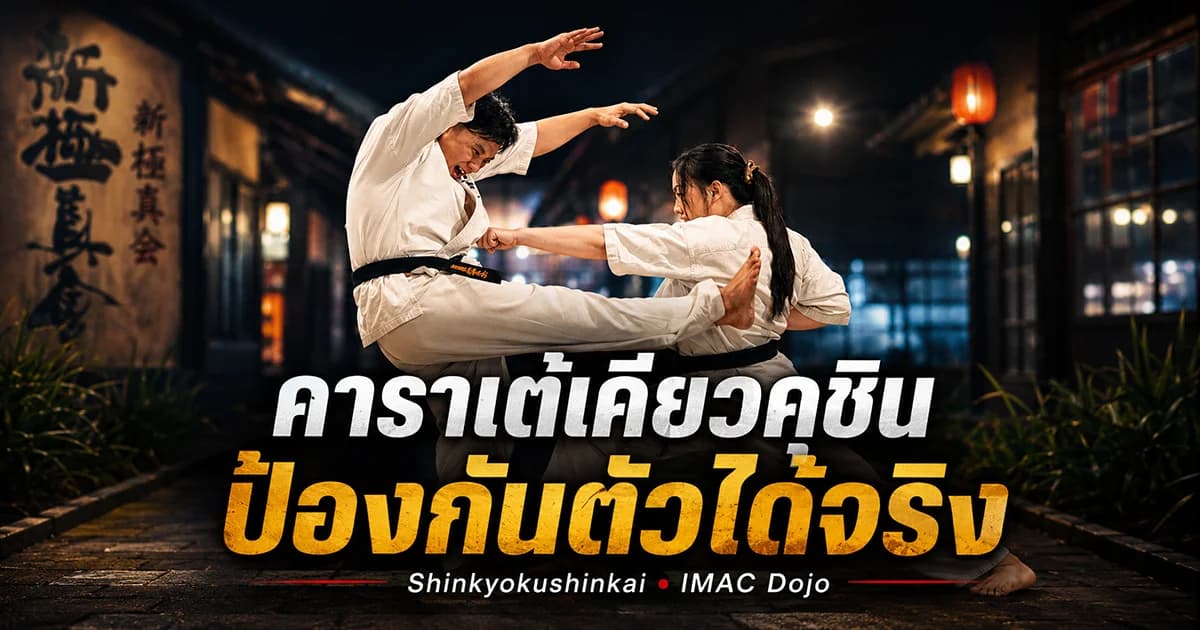
Image note: Shinkyokushin Kyokushin Karate training session at IMAC Dojo martial arts school in Bangkok.
Shinkyokushin Karate is a full-contact Japanese martial art developed from Kyokushin Karate. It combines basics, technique, rules-based contact practice, physical training, and the perseverance associated with Osu no Seishin. The World Karate Organization (WKO) is led by Kenji Midori.
IMAC Dojo teaches Shinkyokushin Karate in Bangkok, progressing from Kihon and Kata fundamentals to partner drills and Kumite according to each student's readiness.
In this article
The Essence of Shinkyokushin: Mastering Shin Gi Tai
At IMAC Dojo, we preserve the traditional values of Budo (the martial way), emphasizing that karate training is a lifelong path toward self-refinement rather than a mere point-based sport. Our curriculum is anchored around the core concept of Shin Gi Tai (心技体):
- Shin (心 - Mind/Spirit):Developing humility, emotional control, respect, and a dedicated sense of discipline.
- Gi (技 - Technique):Perfecting biomechanics, precise target acquisition, and sharp combative skills.
- Tai (体 - Body):Building strength, endurance, balance, and controlled movement. According to Budo philosophy, these three pillars are practiced together: technique and physical ability should be guided by humility, discipline, and respect. IMAC Dojo reinforces this through the practice of "Osu" (押忍) as a reminder of endurance and continuous learning.
Legacy of Strength: From Mas Oyama to the Modern WKO
Shinkyokushin continues the approach associated with Sosai Masutatsu Oyama, the founder of Kyokushin Karate, emphasizing serious technical, physical, and mental practice. Stories of his isolated training on Mt. Minobu and Mt. Kiyosumi are part of the style's transmitted history, but their details should be read as tradition rather than as a record verified in every respect. Kyokushin is commonly translated as "The Ultimate Truth."
Following Oyama's passing in 1994, senior disciples led by World Champion Kenji Midori restructured the organization into a transparent, democratized non-profit entity known as WKO Shinkyokushinkai. The character "Shin" (新) represents "New"—symbolizing global transparency—while also evoking "Shin" (心), meaning "Heart." Under Midori’s philosophy of Master our Mind, the organization serves to build youth character, spread global peace, and harmonize the mind, technique, and body through its iconic "Kokoro" emblem.
Why Kyokushin is Internationally Renowned as the "Strongest Karate"
Kyokushin style is highly acclaimed worldwide within the combat sports community due to its functional full-contact methodology:
- Full-Contact Sparring (Kumite):Full-contact competition rules and ordinary class practice are different contexts. In class, instructors choose drills, protective equipment, and contact levels according to experience so students can learn distance, timing, defense, and response without rushing into heavy contact.
- Advanced Body Conditioning:Conditioning gradually develops strength, endurance, balance, and force control. Drills such as Ude-kitae (腕鍛え) should be introduced under instructor supervision, while Uke (受け) trains practitioners to receive and redirect force before responding.
- The Spirit of Perseverance:The 100-Man Kumite is a continuous challenge discussed in Kyokushin history and is used as a symbol of perseverance and self-control. It is not an ordinary class exercise or a starting point for beginners.
- Influence on modern combat sports:Combat-sport athletes including Georges St-Pierre and Andy Hug have Kyokushin backgrounds. The structure of Kihon (basics), Kata (forms), and Kumite (partner practice) is therefore often discussed in relation to skill development across several combat sports.
Comparison Table
| Comparison Topic | Sport Karate | Kyokushin Full Contact |
|---|---|---|
| Scoring approach | Speed-focused touch-and-stop point system | Impact effectiveness, knockdown pressure, and practical resilience |
| Protective equipment | Gloves, shin guards, mouthguard, and face protection are common | Bare hands and bare feet in formal rules, with safety gear used progressively in class |
| Body training | Agility and reaction speed | Strength, endurance, balance, and conditioning |
The Disciplined and Welcoming Community at IMAC Dojo, Ladprao 101 Bangkok
At IMAC Dojo Bangkok, disciplined training is combined with a friendly atmosphere. The teaching team shares responsibility for fundamentals, movement, Kata, and Kumite according to student readiness:
- Sensei Phoenix:Explains fundamentals and the application of skills for beginners.
- Sensei Patty:Focuses on basic conditioning, body control, and self-defense practice for women.
- Sensei Ken:Breaks techniques into clear steps for students with different levels of experience.
- Sensei Ryu:Focuses on movement, angles, and footwork.
- Sensei Rain:Focuses on progressive Kumite practice and observing student readiness.
- Sensei Michelle:Focuses on Kata detail, balance, and continuity of movement.
Classes cover Kihon, Ibuki, Kata, Bunkai, and Ido Geiko. Beginners work from foundational drills before pressure increases, with equipment and partner work managed for the activity. Contact training still carries risk, so students should stop and tell the instructor whenever they feel unready or unsafe.
IMAC Dojo students bring different backgrounds and goals. Instructors therefore adjust the progression to each student's experience while maintaining a culture of respect for training partners and avoiding premature heavy contact for beginners.
Ask a Question or Arrange a Visit
To learn how Shinkyokushin Karate is taught at IMAC Dojo, ask a question or arrange to watch a group class.
- Phone
- 091-485-5445
- LINE
- @imacdojo
- Address
- 19, 21 Soi Pokaew 3 Yak 9, Klongchan, Bangkapi, Bangkok 10240, Thailand
Sources and further reading
- WKO ShinkyokushinkaiPrimary
Frequently Asked Questions
I have absolutely no prior martial arts experience. Can adults or seniors safely learn Kyokushin Karate?
Beginners can start with Kihon, posture, and basic movement before intensity increases according to readiness. Instructors adjust drills to each student's experience. Anyone with a health or mobility concern should disclose it before training.
Is live sparring (Kumite) dangerous at your dojo? Should I worry about major injuries?
Contact training carries risk and cannot be guaranteed injury-free. For beginners, instructors manage partners, contact level, and equipment for the activity, with the focus on technique and self-control. Students should stop and tell the instructor immediately if they feel unsafe.
How long does it take to earn a black belt, and is the certification internationally recognized?
The timeline and grading schedule depend on training consistency, skill level, and the current grading rules, so there is no fixed duration. Ask IMAC Dojo directly to confirm the current examination process and how a certificate is recognized before enrolling.
Ready to start martial arts?
Message IMAC Dojo to ask which course fits your age, goals, and training background.
Ask on LINE Official