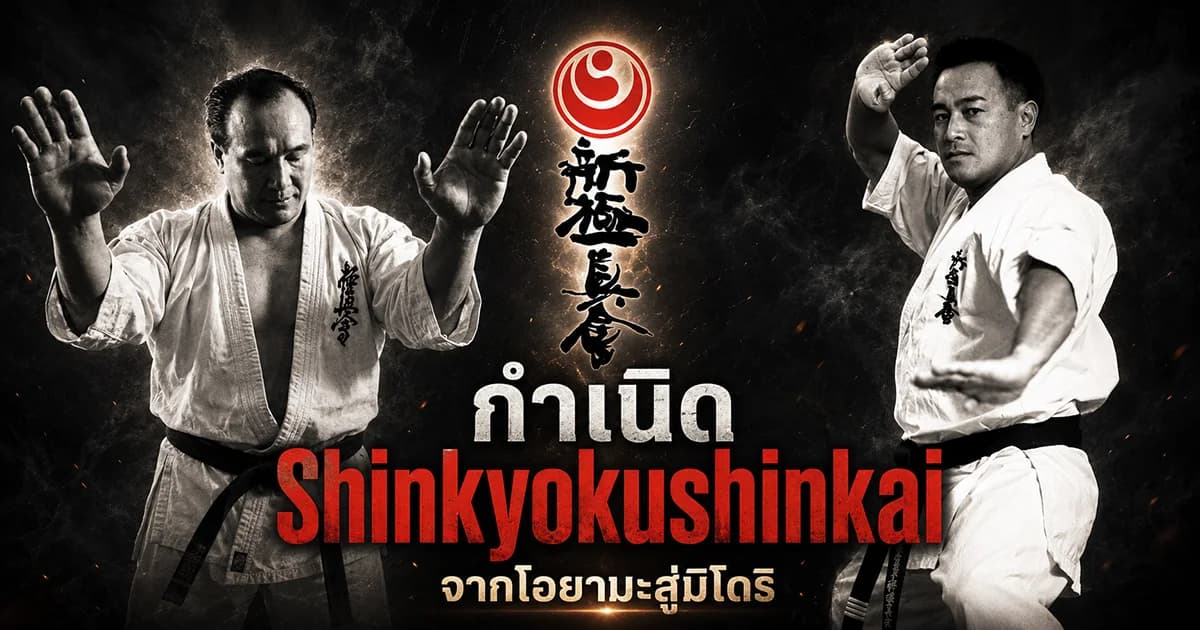
The Birth of Shinkyokushinkai: From Mas Oyama to Kenji Midori
A clear guide to Shinkyokushinkai history, from Mas Oyama's Kyokushin roots to Kenji Midori's WKO era, the Kokoro symbol, and what it means for karate students in Bangkok.
By
 Thaninpong Supapitakpong (Phoenix)Founder and instructor at IMAC Dojo
Updated 26 Aug 2026
- Author
- Thaninpong Supapitakpong (Phoenix)
- Published
- Last updated
- Sources
- 2
- Reading time
- 4 min
Short Answer
Shinkyokushinkai is a full-contact karate organization rooted in Mas Oyama's Kyokushin Karate and shaped into the modern WKO Shinkyokushinkai system under Kenji Midori after 2003. It preserves hard training, kumite, kata, and budo discipline while emphasizing Kokoro (heart and mind), transparency, youth development, and international exchange.
Key Takeaways
- Mas Oyama established the foundation of Kyokushin Karate as a real full-contact karate system.
- After Oyama's passing in 1994, the Kyokushin world entered a major organizational transition.
- Kenji Midori, the 1991 Kyokushin World Open champion, became a key modern leader of WKO Shinkyokushinkai.
- Shinkyokushinkai keeps hard full-contact training while presenting a transparent, open organization focused on youth development.
- For students at IMAC Dojo Bangkok, this history explains why karate training is not only fighting practice, but discipline, respect, and personal growth.
This article connects global Shinkyokushinkai history with the way full-contact karate is taught safely and progressively at IMAC Dojo in Bangkok.
Continue with the Japan-to-Thailand story and the founder's family experience in Shinkyokushin Karate: From Japan to Thailand.
When people talk about full-contact karate, Kyokushin Karate is usually the starting point. It is known for hard basics, knockdown fighting, endurance, respect, and the word Osu as a daily expression of patience under pressure.
After Mas Oyama passed away in 1994, the Kyokushin world faced questions of succession, governance, and how to preserve its essence for a new international era. Shinkyokushinkai emerged as one of the most important answers to that question.
In this article
1. What is Shinkyokushinkai?
What is Shinkyokushinkai? It is more than a question about a name. It points to a living budo organization that inherited Kyokushin's full-contact training culture while shaping it for modern students, families, instructors, and international dojos.
At IMAC Dojo Bangkok, we explain Shinkyokushinkai as a path of basics, movement, kata, controlled kumite, etiquette, and self-control. The goal is not aggression. The goal is to build a body and mind that can stay calm under pressure.
2. Mas Oyama and the Kyokushin foundation
Who was Mas Oyama? That is the first question to ask before studying Shinkyokushinkai history. Oyama made Kyokushin famous as a karate system tested through full-contact sparring, conditioning, and the courage to face real impact.
The Official Mas Oyama History records important milestones such as Kyokushin's global growth and the 1964 headquarters period. For modern karate students, those dates matter because they show how a tough local dojo culture became an international movement.
3. From Kyokushin to WKO Shinkyokushinkai
The history of Shinkyokushin Karate cannot be separated from the transition after 1994. After Oyama's passing, Kyokushin groups had to decide how to preserve the core of the art while creating governance that could work across countries and generations.
What is WKO Shinkyokushinkai? The practical answer is World Karate Organization Shinkyokushinkai: a global structure using the Kokoro symbol and communicating full-contact karate as budo, not just competition. The World Karate Organization official site also highlights courtesy, etiquette, youth inspiration, and international participation as part of its message.
4. Kenji Midori and the new era
Who is Kenji Midori? He is one of the defining leaders of modern Shinkyokushinkai and a symbol of technical courage. His reputation matters because he showed that size is not the only factor in full-contact karate.
Kenji Midori, the 1991 Kyokushin world champion, matters for more than the trophy. That victory represents the idea that timing, heart, and technical precision can overcome the fear of bigger opponents.
5. Kyokushin vs Shinkyokushinkai
The difference between Kyokushin and Shinkyokushin is best understood as a difference in organization and identity rather than a rejection of the original training roots.
| Topic | Kyokushin | Shinkyokushinkai |
|---|---|---|
| Root | Founded by Mas Oyama as a full-contact karate system | Inherits Kyokushin roots through the WKO Shinkyokushinkai structure |
| Symbol | Kanku or group-specific emblems | Kokoro (心), meaning heart and mind |
| Training | Hard basics, kata, knockdown kumite, endurance | The same serious training culture with emphasis on safety, education, and international budo |
6. Kokoro and Master Our Mind
Kokoro (心) is at the heart of how Shinkyokushinkai communicates, because the word does not only mean the heart in an emotional sense. It also covers the mind, intention, courage, and knowing how to govern oneself. Hard training therefore is not meant to build aggression, but to let the student see themselves more clearly.
In the Shinkyokushin Karate classes at IMAC Dojo we translate this idea into real practice: stand firmly, breathe properly, understand distance, respect your training partner, and stop when it is right to stop. Children practise discipline, adults practise focus, and parents see progress they can point to.
7. What this means for Bangkok students
Learning Shinkyokushin karate in Bangkok starts from practical concerns. Parents want discipline and safety. Adults want fitness, confidence, and self-defense. Beginners want to know whether full-contact karate is too hard to start. The answer depends on progression and teaching quality.
For a practical training perspective, read our article on Shinkyokushin Karate for self-defense, or meet the IMAC Dojo instructor team to connect the history with real classes in Bangkok.
Sources and further reading
Frequently Asked Questions
What is Shinkyokushinkai?
Shinkyokushinkai is a full-contact karate organization rooted in Mas Oyama's Kyokushin Karate and developed into the modern WKO Shinkyokushinkai era under Kenji Midori. It emphasizes hard training, respect, and Kokoro or heart-mind discipline.
What is the difference between Kyokushin and Shinkyokushinkai?
They share the same technical roots, but Shinkyokushinkai uses the WKO structure and Kokoro symbol to express a modern international identity focused on budo character, transparency, and youth development.
Can beginners learn Shinkyokushin karate at IMAC Dojo?
Yes. Beginners start with basics, stance, movement, breathing, etiquette, and controlled drills before progressing to safe partner work and kumite appropriate to their level.
Who created Shinkyokushinkai?
Its root is the Kyokushin karate built by Mas Oyama. After his passing in 1994 the organisation went through a transition, and since 2003 it has run as WKO Shinkyokushinkai under Kenji Midori. The accurate answer is therefore not a single founder, but a lineage carried from Mas Oyama's Kyokushin into the present organisation.
Ready to start martial arts?
Message IMAC Dojo to ask which course fits your age, goals, and training background.
Ask on LINE Official