Parents Training in Martial Arts Together with Their Children: A Priceless Family Activity
The day I weighed nearly 97 kilograms and sat waiting beside the mat was the day I decided to train too. This article sets a decade of the Supapitakpong family beside research on oxytocin, rough-and-tumble play, and the cost of parental pressure.
By
 Thaninpong Supapitakpong (Phoenix)Founder and instructor at IMAC Dojo
Updated 9 Aug 2026
- Author
- Thaninpong Supapitakpong (Phoenix)
- Published
- Last updated
- Sources
- 7
- Reading time
- 8 min
Short Answer
Parents who get on the mat gain more than parents who drop their children off, because research found that ground grappling raises salivary oxytocin more than punch-kick sparring, and that adult-supervised rough-and-tumble play is associated with better emotion regulation in children. Crucially, a parent does not need to be better than the child: falling over yourself is what reduces the pressure parents otherwise pass on without meaning to.
Key Takeaways
- A study of 68 jujitsu practitioners found salivary oxytocin rose significantly more after ground grappling than after punch-kick sparring.
- Rough-and-tumble play between an adult and a child is associated with emotion regulation, but the effect depends on how well the adult holds the boundaries, not on how hard the play gets.
- Japan runs judo classes where parents genuinely train alongside their children, organised by local authorities and the judo federation.
- Thai brain-imaging research found child boxers with more than five years of fighting had a lower average IQ than a comparison group, which drove proposals to set a minimum age for competitive bouts.
- Parental pressure predicts perfectionism and burnout in young athletes; training yourself is the most reliable way to shrink a parent's ego.
This article draws on the experience of Phoenix, founder of IMAC Dojo, as a father and an instructor rather than a clinician or psychologist. The research cited provides context; it is not a promise of the same outcome for every family.
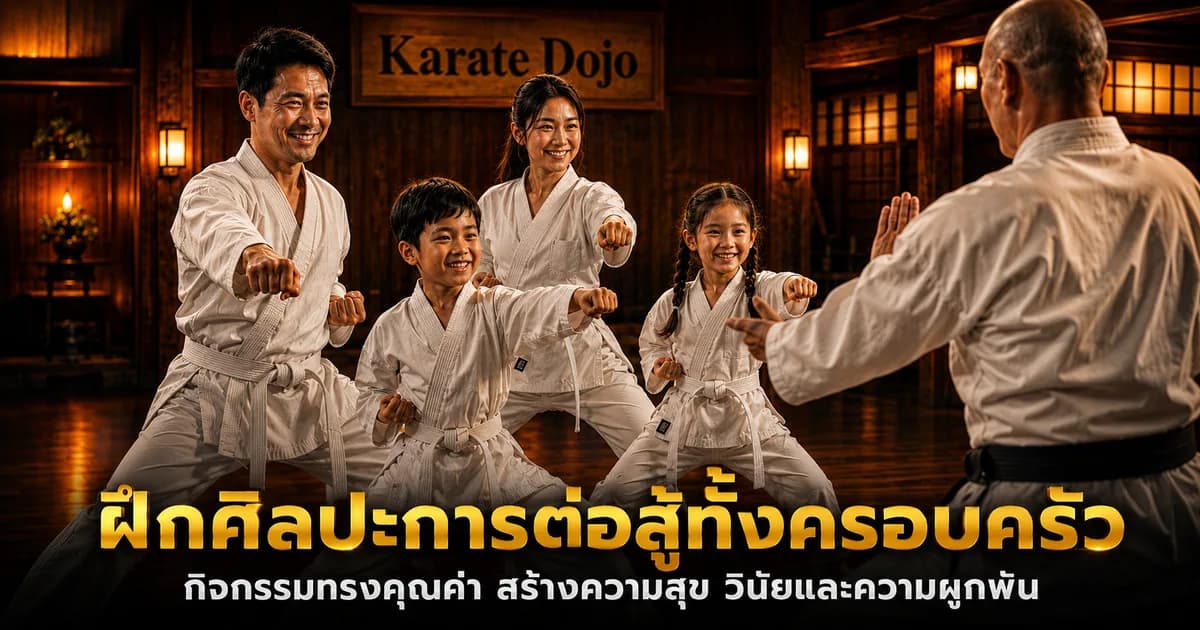
I still remember clearly the day I weighed nearly 97 kilograms. I took all four of my children to train and sat waiting by the mat. Feeling like I was wasting time, I decided to get down and train myself. The first week I was so sore I could barely manage the stairs at home.
But that was the beginning of a journey spanning more than a decade that changed the body, the family relationships, and the outlook of the Supapitakpong family for good.
In this article
Why training together is different from simply dropping your child off
If you are unsure whether an adult can start from scratch, my own account of beginning karate at 42 is in starting karate between 30 and 60, and every programme we run is listed on the full course listing.
At 39 I already had four children. What turned my life around was not the decision to exercise, but inviting my wife to train alongside our kids, until between us we had studied at no fewer than 12 to 15 schools across several disciplines.
The difference I felt most clearly comes at the moment a child cannot make a technique work, or is afraid of being paired up. A parent on the same mat is someone who can steady that moment, not just someone waiting to hear the result. And the parent learns how hard the technique actually is before telling the child why they failed.
The mechanism that turns a training mat into a bonding space
The study martial arts increase oxytocin production tested the saliva of 68 jujitsu practitioners before and after training and found oxytocin rose immediately after high-intensity work, and that ground grappling raised it significantly more than punch-kick sparring. The authors attribute the difference to closer and longer tactile contact. It was measured in adult practitioners, not in parent-child pairs.
The second mechanism is consensual play fighting. The observational study of rough-and-tumble play and the regulation of aggression in father-child dyads found the quality of the play matters more than the quantity: when the adult holds the pace and the boundaries, this kind of play is associated with lower aggression, and when the adult does not, the association can reverse. In a dojo, the rules, the instructor, and the bow do that boundary-holding job.
Through these sessions my children learned that losing means getting back up, not something to be ashamed of. The safe-falling skill that underpins every throwing art is covered in Ukemi: falling safely in Judo.
What I could not explain to my children back then, science explains better. Hugging a child after a session of throwing practice really is different from sitting down to a meal together.
A lesson from Japan: judo classes where the parents are on the mat too
One officially announced example is the beginners' parent-and-child judo class run by the City of Hiroshima, open to children from five years old through elementary school together with a guardian, alongside the trial classes for complete beginners run by the All Japan Judo Federation, which people can join without owning a judogi. Neither is aimed at producing Olympic athletes; both open a door for a whole household at once.
What I actually carry over is the etiquette, starting with the bow before stepping onto the mat. I wrote about that in what a Dojo is and the spirit of Budo, and it is the backbone of the classes at IMAC Dojo.
Most Japanese parents do not train in the same discipline as their children. Classes are clearly divided by age, and in many places parents do not even sit and watch, for fear of breaking a child's concentration. There is one interesting exception: judo classes where parent and child train at the same time.
The Thai context: from Muay Thai for a living to martial arts for self-defence
Research by the advanced diagnostic imaging centre and the child safety research centre at Ramathibodi Hospital, reported in a special report on the brains of Thailand's child boxers, compared brain scans of about 300 child boxers with 200 children who did not fight. It found white-matter abnormalities and old microbleeds in the boxing group, and that those with more than five years of fighting had an average IQ around 88, roughly ten points below the standard level. The findings fed proposals to set a minimum age for win-loss bouts.
Today urban Muay Thai has largely become a health activity that a parent can take alongside a child, while taekwondo has become a popular choice for Thai families from kindergarten age because parents see it as protection against danger and against being bullied. That last observation is what I see in the industry, not a survey figure, and the comparison between disciplines for children is covered in karate versus taekwondo for children.
| Dimension | Traditional Muay Thai | Modern family martial arts |
|---|---|---|
| Purpose | Family income and social mobility | Health, a family activity, and self-defence skills |
| Starting age | Competitive bouts from childhood | Any age, with contact levels separated by age |
| Risk | Repeated head impacts accepted in exchange for income | Force-controlled practice, no rush into real contact |
For parents specifically worried about violence at school, I wrote a separate article at reducing school violence with the right self-defence training.
Thai society travelled a different road from Japan. Traditional Muay Thai was once an economic option for rural children who started competing young, and a single purse mattered a great deal to a family's income.
A double-edged sword: when parental expectation hurts the child
The study on the mediating role of perfectionism between parental involvement and young athletes' performance found parental pressure predicts both perfectionistic striving and negative reactions to falling short, while the clinical report on overuse injuries, overtraining, and burnout in young athletes from the American Academy of Pediatrics links intensive year-round training without rest to burnout and dropout.
The often-quoted figure that around 70 percent of young people quit sport before the age of 13 comes from a United States youth-sport organisation's poll and has since been questioned for having no traceable source. I do not use it as a conclusion. I use it as a reminder that children really do quit when the fun runs out, and that the most fragile moment is the car ride home after a competition.
Training with your child on the mat is the remedy I trust most, because it makes the parent meet failure first, and the ego shrinks on its own after that.
I have met plenty of instructors who claim their own discipline is the best. I believe every discipline is good in its own context. What is more dangerous than choosing the wrong discipline is the parent's own behaviour.
How to start as a family and keep going
Every course's times and fees sit on one page at the schedule and pricing page, and the beginners' judo class is at the Judo course.
See the schedule, fees, and class format parents and children can train in togetherStart with a class parents can genuinely join, not merely a room with chairs. Ask the instructor three direct questions: how an adult with no background begins, how contact levels are separated for young children, and whether a child can stop on a day they are not ready. Those three answers tell you more about a school's culture than the trophies in the cabinet.
Over more than a decade the Supapitakpong family invested in studying many disciplines. What came back was not only my own and my wife's health, but the confidence that our children carry self-defence skills with them. That is why I founded IMAC Dojo: to pass on what our family learned, because training was never about one discipline. It is a road where parent and child fall and get back up together.
Sources and further reading
- Martial arts increase oxytocin production — Scientific ReportsReferenceAccessed 9 Aug 2026
- Rough-and-tumble play and the regulation of aggression — PubMedReferenceAccessed 9 Aug 2026
- Beginners' parent-and-child judo class — City of HiroshimaReferenceAccessed 9 Aug 2026
- Trial judo classes for complete beginners — All Japan Judo FederationReferenceAccessed 9 Aug 2026
- One head punch too many — Bangkok PostReferenceAccessed 9 Aug 2026
- Overuse injuries, overtraining, and burnout in child and adolescent athletes — American Academy of Pediatrics (PubMed)ReferenceAccessed 9 Aug 2026
- The mediating role of perfectionism in parental involvement and young athletes' performance — Scientific ReportsReferenceAccessed 9 Aug 2026
Frequently Asked Questions
Should parents train in martial arts with their children?
If health allows, it is well worth trying. There is no need to be skilled or to learn as fast as your child. The value is in being a role model and being present at the moment your child cannot do something. Anyone with a health condition or an old injury should consult a clinician and tell the instructor before starting.
Which martial arts are suitable for children?
No single discipline suits every child. Arts that emphasise balance and discipline suit young children, while grappling arts let a smaller child use technique instead of strength. What matters more than the name of the art is how the instructor stages contact by age.
Why train martial arts as a family?
Because the whole household can genuinely do it at the same time, and it involves the kind of physical contact that research associates with oxytocin release. It also lets parents feel how hard the thing their child is learning actually is, rather than judging only the result.
What is the safest way to teach martial arts to a child?
Choose a school that teaches falling and defence before contact, separates intensity by age, and lets a child stop without pressure on a bad day. Above all, watch your own pressure as a parent, which research links to anxiety and burnout in children.
Ready to start martial arts?
Message IMAC Dojo to ask which course fits your age, goals, and training background.
Ask on LINE Official