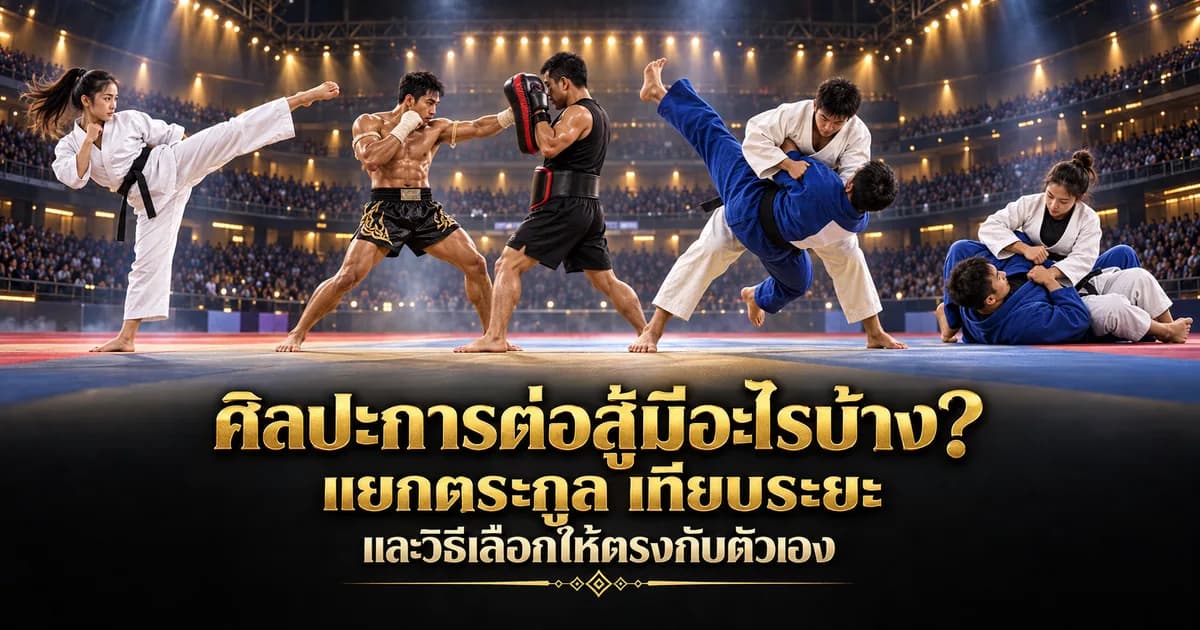
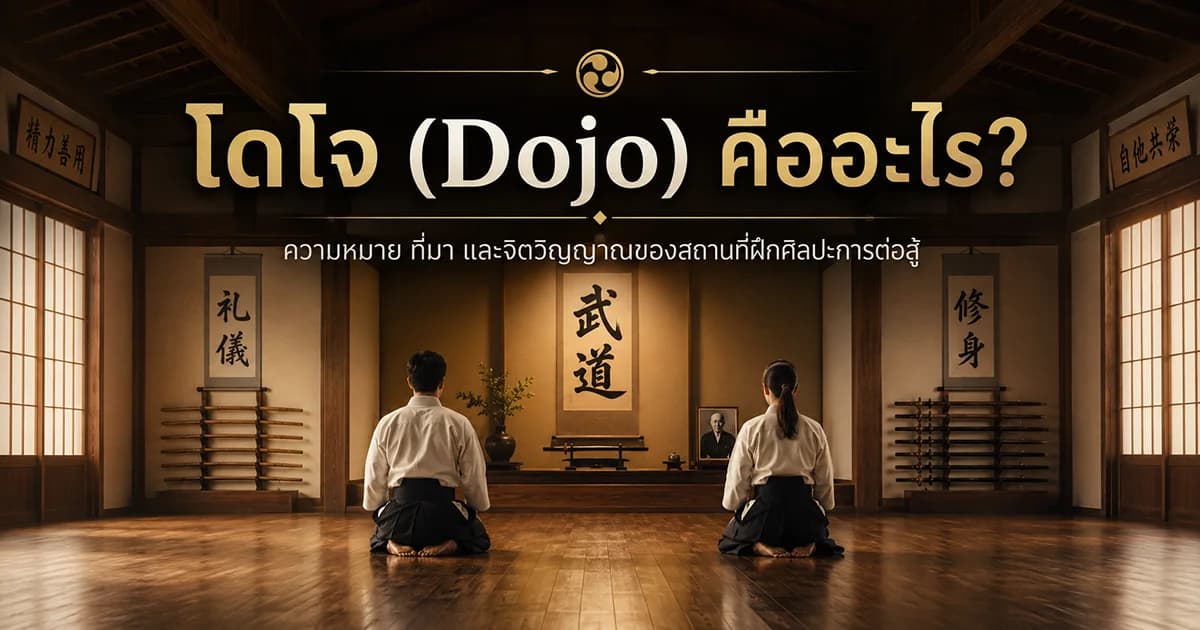
What Is a Dojo? Meaning, Origins, and the Spirit of a Martial Arts Training Place
A dojo is more than a training room. It is a disciplined place where martial arts students train body, mind, etiquette, safety, respect, and responsibility.
- Author
- Thaninpong Supapitakpong (Phoenix)
- Published
- Last updated
- Sources
- 6
- Reading time
- 17 min
Short Answer
A dojo is a martial arts training place, but its meaning is deeper than a gym or practice room. The Japanese word 道場 combines 道, the Way, and 場, place. Historically, it also connects with Buddhist ideas of Bodhimaṇḍa, a place of awakening. In modern budo, a dojo is where students train technique, body, mind, etiquette, respect, safety, and responsibility together.
Key Takeaways
- A dojo is a place of the Way, not only a room for drills.
- Dojo etiquette teaches students to respect the art, teacher, partners, space, and themselves.
- Bowing before entering and leaving the mat marks a shift into focused, careful practice.
- Budo Spirit appears in punctuality, cleanliness, safety, humility, and responsible use of technique.
- At IMAC Dojo, this meaning guides Judo, Karate, Wing Chun Sambo, and self-defense training in Bangkok.
A dojo is not an empty room. It is a place where the student enters with respect for the art, the teacher, the training partner, and the self.
People often ask what is a dojo and expect a short answer: a martial arts training hall. That is true, but incomplete. In budo culture, a dojo is also a moral and practical environment that shapes how students move, speak, listen, bow, train, and take responsibility.
If you have watched a Judo or Karate class, you may have seen students bow before stepping onto the mat and bow again when leaving. To an outsider it can look like a Japanese ritual. To a serious practitioner it is a way to change the mind before training begins.
A dojo is not a casual lounge, a changing room, or a place where students can forget risk. Martial arts involve falling, gripping, striking, distance, pressure, and trust. Without etiquette, the same techniques that build skill can become careless and dangerous.
This article explains the meaning of the word dojo, its Buddhist roots, its connection to modern budo, and why respect, punctuality, cleanliness, and safety matter at IMAC Dojo.
In this article
The Short Version: A Dojo Is a Way of Training
- Dojo meaning is literally a place of the Way, a space where training is used to cultivate body, mind, etiquette, and character.
- Bowing is not decoration; it marks a conscious entry into careful practice.
- Budo Spirit is shown through punctuality, discipline, clean conduct, safety, and respect for partners.
- For students looking for a martial arts school in Bangkok, dojo culture is one way to see whether a school builds long-term habits, not only short-term techniques.
The Word 道場: Place of the Way
| Term | Reading | Meaning |
|---|---|---|
| 道場 | dojo | place of the Way, a space for disciplined training |
| 武道 | budo | Japanese martial ways that train technique, body, and mind |
| 礼法 | reiho | etiquette, formal respect, and correct conduct |
The word dojo is written 道場. 道, pronounced do, means the Way, a path, or a discipline of self-cultivation. 場, pronounced jo, means place or field. Together, the word can be read as place of the Way.
Historically, the word is not limited to martial arts. It also connects with Buddhist vocabulary and Bodhimaṇḍa, the place of awakening. Over time, this sense expanded into places of disciplined practice, and later became widely associated with Japanese martial arts.
That history matters because it prevents a shallow translation. A dojo is not only where students repeat techniques. It is where they learn how to stand, fall, listen, wait, bow, control force, and become safer people to train with.
From Bodhimaṇḍa to Modern Budo: Why a Dojo Weighs More Than a Gym
| Term | Reading | Why it matters |
|---|---|---|
| 菩提道場 | bodai-dojo | connects dojo with Buddhist language of awakening and disciplined practice |
| 稽古場 | keikoba | a practice place, showing that older training spaces used several different terms |
| 指南所 | shinanjo | a place of instruction, emphasizing transmission from teacher to student |
A gym is generally a place to exercise: you pay and then use the space, the equipment, or a class. A dojo sits on a different level, because it places the trainee in a relationship with the teacher, training partners, rules, etiquette, the lineage of the art, and the history of the art that came before us.
When the word dojo travelled from its Buddhist context into the world of budo, the sense of self-cultivation did not disappear. It simply shifted from sitting meditation or studying the Dharma to using the body as a tool for refining the mind. We learn through falling, being thrown, being put under pressure, making the same mistake again, correcting it, and standing back up without blaming anyone.
This is why the word dojo suits a martial arts school that takes building people seriously, rather than one that only sells exercise classes. Students do not receive only sweat or fatigue; they receive a framework of responsibility, discipline, and respect for the lives of others.
A meaningful detail from Japanese research is that dojo did not begin as a martial arts marketing word. It was connected with Buddhist language before it became common in modern budo. 菩提道場 can be understood as the place of awakening, and this background gives the word a spiritual and educational depth.
This does not mean every modern dojo is a religious place. It means the word carries an older idea: a place where disciplined practice changes the practitioner. In martial arts, that change happens through posture, repetition, pressure, etiquette, partner responsibility, and self-correction.
Research on Japanese budo also shows that dojo was not always the ordinary word for every martial training space. Earlier contexts used terms such as 稽古場, keikoba, a practice place, or 指南所, shinanjo, a place of instruction. The word dojo became especially powerful as modern budo developed a stronger educational identity.
A Key Detail from the Buddhist Roots: 菩提道場 and the Place of Awakening
This is why the question what a dojo is can be answered on two levels. At the basic level, it is a place for training martial arts. At the deeper level, it is a space where people use training as a tool to awaken awareness, refine themselves, and learn how to live alongside others.
In research on the dojo, one detail matters a great deal: the word 道場 did not originate in sword halls or Judo halls. It was already alive in Buddhist language, connected with the term 菩提道場, read bodai-dojo, meaning the place of bodhi, which links back to Bodhimaṇḍa, the place of awakening under the Bodhi tree at Bodh Gaya.
Because of this, the word dojo should not be flattened into nothing more than a training hall. The original core of the word is not the building but the state of training that allows a person to change: from unaware to aware, from careless to careful, and from using raw force to using force with mindfulness.
In some Buddhist contexts, 道場 also refers to a place of practice, a place for ceremonies, or a gathering place for the faithful. These meanings show that the word carried dimensions of calm, cleanliness, intention, and respect long before it entered the world of martial arts.
Dojo Did Not Become the Main Martial Arts Word Overnight
| Japanese term | Reading | Context that helps explain it |
|---|---|---|
| 稽古場 | keikoba | A place of practice; a word that reflects how training halls were described before dojo became widespread in modern budo. |
| 指南所 | shinanjo | A place where an art is transmitted or guided, emphasizing the relationship between the teacher and the one receiving the transmission. |
| 講武場 | kobujo | A place for studying and training in martial skills, showing that training spaces were once named in several ways depending on the era and purpose. |
| 武徳殿 | Butokuden | A building or central hall for budo training, connected with bringing martial arts into a modern organized system. |
Another point worth stating clearly is that although the word dojo is old and deeply rooted, it did not immediately become the widespread name for martial arts training halls in the world of 武道, or budo. Some Japanese research indicates that during the Edo period the word 道場 appears in certain documents, such as a Shinkage-ryu ceremony in 1610 and the writings of Miyamoto Musashi in 1645, but the words used for training spaces in general were still very varied.
The word 稽古場, read keikoba, means a place of practice and is commonly found in the context of earlier training halls. There were also words such as 演武場 (enbujo: a space for demonstrating or practicing combat), 講武場 (kobujo: a place for studying and training in martial skills), 武館 (bukan: a building or school of an art), and 指南所 (shinanjo: a place where an art is transmitted or guided). These terms reflect that the world of traditional schools did not have a single all-covering word the way we do today.
It was around the late Meiji period that dojo gradually became the main word for modern budo training places. This point matters, because it keeps this article from overstating that dojo has straightforwardly meant a martial arts hall since ancient times. The more accurate truth is that the word began in Buddhism, traveled through training culture, and gradually became the main vocabulary of modern Japanese martial arts.
Why Students Bow Before Entering the Mat
For more context, read What Is Judo or explore Judo classes in Bangkok at IMAC Dojo.
The bow is a small action with a large purpose. It tells the student: from this moment, pay attention. The mat is a place where mistakes matter. The partner standing in front of you is not an opponent to injure, but a person trusting you with their body.
In Judo, bowing before stepping onto the mat and bowing when leaving helps create a clear border between ordinary behavior and practice behavior. The student enters with awareness, trains with control, and leaves with gratitude.
This is why etiquette is practical. It reduces danger. A student who listens, waits, bows, and respects distance is less likely to throw carelessly, strike emotionally, or ignore a partner's limit.
The Dojo as a Battlefield Without Aggression
Calling the dojo a battlefield does not mean students should become aggressive. It means the training space demands the same seriousness that real danger demands. In a real conflict, a small mistake can become permanent. In the dojo, we rehearse the ability to stay awake before mistakes become habits.
Students learn that posture affects balance, distance affects safety, emotion affects judgment, and careless force affects another human being. These lessons are physical, but they are also ethical.
A good dojo protects this seriousness without making the atmosphere harsh. Students should feel safe enough to learn, but focused enough to understand that martial arts are never toys.
Budo Spirit in Everyday Details
Budo Spirit is not proven by rank alone. It is visible in daily details: arriving on time, wearing clean training clothes, listening before moving, thanking a partner, cleaning the training space, and controlling the ego when practice becomes difficult.
Punctuality matters because training is collective. When a teacher arrives late or students treat the schedule casually, the class loses structure. Cleanliness matters because people fall, kneel, breathe, and train together on the same surface. Safety matters because every technique has consequences.
At IMAC Dojo, this is why etiquette and technical training belong together. Judo, Karate, Wing Chun Sambo, and self-defense all require a culture where students can trust the room.
Japanese Examples: A Dojo Is a Place That Shapes People
Institutions such as Nippon Budokan, Kodokan, Noma Dojo, and Meiji Jingu Shiseikan help explain why the word dojo has weight. They do not treat the dojo as only a floor for techniques, but as an environment for order, etiquette, safety, cleanliness, and character formation.
Nippon Budokan frames budo as a culture that unites body, technique, and mind. Kodokan shows this in Judo through bowing, partner respect, fairness, and correct conduct. Noma Dojo makes the spirit concrete through rules about entering and leaving, quiet behavior, proper clothing, care of equipment, and respect for other schools.
Meiji Jingu Shiseikan adds another layer: cleaning the space, preparing the atmosphere, and entering practice with sincerity. Not every dojo follows the same ritual form, but the message is consistent. A dojo becomes meaningful when the people inside it treat the space as a place for serious self-cultivation.
Shin-Gi-Tai: Mind, Technique, and Body
A useful budo phrase is 心技体, shin-gi-tai: mind, technique, and body. Many students first chase technique, but technique alone is unstable if the mind panics or the body cannot support it. A dojo joins all three through repeated practice.
Students learn whether they can listen when tired, stay respectful under pressure, protect a partner while training hard, and return to basics after making mistakes. This is why dojo culture matters. It turns physical practice into a long-term process of self-correction.
In this sense, the dojo is not separate from daily life. The punctuality, calmness, humility, and responsibility developed in training should follow the student outside the training space.
What Goes Against the Spirit of a Dojo
In some places you may see a teacher arriving late, students lounging on the mat, an instructor lying down while watching students train, or people changing clothes on the training floor. To an outsider these may look like small things, but from the perspective of a dojo they show that the training space has been reduced to nothing more than an empty room.
Changing clothes on the training floor erases the line between the training space and private space. Lying around on the mat turns a surface used for falling, throwing, and serious practice into a rest area. Poor punctuality undermines the credibility of the relationship between teacher and student.
A good dojo does not need to be luxurious and does not need expensive equipment, but it must have clear boundaries about what should and should not be done, and about why those rules exist to protect everyone.
A Dojo Teaches Four Layers of Respect
- Respect for the art because each martial art has passed through experimentation, pain, and transmission across many generations.
- Respect for the teacher because a teacher does not only give technique, but is responsible for safety, the pace of learning, and the attitude of the training hall.
- Respect for training partners because we cannot practice gripping, throwing, receiving force, or self-defense without relying on mutual trust.
- Respect for oneself because a student must know the limits of their own body, have the courage to improve, and not let laziness or emotion lead the training.
How IMAC Dojo Applies This Meaning
Meet the IMAC Dojo instructors, or explore Karate training in Bangkok if you want to understand how dojo culture supports technical progress.
IMAC Dojo uses the word dojo as a commitment, not as decoration. The school aims to create a training environment where students can develop skill, confidence, discipline, and respect over time.
Judo teaches bowing, falling safely, and caring for the training partner. Karate teaches basics, posture, controlled power, and persistence. Wing Chun Sambo teaches structure, centerline, and calmness at close range. Each art becomes healthier when the dojo culture is clear.
Four Meanings of the Word Dojo for IMAC Dojo
| Layer of meaning | Explanation | Example at IMAC Dojo |
|---|---|---|
| A training place | A space for practicing skills safely. | The Judo mat, the Karate area, the Wing Chun Sambo training area, and the rules of the class. |
| A space for self-cultivation | A space where students see their own weak points and gradually adjust. | Repeated practice, receiving feedback, and correcting the basics without rushing. |
| A space of 礼法 | A space where etiquette makes training safe and dignified. | Bowing, listening to instructions, caring for training partners, and keeping the space clean. |
| A space connected to life | What is trained in the dojo should affect how a person lives outside it. | Punctuality, emotional control, responsibility, and respect for others. |
Taking all of this research together, the word dojo in the context of IMAC Dojo should be held in four layers at once. The first layer is the training place in the basic sense: students have a space safe enough to repeat, to fall, to get back up, and to correct themselves.
The second layer is a space for self-cultivation, inherited from the Buddhist root of the word 道場. Training does not end with technique. It includes observing oneself, not deceiving oneself, and accepting that every mistake is a chance to see one's own weak points.
The third layer is a space of order and respect, because a dojo without 礼法, without cleanliness, without punctuality, and without clear boundaries will gradually lose its meaning, even if the mats, the equipment, and the students are all still there.
The fourth layer is a space where real life and training connect. Students do not train only to be skilled inside the room, but to become more mindful, more responsible, more respectful of others, and more careful with their strength and ability outside the dojo as well.
How to Choose a Dojo That Suits Children, Adults, and Families
The name of an art or modern-looking equipment is not enough to judge whether a dojo suits you. What matters more is how the instructor organizes the space, sets the level of difficulty, looks after training partners, and explains the reasons behind the rules. Parents should notice whether children are taught to control their force and respect their peers, or are pushed into competition before they understand the basics. Adults should look at whether the instructor can adapt the training to age, experience, and physical limitations.
- Check the instructors and their teaching approach to confirm there is clear information about who they are, what they specialize in, and how they take responsibility for the class.
- See whether beginners are given a foundation before speed, resistance, or real contact is added.
- Observe the cleanliness and order of the space including the boundaries between the training floor, the rest area, and the changing area.
- Choose a course based on your real goals such as Judo, Karate, Wing Chun Sambo, or self-defense, rather than choosing by the name of the art alone.
- Women who want to start in a specific context and adults interested in Karate for beginners should read the details of the course pages before deciding.
A trustworthy dojo should be able to answer safety questions directly: who supervises the class if an accident happens, how the space and equipment are inspected, what new students begin with, and at what point they start training with more resistance or contact. Guidance from the International Judo Federation also addresses clean mats, a hazard-reduced area around the mat, and having an instructor supervising activity on the mat, which helps confirm that safety is a system rather than just advertising.
For those searching for a dojo in Bangkok, distance and the class schedule should also be considered, because effective training has to happen consistently. IMAC Dojo is located in the Ladprao 101, Bang Kapi area, and provides course information and instructor profiles that can be reviewed before choosing a class, so goals around health, discipline, confidence, and self-defense can be compared against how the training actually works.
Recommended References
- The Budō Charter by Nippon Budokan
- Kodokan on Reigi and the dignity of Judo practitioners
- JapanDict definition of 道場
- International Judo Federation: The Dojo, a Place of Study and Practice
- International Judo Federation: Bowing and Being a True Judoka explains that bowing expresses respect for the place, training partners, the teacher, and the student themselves.
- IJF Judo in Schools: Rules of the Dojo gives guidance on mat space, cleanliness, first-aid equipment, and having an instructor supervising for safety.
If You Remember One Thing
A dojo is a place that makes training mean more than exerting effort. It reminds us that fighting skills must come together with mindfulness, discipline, respect, and responsibility. Without these, excellent technique can become dangerous. With them, ordinary daily practice will gradually change our body, our mind, and the way we live.
Sources and further reading
- International Judo Federation: Bowing and Being a True JudokaReference
- JapanDict definition of 道場Reference
- The Budō Charter by Nippon BudokanReference
- IJF Judo in Schools: Rules of the DojoReference
- Kodokan on Reigi and the dignity of Judo practitionersPrimary
- International Judo Federation: The Dojo, a Place of Study and PracticeOfficial
Frequently Asked Questions
What is a dojo?
A dojo is a martial arts training place, but the word also means a place of the Way. It is where students train technique, body, mind, etiquette, respect, safety, and discipline together.
Is a dojo the same as a gym?
No. A gym is often a place for exercise and equipment. A dojo is a structured training space with teacher-student relationships, etiquette, partner responsibility, and a culture of respect.
Why do students bow in a dojo?
Bowing marks respect for the place, art, teacher, partner, and self. It also helps students enter training with focus and leave with gratitude.
What is Budo Spirit?
Budo Spirit is the attitude of training martial arts as a way of character development. It includes discipline, etiquette, humility, safety, and responsible use of technique.
Did dojo originally mean a martial arts hall?
Not only. The word 道場 has Buddhist roots and is connected with Bodhimaṇḍa, a place of awakening. It later became widely associated with modern Japanese martial arts.
What is the difference between keikoba and dojo?
Keikoba means a practice place. Dojo carries a deeper meaning: a place of the Way where technique, etiquette, mind, body, and self-cultivation are trained together.
What should you do on your first visit to a dojo?
Arrive on time, dress appropriately, listen to the instructor, respect the training area, avoid stepping on the mats unnecessarily, do not train beyond the agreed intensity, and ask the instructor immediately if you are unsure about rules or safety.
Can children learn dojo etiquette?
Yes, and it is one of the important benefits of training. Through real practice, children learn to wait their turn, listen to instructions, respect their training partners, control their force, and take responsibility for a shared space.
Does a dojo need to be a luxurious place?
No. A good dojo does not need to be luxurious, but it must be clean, safe, and orderly, with responsible instructors and a training culture that seriously respects both people and the art.
What should you look for when choosing a dojo for children and adults?
Look at information about the instructors, how beginners are given a foundation, how force is controlled, the cleanliness of the space, the safety rules, and whether training is adapted to a student's age or limitations. A good dojo should be able to explain clearly how each rule protects its students.
What does a safe dojo look like?
It should have training space and equipment suited to the art, clean floors and mats, no dangerous obstructions, and an instructor supervising the training. New students should be taught the basics before force is increased, and everyone should know how to stop or tell the instructor when they feel unsafe.
What does IMAC Dojo teach?
IMAC Dojo teaches several martial arts, including Judo, Karate, Wing Chun Sambo, Wai Kru Muay Thai, and self-defense, with an emphasis on fundamentals, safety, discipline, and the long-term development of each student.
Ready to start martial arts?
Message IMAC Dojo to ask which course fits your age, goals, and training background.
Ask on LINE Official