
Ages
Focus ages 25–60
Official Dojo Website - Bangkok
Course Detail
Wing Chun Sambo: Wing Chun as the close-range core, plus principles from Muay Thai, Karate, Judo, Sambo and Jujitsu covering distance, clinch, takedown and ground control.
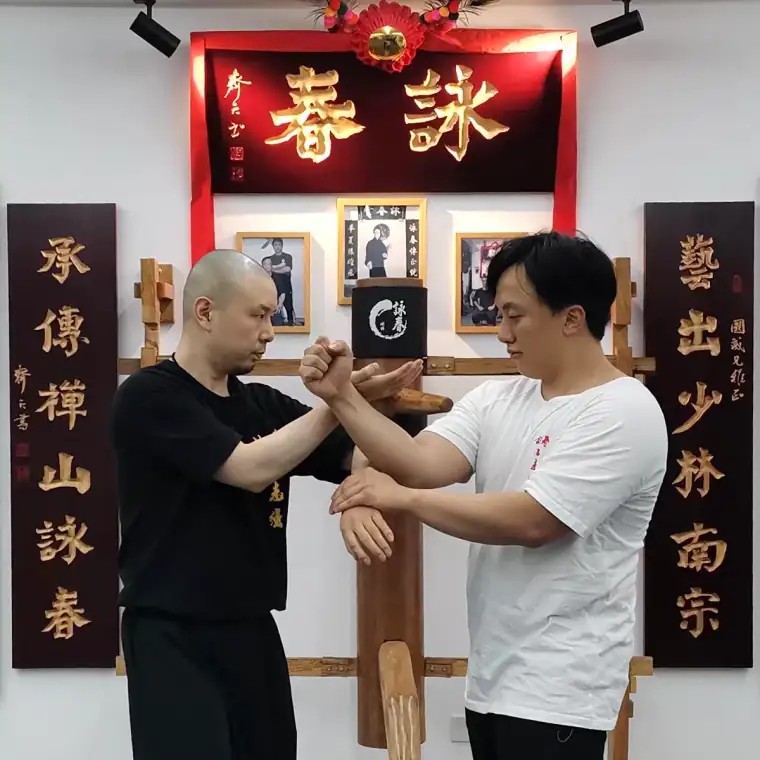
Dojo Legacy
Before you begin
Ages
Focus ages 25–60
Schedule
Wednesday 19:00
Fees
THB 1,500 / month
Experience
Beginners welcome
Format
Group / Private
Location
Ladprao 101, Bangkok
What this course develops
Wing Chun is the foundation, but self-defense happens at every range, so IMAC Dojo built a course that connects fighting from distance, close range, clinch and takedown through to ground control, with Ip Man approach Wing Chun still the close-range core.
Strike • Close Range • Clinch • Takedown • Ground Control. Every art is organised into one curriculum and measured by the school's assessments. You do not need to be a fighter before you join: training starts from the foundation and adds resistance by stage.
Who it is for
What students gain from Wing Chun Sambo
Instructor Team
Wing Chun Sambo
Real situations do not stay at one range, so training is ordered by the way situations tend to change, borrowing the strength of the art designed for each range.
DISTANCE
Muay Thai · Karate
Movement, keeping range, and long-range weapons such as kicks and counters before the other person closes in.
CLOSE RANGE
Wing Chun
Wing Chun core
Structure, centerline, arm control, the chain punch, Chi Sao and joint control in safe drills.
CLINCH
Muay Thai
Neck and torso control, balance, defending against pulls and pushes, and controlled knees.
TAKEDOWN
Judo · Sambo
Breaking balance, throws, takedown defence, and safe falling, which is always taught before the throw.
GROUND
Judo · Jujitsu
Holding position, escaping bad positions, joint locks, and getting back to your feet.
The goal of self-defense is not to fight for as long as possible but to stay safe, control the situation only as far as necessary, and create a chance to get out of danger.
Schedule & Pricing
Last updated 5 September 2026
19:00 - 20:30
1,500 THB/month
4 classes per month. Missed classes are not replaced.
Monday - Thursday, 14:00 - 21:00
1,000 THB/person/hour
Book in advance through LINE Official.
Equipment
Training uniform information for preparing before class.
Course Detail
Wing Chun and Ving Tsun are spellings of the same art, 咏春. This page uses Wing Chun, and whichever spelling you searched for, it is this class.
The Wing Chun Sambo course at IMAC Dojo rests on one idea: Wing Chun is the foundation, but self-defense happens at every range. The curriculum therefore connects fighting from distance, close range, clinch and takedown through to ground control in a single system.
Real situations do not stay at one range, so students learn self-defense from keeping distance and closing it, through close-range fighting, the clinch and the throw, to control on the ground. The course does not claim every technique is Wing Chun. It organises principles from Wing Chun, Muay Thai, Karate, Judo, Sambo (a Russian grappling sport that combines judo with folk wrestling) and Jujitsu by range and situation, taking the strength of each art so students have more tools.
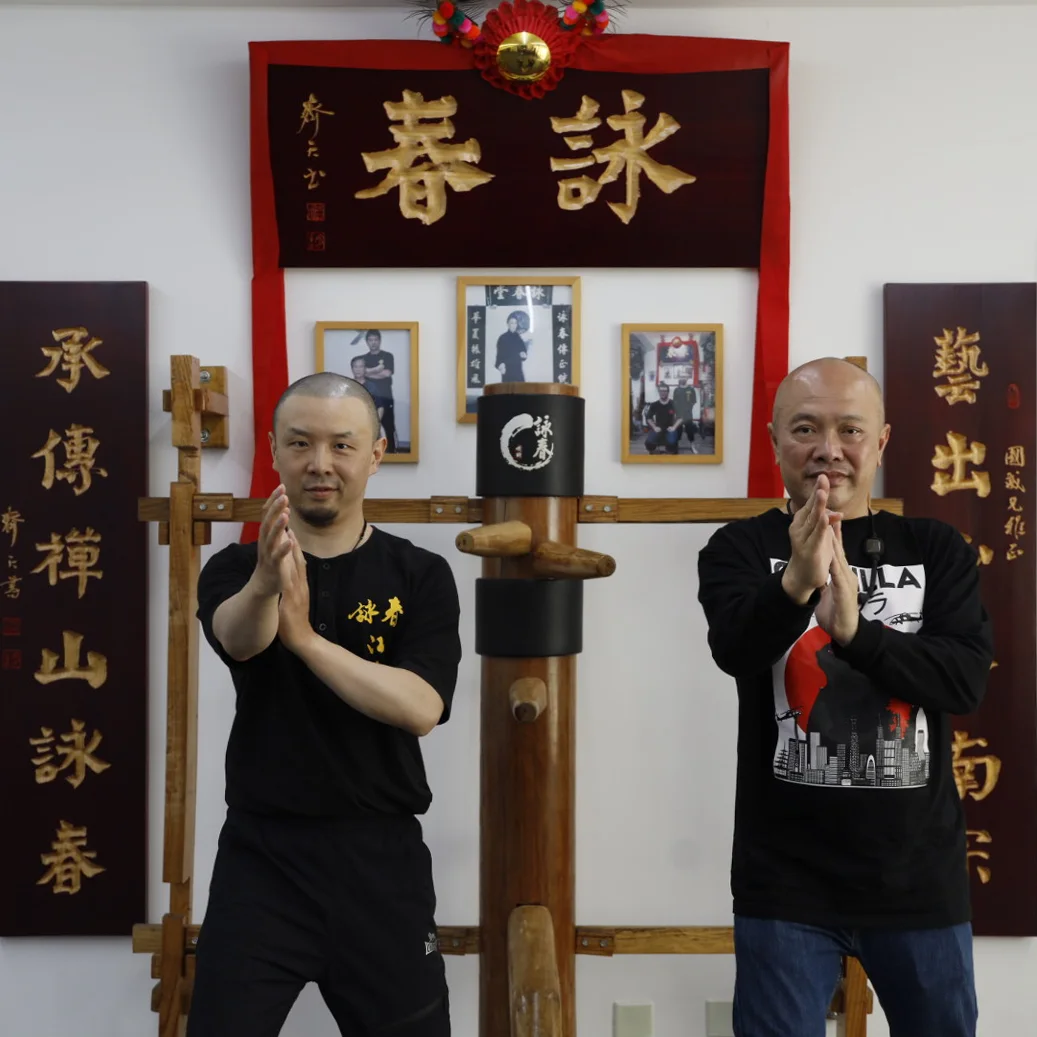
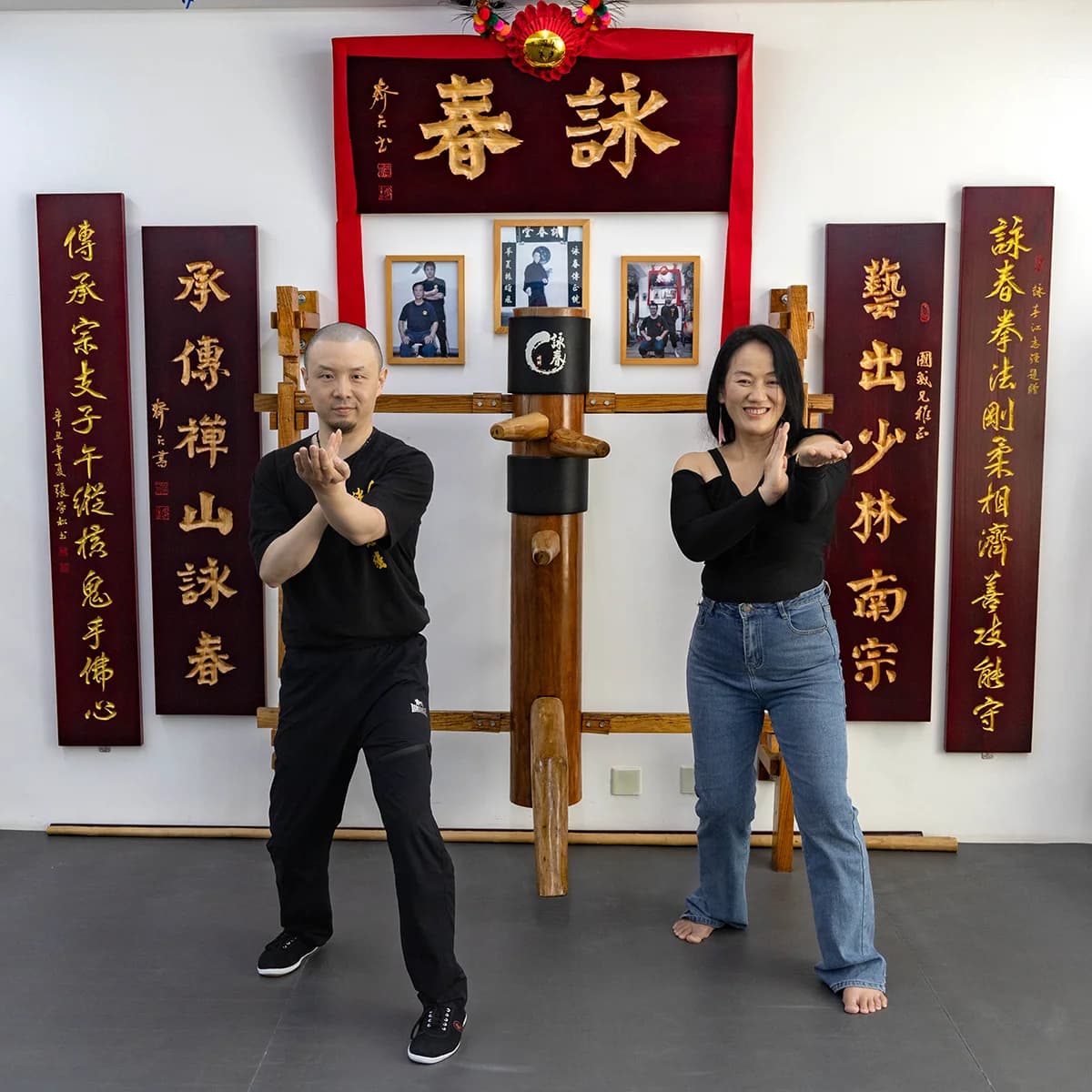
The close-range core is still Ip Man lineage Wing Chun. The instructor is a direct-line disciple of that lineage, taught by his own master in Xi'an, China, and he uses that systematic study to order training from fundamentals to application, teaching in Thai and Chinese.
The goals are health, movement, confidence and the ability to defend yourself, not competition preparation. Training develops principles, distance, timing and decision-making, but it cannot guarantee an outcome in a real incident, and avoiding trouble remains the first option.
 Click to enlarge
Training is divided into five ranges in the order real situations tend to change: distance, close range, clinch, takedown and ground control. Each range borrows from the art designed for it, and every range ends with the same goal: control the situation only as far as necessary, then leave.
Students do not train all five ranges from the first month. The instructor starts with the Wing Chun foundation, movement and safe falling, then adds ranges and resistance as each student is ready.
The principles each range borrows come from what the two instructors of this course have trained and competed in. Khru Puriwat (Ryu) is a former Thai national Combat Sambo athlete (striking, throws and locks), holds Judo 2nd Dan from the Judo Association of Thailand and a Sports Authority of Thailand C-License in Jujitsu, is an intermediate coach and judge of the Professional Muay Thai Association, and holds Shinkyokushinkai Karate 2nd Dan. Khru Panyawat (Ken) holds Judo 1st Dan certified by both the Judo Association of Thailand and the Kodokan in Japan, Shinkyokushinkai Karate 2nd Dan and Muay Thai Rangsit Level 2. Distance and clinch therefore borrow from Muay Thai, Karate and Combat Sambo, the takedown from Judo and Sambo, and the ground from Judo and Jujitsu. Those credentials are where the principles come from; they are not separate Sambo or Jujitsu classes.
Students start by understanding distance, movement, keeping range and long-range weapons such as kicks and counters when someone tries to close in, applying principles from Muay Thai, Karate and Combat Sambo so their skills do not begin only once the attacker is already close.
At this range students train stance, stepping in and out, reading the moment the other person closes the distance, and keeping the guard while retreating — the skills that end many situations before they become contact.
When the distance shrinks and arms make contact, Wing Chun principles do the most work. Students train structure, centerline, arm control, switching from defence to attack, short punches, the chain punch, and controlled joint control in safe drills.
This is the Wing Chun DNA of the course. Everything taught in the Wing Chun class before is still taught, and it is where students spend the most training time, because most self-defense situations for ordinary people happen here.
When the distance is too close for normal punching, students train neck and torso control, balance, defending against being pulled or pushed, and short-range weapons such as the knee, applying Muay Thai and Combat Sambo principles in the clinch.
The order is neck and torso position, finding the advantageous position, controlled knees, and off-balancing the other person to open a way out of the clinch.
When the situation changes from striking to a struggle for body control, students learn balance, breaking balance, throws, taking someone down and defending against being taken down, with the two arts given clearly separate jobs.
Before we teach a throw, we teach how to fall. Safe falling is the first skill of this range, and for working-age adults it is the one they use far more often than a throw.
If the situation goes to the ground, students train holding position, control, escaping bad positions, joint locks and getting back to standing, drawing on Judo and Jujitsu according to their readiness. This is not a separate jujitsu class: it is ground-control principle for self-defense and for getting back to your feet as fast as possible.
At the appropriate stage there is controlled practice of striking from the ground, so students understand how self-defense on the ground differs from grappling alone. This is advanced course material, not something beginners do on day one.
Control, then exit. The goal of self-defense is not to fight for as long as possible but to stay safe, control the situation only as far as necessary, and create a chance to get out of danger. Every range in the course therefore ends with finding the exit, using the voice and asking for help, not with winning.
The curriculum takes inspiration from how Bruce Lee thought: openness to knowledge from many arts, and choosing the tool that fits the situation, without forcing students to answer every problem with one art. The course claims no lineage connection to Bruce Lee and does not teach Jeet Kune Do.
IMAC Dojo therefore keeps Wing Chun, one of the key foundations of our approach, especially its structure, centerline, hand control and close-range fighting, while adding knowledge from other martial arts to fill the other ranges.
Although the course has grown into Wing Chun Sambo, the Wing Chun foundation is still taught as a system. Students still study the forms and key principles of the art, so the integration is not a pile of techniques from different arts with no roots.
That foundation has four parts: Siu Nim Tao, Chum Kiu, Biu Jee and Muk Yan Jong. Each has a different job and they connect as one system, giving students a stable base, an understanding of the art's structure and steady close-range progress.
Siu Nim Tao is the most important foundation form of Wing Chun and the root of the whole system. It is where students begin training stance, balance, centerline control, economical use of force and structured delivery of techniques.
Although it is the first form of the course, students can begin to understand self-defense principles and close-range countering from the start.
Siu Nim Tao teaches that the real power of Wing Chun does not come from using more strength but from correct body structure, a stable centre and precise force at the right distance, which is why it matters so much for the foundation of the whole art.
Chum Kiu is the second form, where students begin to connect the waist, elbows, shoulders, stance and stepping more clearly. If Siu Nim Tao builds the structure, Chum Kiu makes that structure move and keep its balance.
Students train controlling the partner's bridge arms, switching from defence to attack, and using force from the whole body rather than the arms alone. This is what makes Wing Chun more than a simple-looking art: it uses detailed structural and mechanical principles.
Students who train Chum Kiu well begin to see how Wing Chun counters and controls close-range situations.
Biu Jee is the advanced form of Wing Chun, focused on speed, precision, changing angles and countering under more pressure. Students train both hands working together, sending force from the legs, waist and hips, and solving close-range problems efficiently.
Biu Jee trains students to recover structure, change angle and regain balance in more complex drills, with intensity raised according to readiness.
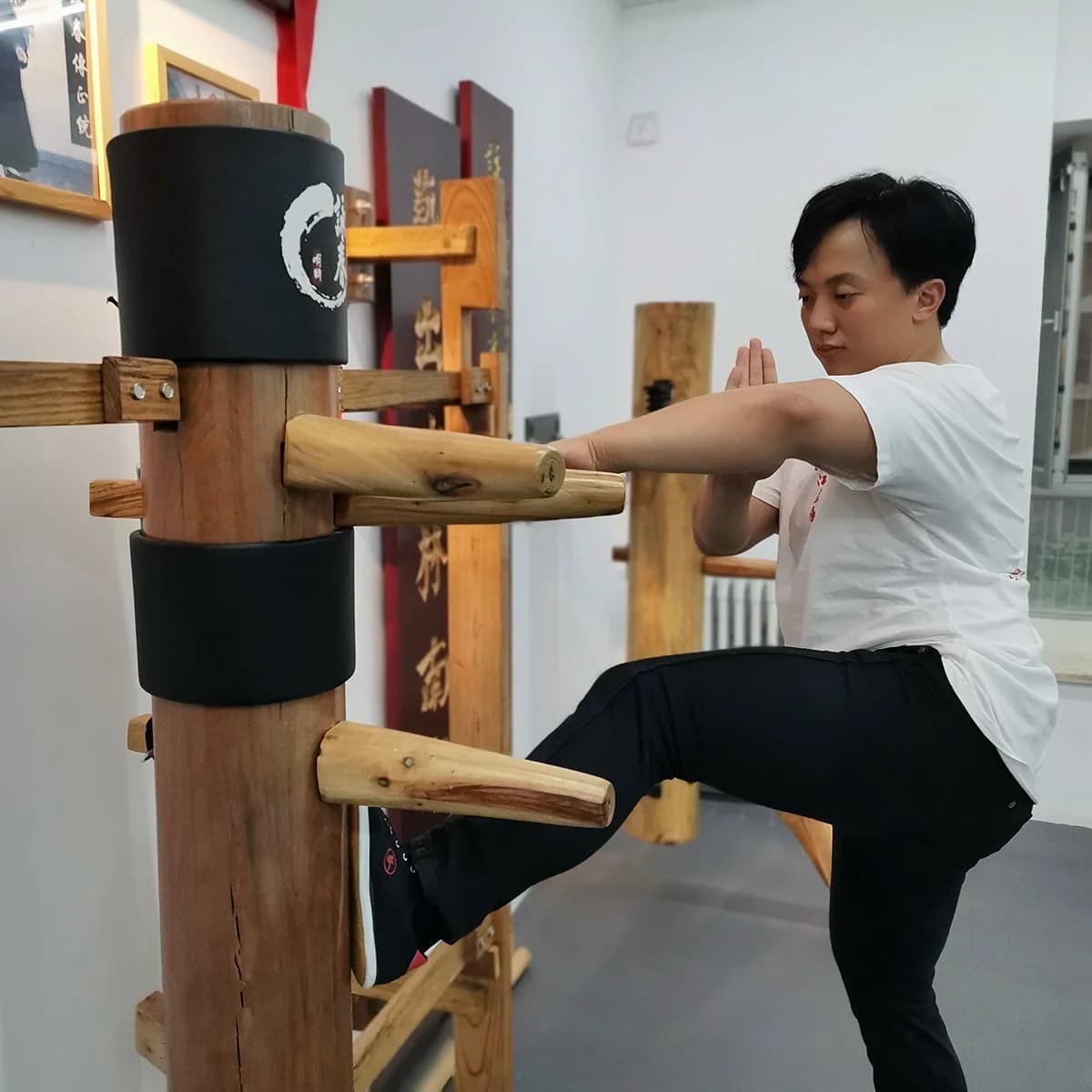
Muk Yan Jong, the wooden dummy, takes the principles of the main forms and makes them more precise and natural. Students develop their understanding of angle, distance, movement, receiving and issuing force, and controlling the timing of contact.
Dummy training gives structured repetition, a clearer sense of body position, and connects the Wing Chun principles before they are trained with a partner.
Wing Chun is best known for its most visible trait: straight punches thrown in succession along the centerline at close range. The idea behind it is not to punch as fast as possible but to hold the centerline first and let the punch travel the shortest path without losing structure.
The hand tools that work with the straight punch are Tan Sao, Bong Sao, Pak Sao and Lap Sao, which clear the partner's arm off the centerline and open the way for the punch. All of them are rooted in the forms above, from Siu Nim Tao to Muk Yan Jong.
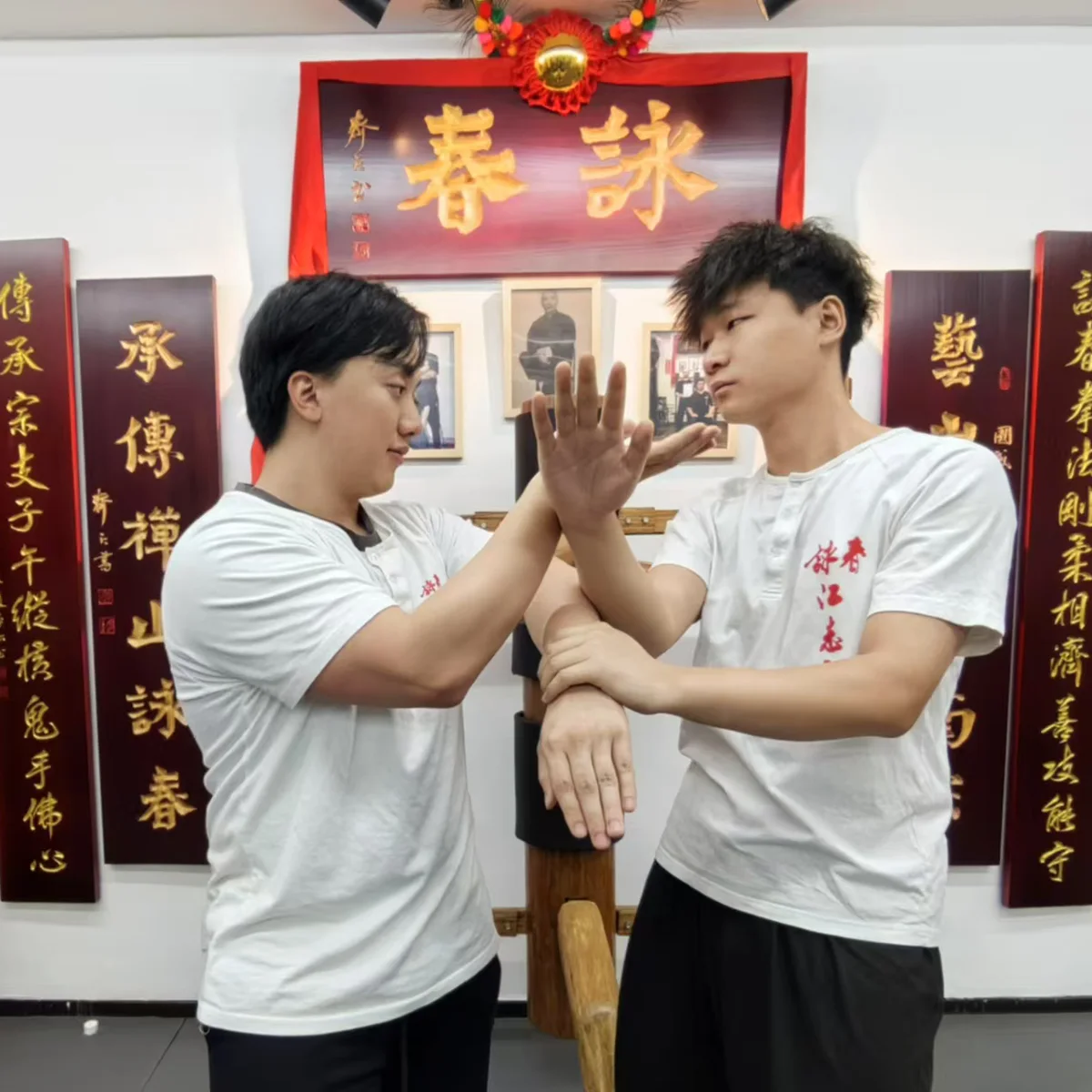
Chi Sao contact drills are what make the chain punch work at close range, because students learn to read pressure through touch rather than sight alone and respond with the structure and centerline they have trained. Precision and structure always come before speed.
Many arts, one system, assessed through the school's own tests. This is what separates the course from doing Muay Thai one day and Judo the next: everything is one curriculum, and when a student passes an assessment the school changes the T-shirt colour by stage to show their progress.
Assessments add skills range by range. The early stage focuses on the Wing Chun foundation, movement and safe falling; the middle stage adds striking, close range and basic clinch; the advanced stage adds takedowns, control, ground work and training against resistance.
You do not need to be a fighter before you join. The course starts from the foundation and adds resistance by stage, so it suits working-age adults who want exercise plus self-defense skills, people who have never trained a martial art, former Wing Chun students who want to understand the other ranges, and women and men who want confidence, reaction and body control.
IMAC Dojo teaches systematically: structure, centerline, distance, timing, close-range response and every range under the instructor's supervision. The instructor adjusts intensity to each student's age, health and background.
Women and beginners who want to compare options before enrolling can read the self-defense class for women page and choose a class by goal and readiness.
Read the article on women's self-defense with Wing Chun for example situations and how to start safely.
Those interested in history can read whether Wing Chun came from Shaolin or the Red Boat, an article that uses several sources and separates legend from what can be checked.
One course, many ranges. Students get the traditional art through the forms and principles of Wing Chun, and a modern self-defense system that runs from distance to ground control, with every art organised into one curriculum and measured by the school's assessments.
Media
 Gallery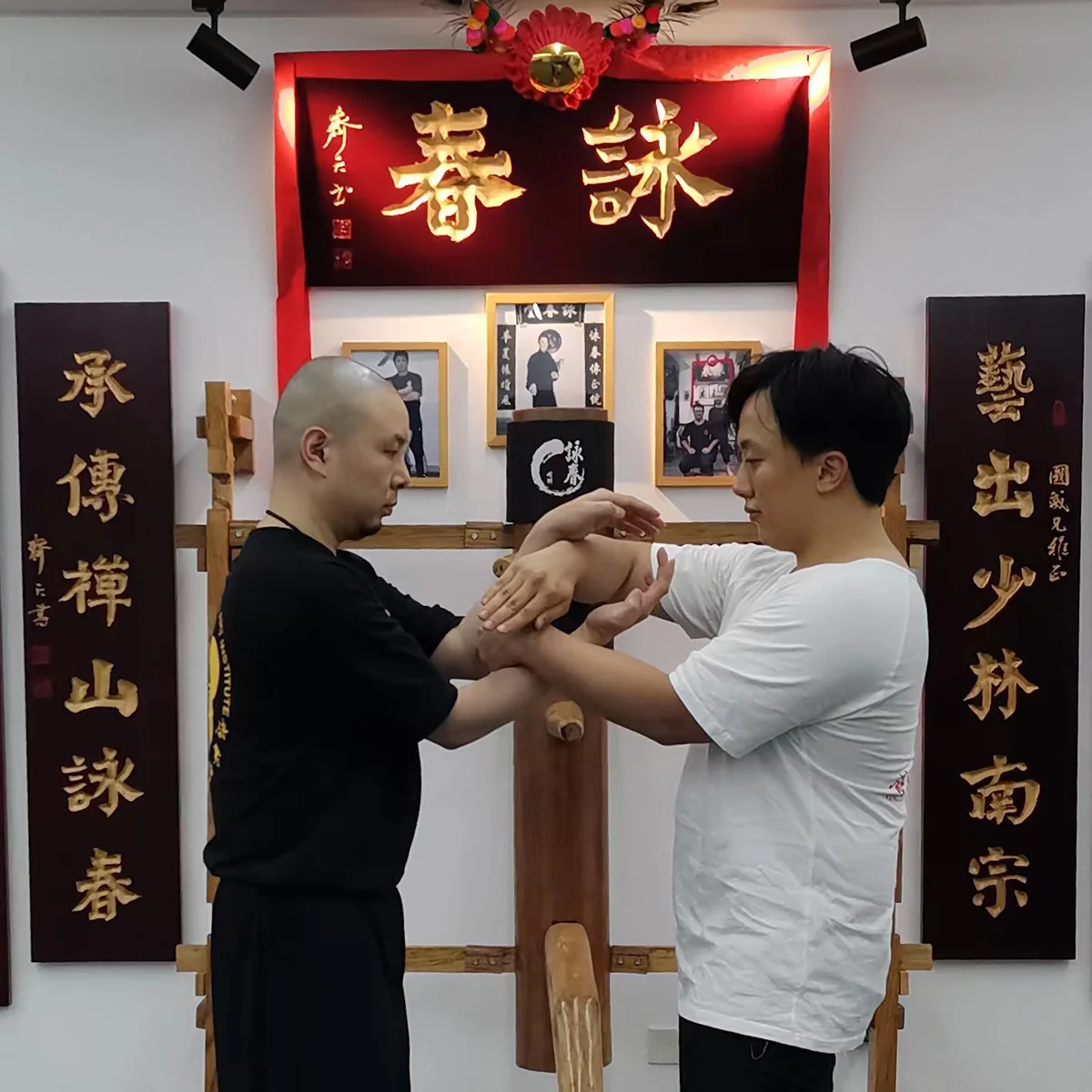
Schedule & Pricing
Message us on LINE Official with the student's age, any previous experience, and the training goal.
We recommend the class that fits and confirm which times are open.
Agree a start date and come to the dojo at that time.
You do not need to buy a uniform for the first session — a t-shirt and comfortable trousers are fine.
Direction
The dojo is on Soi Pokaew 3 Yak 9 in Khlong Chan, Bangkapi. The soi opens onto Ladprao 101, so it is an easy trip from Bangkapi, Khlong Chan, Bueng Kum, Ramkhamhaeng, Nawamin and Chok Chai 4. By train, take the MRT Yellow Line to Ladprao 101 station and continue into the soi.
Parking: you can park along the front of the school. This is the same soi as NIVA International School, so there is plenty of space, and police patrol it regularly because of the school's police box. Parents bringing children can wait and watch the class.
FAQ
Next Courses
Students who want to go deeper in one range can also explore Judo (throws and ground control), Shinkyokushin Karate (striking), and Wai Kru Muay Thai at IMAC Dojo.
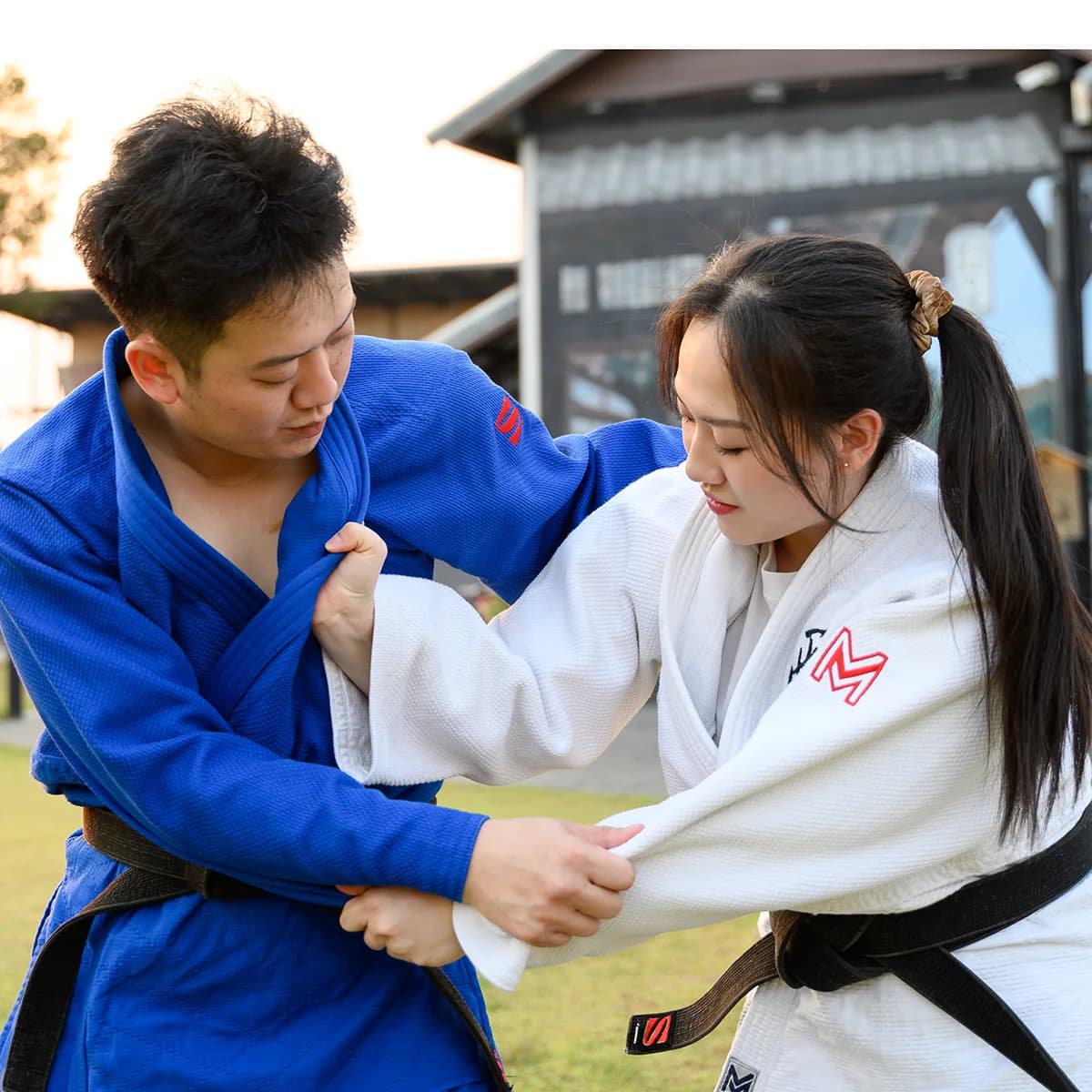
Learn safe falling, throws, and opponent control through structured Kodokan Judo training in Bangkok.
View course
Train full-contact Shinkyokushin Karate with black belt instructors following clear WKO Japan standards.
View course
Learn Wai Kru Muay Thai movements, meaning, rhythm, and Thai cultural values through structured practice.
View courseBegin with confidence
Talk with the IMAC Dojo team about the class format, schedule, and training path that fits your goals.
Courses
Blog
Local Guide
IMAC Dojo teaches Wing Chun Sambo at Ladprao 101, Bangkapi: Wing Chun as the close-range core, with principles from Muay Thai, Karate, Judo, Sambo and Jujitsu covering distance, clinch, takedown and ground control. Built for working-age adults around Ladprao, Bangkapi, Khlong Chan, Bueng Kum and Ramkhamhaeng who want exercise plus self-defense skills with no prior experience.


