
Why Train "Wing Chun + Sambo"? Closing the Gaps Through Combined Arts for Real-Life Self-Defense
This article explains why IMAC Dojo combines Wing Chun with Sambo for real-life self-defense, covering Sambo's history, throw biomechanics, leg-lock risks, legal limits, and who the Wingchun Sambo Thailand course is designed for.
Short Answer
Wing Chun excels at close range in a stand-up exchange, but the moment an attacker rushes in to clinch, grab a lock, or throw you to the ground, Wing Chun's gaps begin to show. Sambo (Sambo) was designed from the outset to handle clinching and ground fighting specifically, born from the Red Army's need for unarmed self-defense. Combining these two arts is not about diminishing Wing Chun's value — it's about closing the gaps that every single-discipline art genuinely has.
- Author
- Thaninpong Supapitakpong (Phoenix)
- Published
- Last updated
- Sources
- 0
- Reading time
- 11 min
Key Takeaways
- Wing Chun is strong at centerline control and close-range counters, but it was not designed for clinching or ground fighting.
- Sambo originated in the Soviet Union during the 1920s-1930s to create the most effective unarmed self-defense system for the Red Army.
- The kinetic energy from a throw can reach up to 27,000 inch-pounds, more than four times the force of a kick — this is why safe falling matters so much.
- Combat Sambo allows punches, knees, elbows, kicks, chokes, and joint locks, unlike Sport Sambo, which prohibits chokes.
- Knowledge of legal limits such as "necessity" and "proportionality" matters just as much as physical skill.
- IMAC Dojo designed the Wingchun Sambo Thailand course to be genuinely accessible to ordinary people with no prior martial arts background.
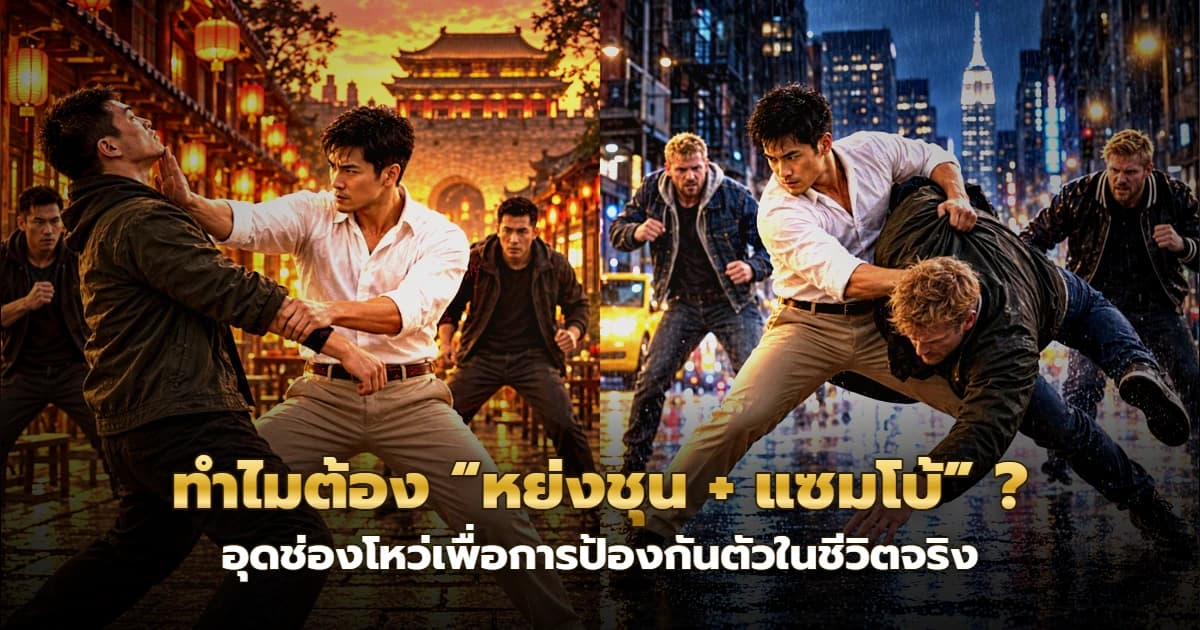
I get this question often from people who come to enroll at the dojo. They ask why we teach Wing Chun and Sambo for real-life self-defense together, when Wing Chun is already famous as a close-range fighting art that many Americans rank among the world's top self-defense systems for the street. My answer is simple: real situations on the street never wait for us to fight only at the range we're comfortable with.
In this article
Why Wing Chun Alone Isn't Enough for Real Situations
In my view, Wing Chun is a Southern Chinese martial art distinguished by centerline control, rapid counters, and close-range hand techniques — so effective that many people in the United States regard it as one of the most powerful street self-defense arts. But the problem is that real life doesn't write a script where an attacker stands and fights us the way it happens in Chinese films where the nun Ng Mui teaches Yim Wing Chun, or in Shaw Brothers movies where every pair of combatants trades blows standing at the same range. I've trained and taught Wing Chun for a long time, and what I see repeatedly is that real attackers rarely use beautiful techniques. They just rush in, clinch, or drag you to the ground with brute force.
This is exactly where I've come to see that "fighting skill" and "self-defense" aren't always the same thing. Fighting skill (搏击术 — bó jī shù — the art of combat dueling in the ring) is, at its core, a sport with contact governed by rules. A top-level fighter can certainly use it to defend themselves excellently, but the difficulty of training to reach that level isn't something the average person can handle. Many places open courses under fancy names like "self-defense for women" when in reality the content is just simplified fighting skills relabeled. I therefore think that honestly acknowledging the limitations of each discipline matters more than exaggerated advertising.
What Is Sambo, and Why Is It the Closest Thing to a Street Fight?
Sambo was born in the Soviet Union between the 1920s and 1930s, out of the government's need to create the most effective unarmed combat system for the Red Army and security agencies. The word Sambo is an abbreviation of the Cyrillic "САМозащита Без Оружия" (SAMozashchita Bez Oruzhiya), which translates literally as "self-defense without weapons." This wasn't the work of a single genius, but the integration of national-level tactical knowledge, starting with the vision of Vladimir Lenin, who founded the Vsevobuch unit and assigned K. Voroshilov to establish the Dinamo training center for the NKVD secret police.
The true foundation came from two experts who worked in parallel: Vasili Oshchepkov, a former orphan from Sakhalin who studied in Japan and earned a second-degree black belt (Nidan) from Jigoro Kano, the father of judo at the Kodokan institute, and brought judo's philosophy of "maximum efficiency" together with freestyle wrestling. The other was Viktor Spiridonov, a World War I veteran wounded in the left arm by a bayonet, who developed the "Samoz" system emphasizing movement and using the opponent's force rather than raw strength. Later, Anatoly Kharlampiyev and I.V. Vasiliev traveled to study folk wrestling styles across the Soviet Union — Chidaoba from Georgia, Kurash from Uzbekistan, Koch from Armenia, and Bukh barilda from Mongolia — leading to Sambo's official declaration as the Soviet national sport in 1938 and the founding of the International Sambo Federation (FIAS) in 1984. I believe this history matters because it explains why Sambo is a system "forged" from the necessity of survival, not an art born purely from ritual or philosophy alone.
Types of Sambo You Should Know Before Using It for Self-Defense
Sambo branches into several forms depending on its purpose, and understanding this distinction is very important before applying it in practice. Sport Sambo emphasizes throws, ground control, and joint locks, but prohibits choking techniques. Combat Sambo combines grappling with punches, knees, elbows, and kicks, and allows both chokes and every type of joint lock. Military or Special Sambo, meanwhile, is designed for special forces units like Spetsnaz, with no rules whatsoever, emphasizing bone-breaking and disarming techniques. Self-Defense Sambo is an adaptation of Combat Sambo suited for civilians operating within legal constraints, focused primarily on opening a path to escape.
At IMAC Dojo, I've chosen to draw principles from Self-Defense Sambo and Combat Sambo and adapt them, because our goal isn't to create ring fighters — it's to create ordinary people who can handle dangerous situations with a clear head.
The Biomechanics of Throws and Why Safe Falling Matters Most
Applying Sambo for real self-defense requires understanding deep biomechanics, because the street has no mats like a dojo does. Sambo's techniques aim to destroy an opponent's center of gravity, known as Kuzushi, and biomechanical research indicates that the kinetic energy transmitted through the thrower's arm into the body being thrown can reach as high as 27,000 inch-pounds — more than four times the energy from a kick. When this impact happens against real concrete, that level of force can end a fight instantly.
For this reason, the first skill every Sambo practitioner must master is Strakhovka, or safe falling (Breakfalls), which involves distributing impact force across the widest possible surface area, slapping the ground to create a counter-force, and tucking the chin to protect the skull. I always teach this as the first stage, because in practice, people who have never trained to fall often get hurt worse than those who are actually thrown. Once in close range, techniques begin with control methods like the Russian Tie or the 2-on-1 Clinch, using both hands to trap one of the attacker's arms, cutting off the working cycle of the shoulder and hip, breaking their balance and opening the way for a Double Leg Takedown, a leg sweep, or a Waki Gatame to follow.
Lower-Limb Joint Locks and the Limits You Must Respect
This is a point I want every practitioner to understand in detail, because it's the most powerful technique among all of Sambo's techniques, but also the riskiest. The military doctrine behind the popularity of lower-limb joint locks (Leg Locks) is the idea that a soldier wounded in the leg becomes more of a burden to their unit than a soldier who has died. Destroying the mechanism of walking is therefore the most tactically effective strategy. The human knee's structure is supported by four primary ligaments: the Anterior Cruciate Ligament (ACL), which prevents the shinbone from sliding forward; the Medial Collateral Ligament (MCL), which prevents the knee from bending inward; the Posterior Cruciate Ligament (PCL); and the Lateral Collateral Ligament (LCL). Each has a point of vulnerability when subjected to force at an unnatural angle, and a technique like the Heel Hook (locking the ankle by twisting the heel) is designed to place stress directly on these ligaments.
In my view, the true danger of these techniques isn't the pain itself — it's that structural damage often occurs before the brain fully registers the pain. The person being locked may not even notice that a ligament has already torn before they're forced to submit. For this reason, I don't teach full leg-lock techniques to general practitioners without a foundational background, because the risk of injury is higher than necessary for the purpose of self-defense. What matters more is understanding when to use these techniques and when to avoid them, because dropping to the ground to attempt a leg lock can cost you your mobility advantage and open the door for a second attacker or a concealed weapon to strike. This is why the philosophy of Combat Sambo places greater importance on Top Control than on diving straight into a complex submission.
Legal Limits You Must Know Before Using These Techniques
A point I emphasize to every student is that physical skill means nothing if you don't understand legal boundaries. Self-defense must always be governed by the principles of "necessity" and "proportionality." Locking a joint until a ligament tears may exceed what's necessary in some situations, and could turn the person defending themselves into the accused instead. I therefore emphasize teaching practitioners to use these techniques to control a situation and open a path to escape, not to inflict maximum damage on an opponent. This is the heart of Self-Defense Sambo, which differs from Combat Sambo in a military context.
Comparing Wing Chun and Sambo in the Context of Real Self-Defense
To make this clearer, let me summarize the strengths and weaknesses of each discipline in the comparison table below, which is something I use to explain things to prospective students at the dojo all the time.
| Aspect | Wing Chun | Sambo |
|---|---|---|
| Preferred range | Stand-up, close hand range | Clinch, throws, and ground |
| Main strength | Centerline control, fast counters | Breaking balance, safe falling |
| Weakness | Limited ability to handle clinching | Weaker at long range and stand-up exchanges |
| Origin | Southern Chinese martial art, Weng Chun lineage | Soviet Red Army, 1920s-1930s |
As you can see, these two disciplines don't conflict — they complement each other perfectly. Wing Chun handles the first moment an attacker closes in, while Sambo takes over the instant the situation shifts into a clinch or a fall to the ground. I believe this is the real reason IMAC Dojo chose to develop the Wingchun Sambo Thailand course specifically — not to create novelty for marketing purposes, but because years of teaching experience have told me that ordinary people with no athletic background need a more comprehensive toolkit than a single discipline alone can offer.
Who Should Learn Wingchun Sambo and How to Prepare
The Wingchun Sambo Thailand course at IMAC Dojo is designed primarily for the 25-to-60 age group, which I've observed tends to be working people who have never had any athletic background and who don't want to become ring fighters, but do want practical self-defense tools they can actually use in everyday life. Let me emphasize again that this course is not MMA (mixed martial arts practiced in the ring). The principles from judo, wrestling, and jiu-jitsu that appear in the training content are principles drawn upon for adaptation, not arts taught as separate courses.
For anyone hesitating over whether this kind of training suits them, I want to say that no prior physical background is required at all. What our dojo values most is correct basic posture, discipline in training, and the safety of every practitioner. Each person is trained according to their own potential, with no comparison or pressure to compete against anyone else, because the true goal is for practitioners to go home with confidence — not to go home with an injury from training beyond their capacity. I always tell every new student to start by learning to fall safely first, then build step by step toward range control and closing the gap from Wing Chun's striking into Sambo's clinching. Good self-defense training isn't about rushing to reach the most advanced techniques — it's about laying a foundation solid enough that the body remembers it as an automatic reaction.
Anyone interested can find details on class schedules and training rates on the dojo's schedule and pricing page, which I recommend everyone review before making a decision, because choosing a self-defense training venue that suits you is something that deserves careful consideration — not simply following a trend, but finding a training philosophy that genuinely matches what each person needs.
Conclusion
Over the many years I've spent teaching Wing Chun and seriously studying Sambo's structure, I've become increasingly convinced that clinging to a single discipline is a risk that anyone training for self-defense shouldn't overlook, because dangerous situations in real life never choose a fighting range that matches what we're comfortable with. Combining Wing Chun, which is strong at close range, with Sambo, which excels at clinching and the ground, is therefore the most straightforward answer — and the one most honest about the limitations of each discipline. The Wingchun Sambo Thailand course at IMAC Dojo didn't arise from a marketing trend, but from observing the real problems of ordinary people who need comprehensive, safe self-defense tools. I hope this article has helped readers gain a clearer overall picture of both disciplines and make a confident decision about which training path suits them best.
Frequently Asked Questions
What's the biggest difference between Wing Chun and Sambo?
Wing Chun excels at stand-up close range and centerline body control, while Sambo excels at clinching, throwing, and ground fighting. The two therefore complement each other at different stages of a situation.
How is Sambo different from judo?
Both share some common roots through Vasili Oshchepkov, who once studied judo under Jigoro Kano, but Sambo developed further by blending folk wrestling styles from multiple nations and clearly places greater emphasis on lower-limb joint locks than judo does.
Can children learn Wingchun Sambo at IMAC Dojo?
The Wingchun Sambo Thailand course is designed primarily for the 25-to-60 age group. Parents interested in having their children train in martial arts should inquire directly with the dojo about age suitability.
Is Wing Chun alone enough for real self-defense?
Wing Chun is highly effective at close range in a stand-up fight, but once a situation shifts into clinching or being thrown to the ground, practitioners without a grappling foundation are often immediately at a disadvantage.
Does this course teach full leg-lock techniques?
No, it does not, because the risk of injury to the knee ligaments is higher than necessary for general self-defense purposes. I emphasize understanding the principles of control rather than destroying joint structures.
Do I need a prior athletic background to learn this?
No, it isn't necessary. This course is designed to be accessible to ordinary people with no prior background, emphasizing correct posture, discipline, and training according to each person's own potential.
Ready to start martial arts?
Message IMAC Dojo to ask which course fits your age, goals, and training background.
Ask on LINE Official