Bangkok Floods and Southern Kung Fu: Why Cantonese Boxing Stands Low and Rarely Kicks High
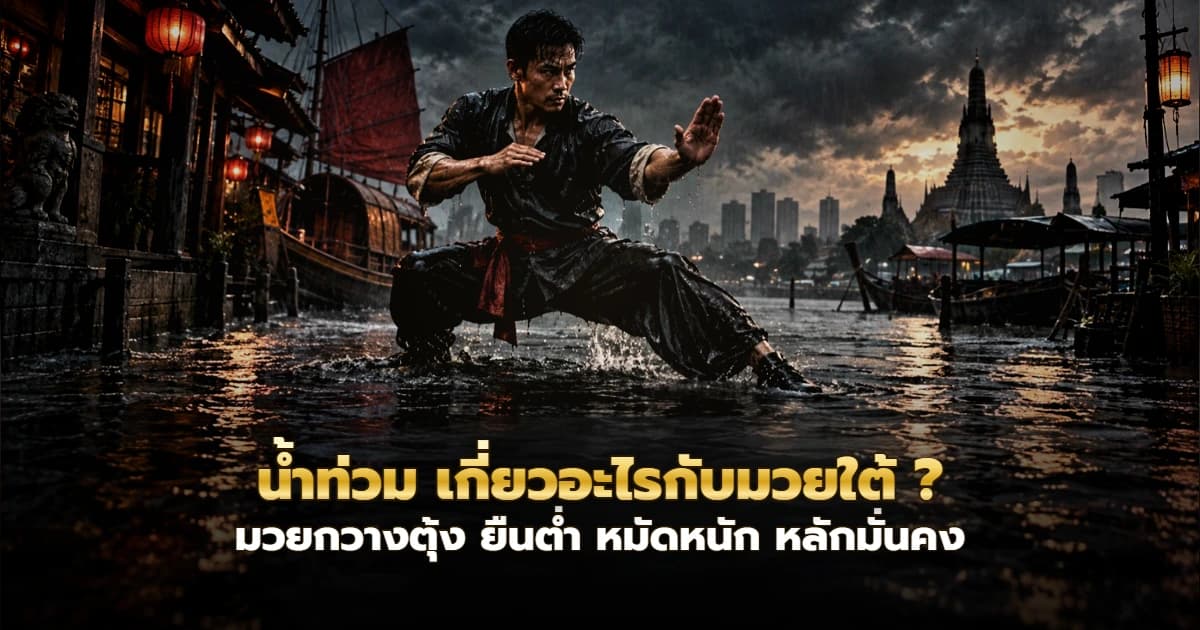
Heavy rain flooded parts of Bangkok on 25–27 September 2026. A look at Cantonese kung fu from the Pearl River Delta: why southern styles such as Wing Chun stand low and rarely kick high, what is history and what is legend about the Red Boat opera, the wooden dummy and the six-and-a-half-point pole, and how the same balance principles apply when you have to walk through floodwater.
By
 Thaninpong Supapitakpong (Phoenix)Founder and instructor at IMAC Dojo
Updated 25 Sept 2026
- Author
- Thaninpong Supapitakpong (Phoenix)
- Published
- Last updated
- Sources
- 6
- Reading time
- 11 min
Short Answer
Bangkok floods and southern kung fu meet in the Pearl River Delta, a land of mud, canals and boats, where Foshan has relied on the Sangyuan Wei (桑园围) dyke system against floods for more than 900 years. On slippery ground and boat decks a high kick risks a fall, so southern styles stand low, step short and use the "bridge arm" (橋手, the forearm as the point of contact) as their main weapon, as the saying "southern fists, northern kicks" (南拳北腿) puts it. The same principle helps if you must cross floodwater: short steps, and feel the ground before committing weight. The safest option is still not to wade in at all.
Key Takeaways
- The Thai Meteorological Department issued heavy-to-very-heavy rain warning No. 8 for 25–27 September 2026, covering Bangkok and its vicinity, and flooding was reported in several Bangkok districts.
- Southern styles such as Wing Chun, Hung Kuen and Choy Li Fut grew up in the wetlands of Guangdong, not on the dry northern plains.
- On mud and wet decks a high kick risks more than it gains, so southern styles stand low, step short and fight mainly with the hands.
- In 1854 Red Boat opera performers rose up with Li Wenmao, and local opera was banned for about 15 years; that part is history, while training kung fu on the boats is still legend.
- The wooden dummy as a converted ship's windlass, and the six-and-a-half-point pole as a boat pole, are theories and lineage stories without documentary proof.
- If you must wade through floodwater, take short steps, feel the ground before putting weight on it, and follow the Department of Disease Control's advice.
The heavy rain flooding Bangkok this week reminded me of something I have long been interested in: the origin of Cantonese kung fu, the southern Chinese boxing known for low stances, strong hands and almost no high kicks. The Thai Meteorological Department issued heavy-to-very-heavy rain warning No. 8 for 25–27 September 2026, covering Bangkok and its vicinity, and I believe the story of people and water along the Pearl River has a lesson for us on days when we too have to deal with floods.
In this article
Why the Bangkok Floods Remind Me of Southern Chinese Boxing
I have always liked to look at how environment shapes a fighting art. On 25 September 2026 flooding was reported in several Bangkok districts, including Sai Mai, Bang Khen, Chatuchak, Huai Khwang and Lat Krabang. When rain floods the roads, my worry is not just traffic or a wet house but the students and parents who travel to the dojo every week. A family's safety always matters more than making it through the rain.
Thinking it over, floods and southern Chinese boxing are not far apart at all. Foshan (佛山) in Guangdong, a major home of southern boxing and of Wing Chun, sits in the Pearl River Delta (珠江三角洲), the plain of river sediment that the Pearl River (Zhujiang) lays down before it flows into the South China Sea in southern Guangdong, and it has always lived with floodwater. The Sangyuan Wei (桑园围) dyke system in Foshan's Nanhai and Shunde districts was begun in the Northern Song dynasty, is more than 900 years old, serves irrigation, flood control and drainage, and was listed as a World Heritage Irrigation Structure on 8 December 2020. People and water here are not a backdrop for martial-arts films; they are the real conditions people have adapted to for generations.
What I want to suggest is that river life may not have "created" southern boxing directly, as the story is often told, because southern boxing is a collective name for many schools from many places. But the ground itself, with its mud, narrow canals and rocking boats, pushed fighting arts in the same direction: low stances, strong hands and little reliance on high kicks.
Southern Fists, Northern Kicks: The Difference in Movement Science
The Chinese saying "southern fists, northern kicks" (南拳北腿) is more than a figure of speech. Northern styles such as changquan (长拳, long fist) grew up on wide plains of hard, dry ground, where long steps, jumps and long-range kicks are natural. Southern styles in Guangdong and Fujian grew up in a land of rivers and canals where people travelled mainly by boat, as the old phrase "boats in the south, horses in the north" (南船北马) says.
In terms of basic physics, friction between the foot and mud or wet wood is very low. A high kick keeps the body balanced on one leg for longer, so the centre of gravity leaves the base of support easily, and a fall into mud or water opens you to your opponent or, worse, means drowning. Anyone who has lifted a leg on a wet tiled floor knows how fast stability disappears. This is an explanation from principle, not historical proof that it is the only reason for the southern style.
| Aspect | Northern styles (北派) | Southern styles (南拳) |
|---|---|---|
| Environment | Wide plains, hard dry ground | Wetlands, mud, boat decks |
| Stance | Wide, long, mobile | Narrow, low, firmly rooted |
| Main weapons | Feet and shins, long kicks | Bridge arm, forearms, fists, elbows |
| Tactics | Keep distance, attack from outside | Drive through the centreline, fight close |
The Red Boat Opera and the Origin of Wing Chun
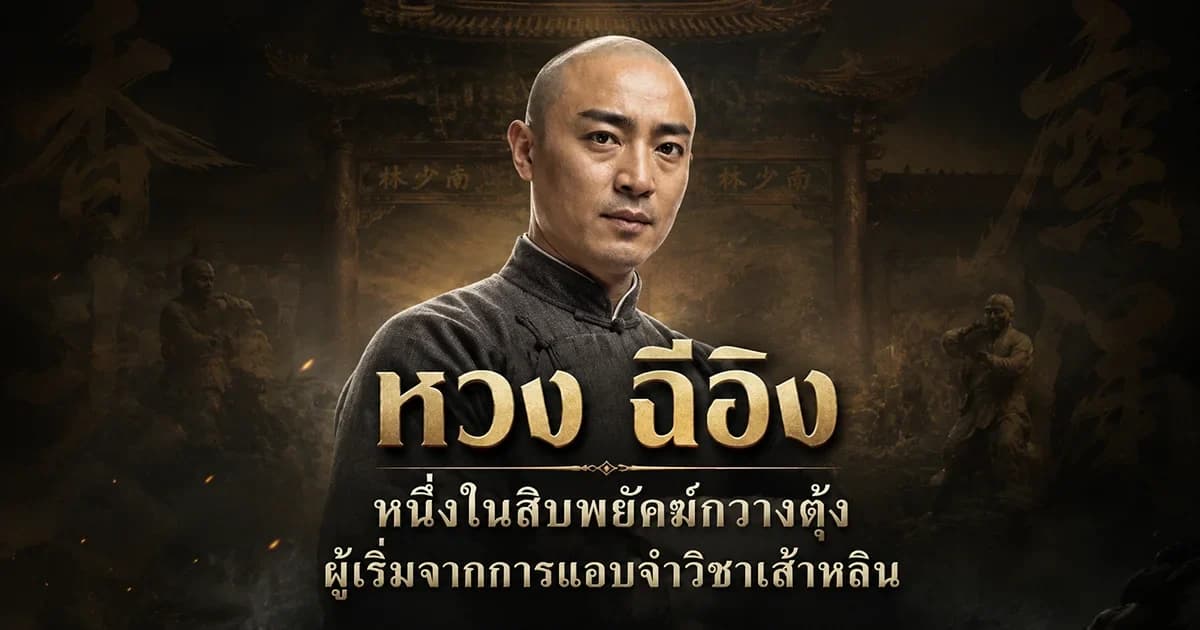
A story I often tell students is that of the Red Boat opera (紅船). In the 18th and 19th centuries Cantonese opera troupes painted their boats red and sailed the waterways to perform in villages across the Pearl River Delta. The boat was transport, lodging and rehearsal space in one, and the centre of the opera world was the Qionghua Guild Hall (琼花会馆) in Foshan.
In 1854, the fourth year of the Xianfeng reign, the opera performer Li Wenmao (李文茂) led Red Boat performers to join the Heaven and Earth Society (天地会) uprising near Foshan, known as the Red Turban Rebellion (红巾起义). After it was crushed, the Qionghua Guild Hall was closed and destroyed and local opera was banned for about 15 years, so performers scattered to riverside villages. The claim that the red boats were a regular hiding place for secret societies has no evidence behind it.
For me this is the heart of the story. A boat deck is narrow and wet, so a fighter on it cannot run, jump or fight in a wide circle; the art has to be compressed into a close-range system, which is the system tied to 詠春拳 (Wing Chun). The lineage that can be traced by real names begins with Wong Wah Bo (黃華寶) and passes to Leung Yee Tai (梁二娣), both Red Boat men, but how they trained on the boats is a story that cannot be confirmed. I wrote about it in detail in Did Wing Chun Come from Shaolin or the Red Boats?.
The Wooden Dummy and the Six-and-a-Half-Point Pole: Stories Tied to Boat Equipment
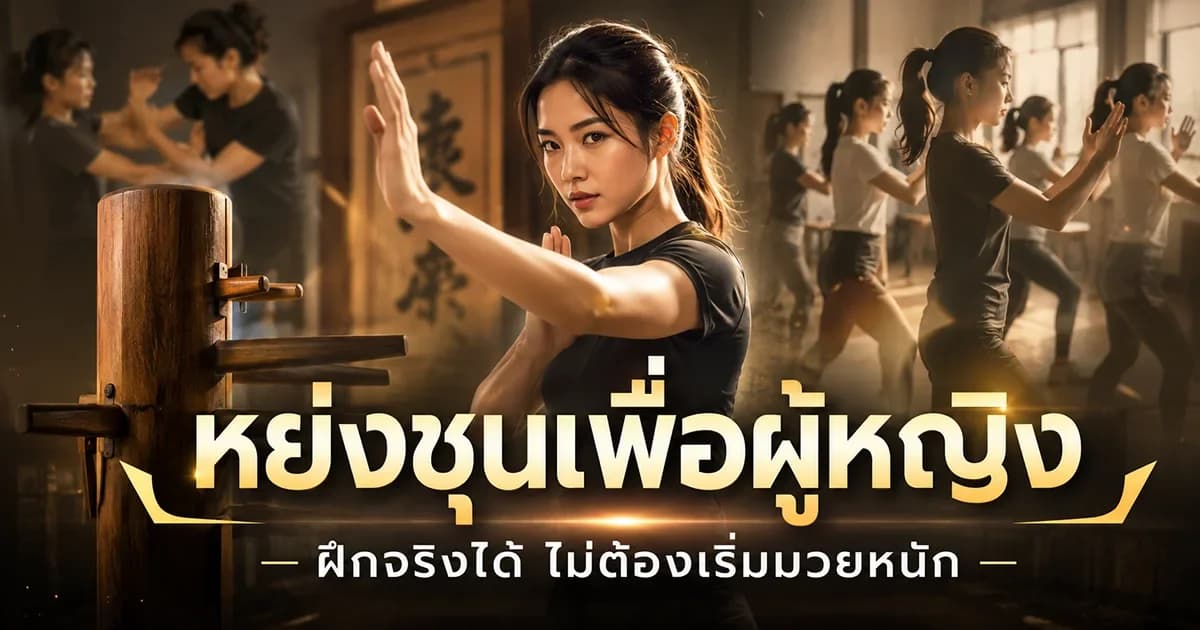
Many people who see the 木人樁 (wooden dummy) assume it was designed to imitate a human body from the start. One theory suggests the southern dummy may have been adapted from a ship's windlass, a wooden drum with holes for levers used to raise sails or anchors; when a boat was retired, the upright drum with arms sticking out could have become a hand-training tool. There is no contemporary document to prove this. What is certain is that the dummy is one stage of the Wing Chun curriculum, after Siu Nim Tau (小念頭), Chum Kiu (尋橋) and Biu Jee (標指), and that dummy forms run to about 108 to 116 movements depending on the lineage. I described dummy training in China in Lessons Learned from Training Wing Chun in China.
In the same way, Wing Chun lineage stories tie the 六點半棍 (six-and-a-half-point pole) to the pole boatmen pushed against the riverbed. The pole is unusually long, thick at the base and tapered at the tip, and its form stresses straight thrusts and short strikes rather than the wide spinning of northern staff work. Poling a boat demands both feet rooted to drive force into the ground, which fits this kind of pole work well. Even if the origin remains a story, the lesson I like is that the best training tools usually come from real situations, not from sitting in a room.
Rooting and the Bridge Arm: Balance on Unstable Ground
When I explain southern balance I use a simple principle: the body's stability depends on the size of its base compared with the height of its centre of gravity. The wider the base and the lower the centre of gravity, the more stable the body. Southern styles therefore make their stances (馬步) especially low, such as the four-level stance (四平馬) of Hung Kuen or the goat-clamping stance (二字拑羊馬) of Wing Chun. Bending the knees, folding the hips and bracing the core lock the pelvis into a pillar, so incoming force goes down into the ground instead of making the feet slip.
For stepping, southern styles drop the high lift of the foot and use short steps that slide parallel to the ground. Time on one leg is kept as short as possible and the feet stay almost always in contact, so they react at once to a tilting boat or slippery mud. With the lower body rooted, the upper body takes over defence and attack. That is where the "bridge arm" (橋手) comes from: the forearm, from wrist to elbow, is the point of contact with the opponent. A southern saying goes "if there is a bridge, cross it; if there is none, build one" (有橋橋上過,無橋自造橋): when the opponent comes in, you do not retreat but reach out to make contact, read the direction of force, and control their structure from there.
I think this philosophy reaches beyond fighting. It teaches us not to run from a problem but to make contact with it and deal with it calmly. On a day when Bangkok floods, the same idea holds: instead of pushing forward when the situation is not ready, root yourself and find a steadier way first.
Lessons from Southern Kung Fu for a Flood Day: Root Before You Move
What I want to pass on is not a fighting technique for flood days but a way of thinking. The first lesson is to "root" before moving. A southern boxer never steps carelessly onto unknown ground; he always feels it before shifting his weight. The same applies when you have to walk through floodwater or drive through a flooded spot: assessing the risk before deciding beats pushing on without looking around. Real courage is not charging at a problem without thinking.
If you really must wade through floodwater, the southern step applies directly: take short steps and let the foot touch down before you shift your weight, because in murky water you cannot see holes, kerbs or manholes. But balance only lowers the risk of slipping; it does not make wading safe. Thailand's Department of Disease Control advises avoiding wading through water or mud unless necessary, wearing rubber boots and gloves if you must, washing immediately after contact with the water, and never touching wet plugs, electrical appliances or wires.
The last lesson is adapting to what cannot be changed. People along the Pearl River did not try to change the river; they built dykes and changed how they moved. For people in Bangkok, who face floods every year, we may not be able to solve flooding, but we can plan our journeys and look after each other. On a day of heavy rain, if the route to the dojo is flooded or unsafe, let your instructor know through the dojo's LINE and stay somewhere safe first.
Conclusion
Cantonese boxing that does not kick high shows me that fighting arts come from adapting to real environments: rooting firmly, using the bridge arm instead of high kicks, and stories of boat equipment turned into training tools. On a day when Bangkok floods, I would like us to look at it the way people along the Pearl River did: do not fight what cannot be changed, but root firmly before moving forward. If you want to train low stances and bridge arms the Wing Chun way, see the Wing Chun Sambo course and the schedule and pricing page. But on a day of heavy rain, every family's safety comes before the training schedule.
Sources and further reading
- TMD heavy rain warning No. 8 (25 Sep 2026, Thai) — ThairathPrimaryAccessed 25 Sept 2026
- Bangkok flood update, 25 Sep 2026 (Thai) — Bangkok Biz NewsPrimaryAccessed 25 Sept 2026
- Heavy rain and rising water: DDC advice on leptospirosis (Thai) — Department of Disease Control, ThailandOfficialAccessed 25 Sept 2026
- World Heritage Irrigation Structure: Foshan Sangyuan Wei (Chinese) — Guangdong Provincial Gazetteer OfficePrimaryAccessed 25 Sept 2026
- Foshan Cantonese opera: Qionghua and the red boats (Chinese) — Southcn.comPrimaryAccessed 25 Sept 2026
- Cantonese Popular Culture and the Creation of Wing Chun's Opera Rebels — Kung Fu Tea / Chinese Martial StudiesPrimaryAccessed 25 Sept 2026
Frequently Asked Questions
Is Cantonese boxing the same as southern Chinese boxing?
Cantonese boxing is part of southern boxing (南拳), a collective name for many schools in southern China, including Guangdong and Fujian. It is not the name of a single school.
Why does Wing Chun have no high kicks like northern Chinese boxing?
Wing Chun is a close-range system built on low stances, short steps and the bridge arm. The explanation most often told is that the art is tied to the Red Boat opera, whose performers had to fight on narrow, wet decks where a high kick easily costs your balance, but the details of training on the boats remain a story.
How is the kung fu wooden dummy connected to boats?
One theory holds that the dummy may have been adapted from a ship's windlass, a wooden drum with holes for levers, but no contemporary document confirms it. What is certain is that the dummy is one stage of the Wing Chun curriculum.
Is the Red Boat opera story history or legend?
Both. The Qionghua Guild Hall in Foshan, Li Wenmao's uprising in 1854 and the roughly 15-year ban on local opera are recorded, but who taught whom on the boats is a story passed down.
Does IMAC Dojo teach Wing Chun?
Yes, through the Wing Chun Sambo course, which uses Ip Man lineage Wing Chun as its close-range core. The course focuses on ages 25-60; days, times and fees are on the schedule and pricing page.
Should I travel to the dojo to train on a day of heavy rain?
Safety always comes first. If there is a heavy rain warning or the route is flooded, let your instructor know through the dojo's LINE and stay somewhere safe first.
What should I watch out for if I have to walk through floodwater?
Thailand's Department of Disease Control advises avoiding wading unless necessary, wearing rubber boots and gloves if you must, washing immediately after contact with the water, and never touching wet plugs or wires. While walking, take short steps and feel the ground before putting weight on it, because holes and manholes are invisible under the water.
Ready to start martial arts?
Message IMAC Dojo to ask which course fits your age, goals, and training background.
Ask on LINE Official