Did Wing Chun Originate from Shaolin or the Red Boat? A Truth No One Can Confirm
Did Wing Chun come from Shaolin or the Red Boat? Explore the legends, evidence, lineage to Ip Man, and the Red Boat's role in Wing Chun history.

By
- Author
- Thaninpong Supapitakpong (Phoenix)
- Published
- Last updated
- Sources
- 3
- Reading time
- 6 min
Short Answer
Wing Chun did not "originate" from a single, specific place. Rather, it is the product of a blending of folk martial arts from the Lingnan region. Its early forms may trace back to the Shaolin system, while the Red Boat served as the crucible in which these skills were systematized into something practically usable.
Key Takeaways
- The legends of Nun Ng Mui and Taan Sau Ng lack historical evidence and survive only through oral transmission
- The Red Boat was a floating residence for Cantonese opera troupes during the Qing dynasty, not a place where the martial art was invented
- The lineage with genuine documented evidence begins with Wong Wah Bo, passing to Leung Yee Tai, then Leung Jan, and finally to Ip Man
- In 2021, Foshan Wing Chun was officially registered as a National Intangible Cultural Heritage of China
I still remember clearly, as a child, sitting and watching the Chinese drama "Legend of the Condor Heroes", and seeing the name Nun Ng Mui appear on screen with a caption stating that she was the creator of Wing Chun.
The question that has lingered in my mind for decades is this: did Wing Chun originate from Shaolin or from the Red Boat? And the answer turns out to be far more complex than any Chinese film has ever told us. Because the deeper I researched, the more I found that no historical document could confirm it with one hundred percent certainty—there are only oral traditions woven seamlessly together with cultural symbolism.
In this article
From the Legend of Nun Ng Mui to Shaolin: A Beginning Without Evidence
Most documents state that Nun Ng Mui or Taan Sau Ng (Jeung Ng) is the origin of the art. Legend has it that Nun Ng Mui created the martial art at Mount Daliang after observing a fight between a snake and a crane. Meanwhile, Taan Sau Ng was said to be an opera performer who fled to Foshan during the reign of the Yongzheng Emperor, famous for his "Taan Sau" (spreading hand) technique, which is recorded in the history of Chinese opera. However, neither figure has any clear historical evidence supporting their existence. As someone who grew up with the film Wing Chun (1994), starring Michelle Yeoh as Yim Wing Chun, Cheng Pei-pei as Nun Ng Mui, and Donnie Yen as Leung Pok To, I understand very well why people of my generation believed this story without question—the film made the legend appear credible. But once I began studying the subject seriously, I found that academic circles consistently use phrases like "it is said that" or "legend has it," which is a clear signal that this is belief, not fact.
The Red Boat: A Crucible for Close-Quarters Combat Skills
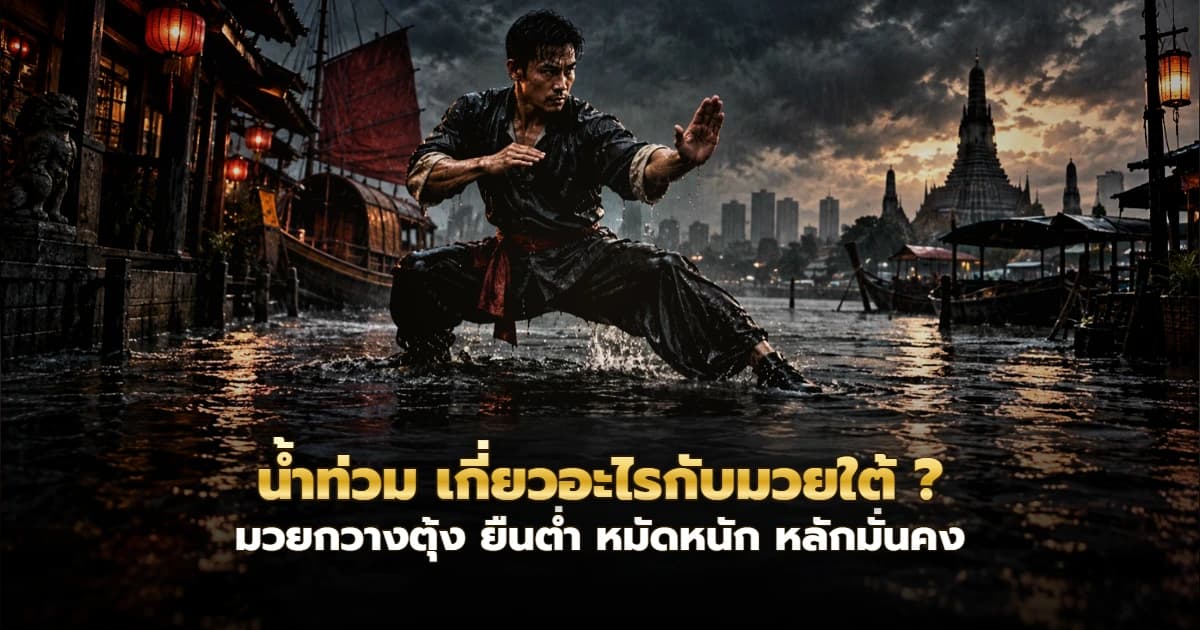
The theory I have always believed is that groups of Han Chinese who upheld the ideology of "Overthrow the Qing, Restore the Ming" under the banner of the Heaven and Earth Society (Tiandihui) were pursued southward by the Manchus and thus blended themselves into opera troupes that traveled by Red Boat—known among the Teochew people as "Ang Tao Chun." Research consistently confirms that the Red Boat was a floating residence for Cantonese opera troupes during the Qing dynasty, with cramped quarters, a rocking vessel, and frequent encounters with river bandits. Opera performers such as Wong Wah Bo and Leung Yee Tai combined martial arts with the "Six-and-a-Half-Point Pole" technique, developing short-bridge, narrow-stance techniques and close-range force generation suited to the confined space aboard the boat. This is the reason why the wooden dummy, or Muk Yan Jong, was designed for use in tight spaces—it was a simulated apparatus for training aboard the boat, not something that originated from a land-based martial arts school in the first place.
Why "Red" Boats? The Hidden Taoist Belief
I want to share this point in particular because it is knowledge rarely found in typical Chinese films. According to the principles of the I Ching or Ba Zi, the southern direction of China is symbolized by the red Vermilion Bird (Zhuque) and the element of Fire. The people of Swatow, Teochew, and Lingnan who traded by boat therefore painted the bows of their vessels red for auspiciousness and safety. Wing Chun, being a highly efficient martial art for close-quarters combat, is thus inferred to be directly connected to the Red Boat, because in the cramped confines of a boat's hold, no one would rely on fists in a genuinely dangerous situation. The butterfly swords (baat jaam do) were therefore weapons used for real killing, and the principles of blade use were adapted into a system of forms with few movements but highly practical application. As for the long pole, it was designed for combat between boats at close range—no one would ever use a pole of that length on flat, open ground.
From Wong Wah Bo to Ip Man: The Lineage with Genuine Evidence
| Theory | Evidence | Current Status |
|---|---|---|
| Shaolin/Nun Ng Mui | Oral tradition, no records | Legend |
| Red Boat | Consistent with spatial technique adaptations | A place for martial arts training |
| Ip Man Lineage | Clearly documented with named individuals | Academically accepted |
The part I consider most credible is the lineage documented with the names of real historical figures: Wong Wah Bo transmitted the art to Leung Yee Tai, who then passed it on to Leung Jan (1820–1890), a renowned physician of Foshan who combined the fierceness of Hung Kuen with the suppleness of Wing Chun, and who was the first to teach the art publicly. From there, it passed to Chan Wah Shun, and then to Ip Man, who moved to Hong Kong in 1949 and applied principles of mechanics to completely reorganize the theoretical framework of the martial art. Students such as Bruce Lee and Leung Ting helped push Wing Chun onto the world stage. This lineage tells us clearly that Leung Jan was "the one who made Wing Chun flourish," not its founder, and that the Red Boat was merely one path in the development of the martial art, not the true point of origin.
Wing Chun in Thailand and at IMAC Dojo
I believe that regardless of whether the origin lies in Shaolin or the Red Boat, what matters more is transmitting the art correctly and safely. At IMAC Dojo, we are fortunate to have Sifu RyuGeGe, a direct disciple of the Ip Man lineage, overseeing the teaching of Wing Chun in Thailand in accordance with the same fundamental principles passed down from Foshan. I believe that the growing recognition of Wing Chun in Thailand over the past decade stems, in part, from curiosity like my own—people who watched Chinese films and wanted to know what the real thing was like. Once they came to study it seriously, they came to understand that the true charm of Wing Chun lies in its economy of movement and efficiency at close range, which aligns perfectly with what scholars describe regarding the techniques developed aboard the Red Boat.
Conclusion
Having engaged with this question since childhood in front of a television screen, up to the present day when I teach martial arts myself, I admit that the most honest answer is "no one knows for certain." Both Shaolin and the Red Boat are fragments of truth that together form a larger picture. The early forms may trace their lineage to the Shaolin system within the context of anti-Qing resistance, while the Red Boat was the space in which those skills were tested, refined, and systematized into the practical martial art we see passed down through Leung Jan and Ip Man to this very day. What I want to leave you with is this: don't let legend cause us to forget the essence of Wing Chun—the principle of using the body economically and efficiently—which is something we continue to uphold and pass on at IMAC Dojo, with respect for the true roots of this martial art.
Sources and further reading
- Foshan Wing Chun in China's national intangible cultural heritage list — General Administration of Sport of ChinaReferenceAccessed 15 Aug 2026
- Foshan Wing Chun: a martial legacy that never disappeared — China Intangible Cultural Heritage Information CenterReferenceAccessed 15 Aug 2026
- Cantonese popular culture and the creation of Wing Chun's opera rebels — Chinese Martial StudiesReferenceAccessed 15 Aug 2026
Frequently Asked Questions
Where exactly did Wing Chun originate?
There is still no conclusive evidence. Academic consensus views it as a product of the blending of folk martial arts across the Lingnan region, including Guangdong, Guangxi, and Hainan.
How are Shaolin and Wing Chun connected?
The legend connects them through Nun Ng Mui or Taan Sau Ng, but there are no historical records to confirm this—it is merely a story passed down through generations.
What role did the Red Boat actually play?
It served as a breeding ground for skills that allowed close-range techniques, short-bridge narrow stances, and the wooden dummy to be systematized into a practically usable form. It was not the origin point of the martial art itself.
Has Wing Chun received any official recognition?
In 2021, Foshan Wing Chun was officially registered as a National Intangible Cultural Heritage of China.
Ready to start martial arts?
Message IMAC Dojo to ask which course fits your age, goals, and training background.
Ask on LINE Official