What Is One-Finger Chan? Separating Yizhi Chan from Hong Kuen Finger Techniques
One-Finger Chan and a finger shape in Hong Kuen may look alike, but they point to different cultural contexts, training methods, and purposes. Learn how to distinguish them responsibly.
- Author
- Thaninpong Supapitakpong (Phoenix)
- Published
- Last updated
- Sources
- 3
- Reading time
- 6 min
Short Answer
One-Finger Chan (Yizhi Chan) should not be treated as the same practice as a finger shape inside Hong Kuen. One-Finger Chan is commonly discussed through Zen symbolism and lineage-specific qigong practice; Hong Kuen is a Southern Chinese martial system built around stance, bridge hands, structure, and whole-body force. A similar hand shape is not proof of a shared lineage.
Key Takeaways
- One-Finger Chan is connected, by name and by idea, to the Zen koan of 'raising one finger'.
- Hong Kuen is built around the horse stance, bridge hands, and the timing of the torso; it does not treat a finger shape as evidence that the same qigong is being practiced.
- The term 'internal power' and explanations of qi mean different things in different schools, so check the teacher and the lineage before believing the advertising.
- If you are interested in learning martial arts in Bangkok, start from verifiable goals such as health, discipline, movement, or self-defense.
A hand shape can travel across traditions. Its lineage, purpose, and method are what tell us what it actually means.
The question "What is One-Finger Chan?" is often answered with the image of a single raised index finger and the exaggerated explanations of short clips. Once the histories of Zen, qigong, and Southern Chinese boxing are separated, it becomes clear that a finger posture cannot, by itself, tell you which art it belongs to.
In the world of Chinese boxing, an image can easily mislead. A master raises one index finger before starting a form, and viewers connect it with One-Finger Chan; some link it to a secret sign, others conclude it is internal power. The more honest answer is that you first have to ask which system the movement belongs to, what it is used for, and from whom it was inherited.
This article does not try to judge which system ranks higher; it invites a closer look. One-Finger Chan is a name with a background in Zen and, in some lineages, in internal training, while Hong Kuen, or Hung Gar, is a Southern Chinese boxing art developed through the structure of the horse stance, bridge hands, breathing, and continuous forms. Both have value in their own context, but they should not be mixed up just because a finger appears in the hand shape.
In this article
One-Finger Chan: a Zen image and a name used by particular training lineages
- The heart of the Zen koan is to point toward awakening or non-attachment, not to show off physical power.
- Breathing and finger-tensing practice, done the wrong way, can irritate or injure the finger joints, tendons, and wrists, so it should not be copied from short clips.
- A verifiable lineage should come with the teacher's name, its sources, the teaching method, and the limits of what it claims, not just an edited demonstration clip.
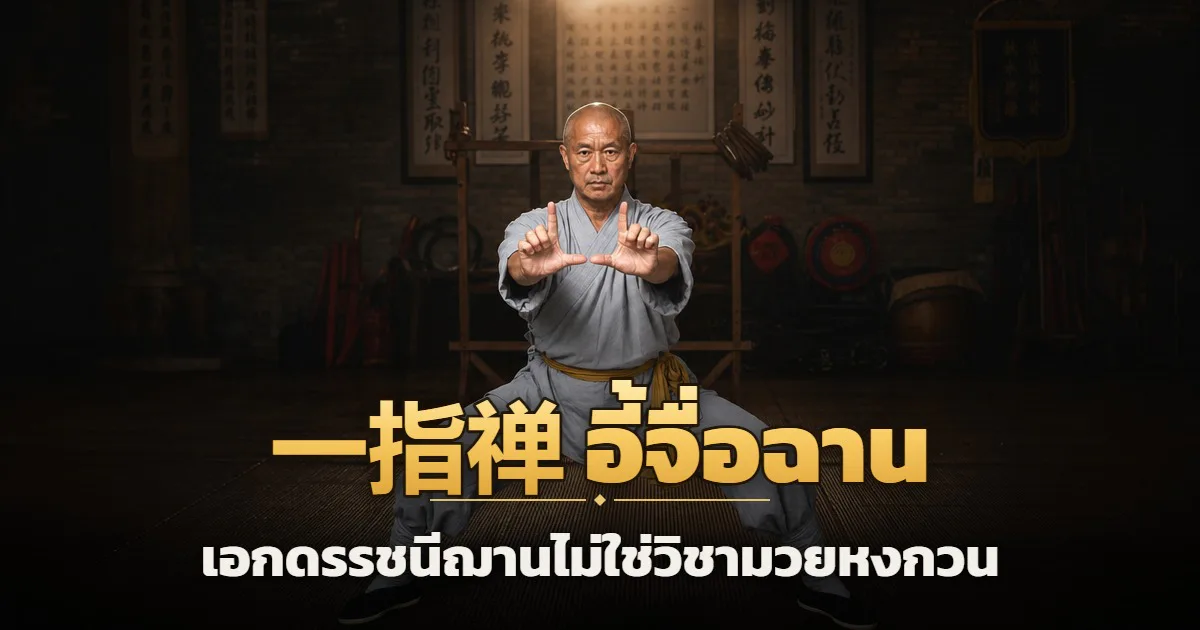
一指禅, pronounced Yī Zhǐ Chán, literally means One-Finger Chan. The name is often associated with the Chan story of Master Juzhi, who responded to questions by raising one finger. In that setting the gesture is a teaching device about awakening and attachment, not a catalogue of fighting applications.
Some qigong and martial arts lineages later adopted the name for their own practices involving hand formation, standing, breathing, and concentration. Lineage documents and websites can tell their own histories differently, so those accounts should be read as lineage narratives, not as the single history of all of Shaolin.
What Hong Kuen uses finger shapes for: bridge hands, the horse stance, and whole-body force
For more cultural context, explore IMAC Dojo's Chinese Wushu articles and compare lineage stories with the evidence in its article on the Ten Tigers of Guangdong.
Hong Kuen, also called Hung Kuen or Hung Gar in different romanization systems, is a broad Southern Chinese martial arts tradition, whose lineages differ in detail and in their line of teachers. Its recognizable features include stable stances, bridge-hand contact, coordinated breathing, and force that begins at the floor and travels through the body instead of appearing from an isolated finger.
Frequently discussed sets such as Gung Ji Fook Fu Kuen, Fu Hok Seung Ying Kuen, and Tit Sin Kuen show a Hong Kuen world of structural alignment, shifting force, receiving and issuing force, and breathing rhythm. In some sets, a name or move containing the words "one finger" should therefore be read as part of the movement sequence, not as evidence that the practitioner is using One-Finger Chan.
Comparison table: the hand shapes look alike, but the roots and functions differ
| Question | One-Finger Chan | Hong Kuen finger shape |
|---|---|---|
| Primary frame | Linked to the story and Zen koan of 'raising one finger' | A component within Southern Chinese martial forms |
| What to examine | The teacher who passes it on, breathing method, safety, and claims about results | Stance, bridge hands, distance, body mechanics, and partner work |
| Goal it can honestly claim | Concentration, breath regulation, and a lineage's own internal training | Body structure, movement, and how the arms are used inside the system |
| Conclusion | This art's name should not stand in for Hong Kuen as a whole | A finger shape alone should not be taken as confirmation of One-Finger Chan |
Why short clips and films confuse people
The idea of checking teachers and lineages connects with our article on the Bai Shi ceremony, and the idea of a disciplined place of training with what a dojo means.
Entertainment media can quickly turn a complex idea into a memorable image: one finger, one point, or one burst of mysterious power that ends it all. Images like these are exciting, but they do not explain the training time, the limits, the names of those who passed the art on, or the difference between performance, health practice, and self-defense in a real situation.
Learners therefore gain more by always asking four simple questions: Whom did the teacher learn the art from? What result is the training for? How are levels adjusted and safety looked after? And what does the school not claim? The answers help to separate systematic learning from the use of an old name for marketing.
Interested in Chinese boxing or self-defense? How to start
A responsible start does not require choosing the most mysterious-sounding art. Begin with a goal you can measure, such as moving better, building confidence, training discipline, or understanding the principles of distance and self-defense. Then choose a teacher who can explain what the class trains and who does not promise exaggerated results.
IMAC Dojo does not currently present One-Finger Chan or Hong Kuen as courses. This article is cultural context for readers who want to evaluate Chinese martial arts claims more carefully before choosing a training path. If you are looking for training with a set timetable, a visible instructor, and clear goals, look at the overview of the courses the dojo runs first, then choose the one that fits you.
Further reading and cautions on interpretation
- Que family Inner Strength One-Finger Chan site (lineage perspective)
- Nanhai Museum overview of Hong Kuen and its forms
- Soto Zen Journal on the one-finger koan
Sources let us see each side's perspective and documents, but much of Chinese martial arts history comes in several lineage-told versions and lists of names, so always separate 'what a school tells' from 'what can be widely confirmed'.
Sources and further reading
Frequently Asked Questions
Is One-Finger Chan part of Hong Kuen?
A similar finger shape is not enough to establish that connection. One-Finger Chan is discussed through Zen and lineage-specific internal practice, while Hong Kuen is a Southern Chinese martial framework centered on stance, bridge hands, and transmitting force through the body.
Is a finger technique in Hong Kuen about sending qi to the fingertips?
In the context of Hong Kuen forms, a finger shape may serve to set the hand form or the timing of a technique. It should not be read as a particular kind of qigong training without an explanation from that teacher's lineage.
Can I learn One-Finger Chan from short videos?
It is not advisable. Training that involves tensing the fingers, the wrists, and breathing patterns should be done under a teacher who can check your form, because copying it wrongly can irritate the finger joints or tendons.
Does IMAC Dojo teach One-Finger Chan or Hong Kuen?
IMAC Dojo does not currently offer either art as a course. This article is meant to explain the cultural context and to help readers check the lineage of what they come across.
How should a beginner choose a martial arts class in Bangkok?
Start from your goal and the kind of training you want, such as strength, discipline, falling safely, close-range movement, or self-defense, then choose a class with clear instructors, a clear schedule, and clear safety boundaries.
Ready to start martial arts?
Message IMAC Dojo to ask which course fits your age, goals, and training background.
Ask on LINE Official