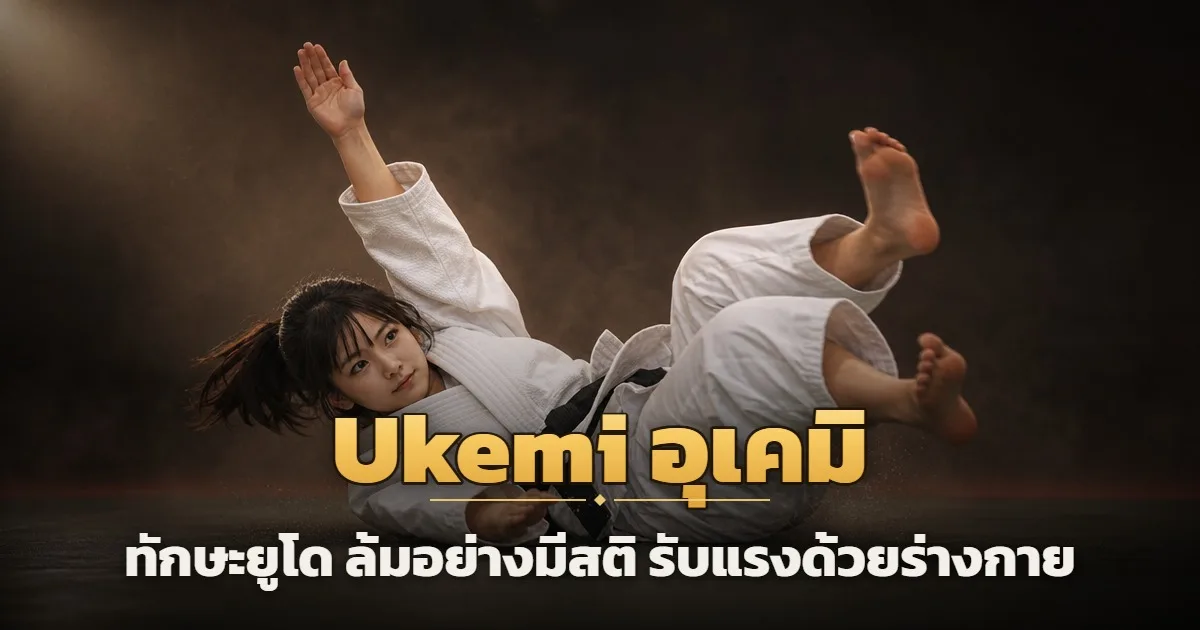
What Is Ukemi? The Judo Skill of Controlled, Safer Falling
Ukemi is Judo's method of receiving a fall with control. Learn its purpose, major forms, progression, common errors, and the safety limits every beginner should understand.
By
 Thaninpong Supapitakpong (Phoenix)2nd Dan Shinkyokushin Karate · Founder and martial arts instructor, IMAC Dojo
Updated 5 Oct 2026
Reviewed by Ryu · Judo 2nd dan (Judo Association of Thailand) · SAT C-License jujitsu coach
- Author
- Thaninpong Supapitakpong (Phoenix)
- Published
- Last updated
- Reviewed by
- Ryu ·
- Sources
- 7
- Reading time
- 11 min
Short Answer
Ukemi (受身) is Judo's controlled breakfall practice. It is not simply dropping to the floor or bracing a fall with straight arms. Beginners practise on mats, from low positions up to standing, under an instructor, to learn how to protect the head, neck, and torso and to build confidence before moving on to throws or Randori.
Key Takeaways
- In Judo, Ukemi means receiving a fall, or falling with control; it is not a special technique reserved for competitors.
- Common forms include Ushiro-ukemi, Yoko-ukemi, Mae-ukemi, and Mae-mawari-ukemi.
- The purpose is to orient the body and spread the impact across the mat, not to take the force with the wrists or elbows.
- Good Ukemi gives students more confidence to practise throws, but it does not guarantee that injuries can be prevented in every situation.
- Learning on mats with an instructor and partners who control their force matters more than trying to make falls fast or high from the start.
In Judo, falling is not a defeat but a skill that lets us get back up, keep training, and look after our training partners responsibly.
The clearest answer to what is Ukemi is that it is a structured Judo practice for receiving a fall with control on the mat, not a way of teaching yourself to fall onto hard ground.
Many people see Judo through its throws and assume that everything important lies with the person who makes the partner fall. For beginners, though, an instructor who teaches responsibly usually starts from the opposite question: if I fall, how do I land safely enough to keep training? The answer is Ukemi.
Ukemi is a foundation that ties together balance, movement, breathing, fear, and respect for the training partner, so it should not be treated as a mere warm-up before throws. Students who start from controlled falling read force better, know when to yield or turn the body as they lose balance, and understand that speed must follow the quality of the basics, not come before it.
In this article
What 受身 (Ukemi) means in Judo
受身 is read as Ukemi. In Judo it describes receiving a fall with the body in a controlled manner. 受け (uke) conveys receiving, and 身 (mi) is the body. The word does not mean that a person should accept every impact; it describes how a student learns to organise the body on the tatami while training.
Judo partners have connected responsibilities. Tori applies the technique, while Uke receives it. Tori must adjust force and timing to the partner's level; Uke learns to respond without panic. This is why Ukemi is part of etiquette and responsibility, not a skill that belongs to one side only.
Receiving force in this sense does not mean that the human body can take any kind of force, or a fall from any height. Ukemi is practised on mats, under controlled conditions, with complexity added gradually as the student becomes ready. A student should therefore draw a clear line between a skill on the tatami and a real accident on concrete, stairs, a road, or in an unpredictable environment.
Why Ukemi comes before throws and Randori
Judo throws involve Kuzushi, or breaking balance, Tsukuri, the fitting or entry phase, and Kake, the execution. Once balance changes, falling is part of the lesson. A beginner who has not been prepared to receive that movement will often stiffen, hesitate, or fear the next repetition.
A progressive Ukemi practice helps students focus on timing, grips, movement, and partner awareness. It should never be used to push a nervous student into full throws too soon. Confidence comes from controlled repetition and clear coaching, not from being told to ignore fear. Before raising the speed or height of practice, the instructor should check trunk control, head direction, breathing rhythm, and the readiness of both partners.
The principles behind controlled, safer falling
- Awareness first: notice the direction of movement instead of reacting blindly.
- Do not brace with rigid arms: straight hands or elbows can place unwanted load on wrists, elbows, and shoulders.
- Protect head and neck: students learn appropriate head and body positioning under supervision.
- Breathe and avoid unnecessary stiffness: control is different from forcing the body rigid.
It is incomplete to describe Ukemi only as slapping the mat. Contact with the mat is one part of a coordinated movement involving the torso, shoulders, hips, legs, and direction of travel. The goal is not to stop a fall with an arm.
Good practice starts with awareness of one's own position, for example sitting, squatting, or kneeling, and only then develops into movement. Students have time to feel which part of the body meets the mat first and which follows, and they learn that softness is not weakness: it means not fighting the force at the moment it is pulling them off balance.
What biomechanics research can, and cannot, tell us
| Measurement | Reported result | How to read it |
|---|---|---|
| Impulsive force on the head during throws | A comparison of Osoto-gari and Ouchi-gari reported 204.82 ± 19.95 and 118.46 ± 63.62 kg·m/s². | These are throw-specific, controlled measurements. They show that direction and the way a throw is received matter; they are not a forecast for every fall. |
| Head angular acceleration in Osoto-gari | One experiment reported 679.4 ± 173.6 rad/s² when an experienced Uke performed Ukemi, versus higher values for a dummy whose head struck the tatami. | It compares defined laboratory conditions; it is not a universal personal safety threshold. |
| Ippon-seoi-nage impact measurement | An exploratory study measured a 351.95 g maximum at the wrist on one axis and 5.18 g at the hip on another. | The study involved two black belts, so it illustrates local measurements rather than prescribing a mat or medical standard. |
These studies matter because they show why Ukemi is more than a ritual before throws. When the head avoids direct contact with the tatami, surface contact, deceleration time, and coordinated trunk movement can change measured motion. A systematic review also found that Ukemi implementation was associated with lower kinematic data than direct occipital contact, while noting meaningful differences between novice and experienced judoka.
The limits are just as important as the numbers. Many studies use small samples, skilled judoka, mannequins, or tightly controlled throws. They explain why supervised mat practice matters; they do not authorise a reader to test falls from standing, stairs, vehicles, height, or hard ground.
Why Kano placed falling before throwing
When Jigoro Kano developed Kodokan Judo from the teachings of Tenjin Shinyo-ryu and Kito-ryu, he did not separate throwing technique from Randori, controlled free practice. That practice can only progress when Tori, the thrower, and Uke, the receiver, can trust each other. Ukemi is therefore the bridge between technique and trust; it is not merely a hurdle before an exciting throw.
Seiryoku-Zenyo, maximum efficient use of energy, and Jita-Kyoei, mutual welfare and benefit, are visible in ordinary decisions: Tori adjusts force and timing, Uke says when a repetition is too much, and the instructor slows or stops practice when fatigue or fear erodes quality. This cooperation makes Judo demanding in a responsible way.
Children, adults, and older learners need different entry points
For children, the first aim is comfort on the mat, responding to signals, turning, and getting up calmly, not imitating a competitor's fall. A movement game such as Janken-Ukemi can turn a fear of falling into age-appropriate practice when chosen by the instructor.
Adults returning to exercise may begin with balance, low-level movement, and breathing. Older learners or anyone with a history involving the neck, back, shoulders, or wrists should tell the instructor first. Starting from a supine or low position is an example of reducing complexity, not a universal programme or rehabilitation prescription.
The main Judo breakfalls
| Term | Meaning | Learning focus |
|---|---|---|
| Ushiro-ukemi (後ろ受身) | Backward breakfall | Managing a backward loss of balance |
| Yoko-ukemi (横受身) | Side breakfall | Organising the body to either side |
| Mae-ukemi (前受身) | Forward breakfall | Managing forward direction with control |
| Mae-mawari-ukemi (前回り受身) | Forward rolling breakfall | Turning forward momentum into a controlled roll |
Ushiro-ukemi is often introduced early because it lets a beginner understand backward movement at a low level. Yoko-ukemi develops both sides of the body. Mae-ukemi and Mae-mawari-ukemi require more coordination of direction and shoulder movement, so an instructor chooses the right moment to introduce them.
Names and groupings of these techniques can differ slightly between languages and schools, but the core principle does not change: students are not competing over who falls loudest or fastest. The aim is to control the body, stay aware, and return to a safe position from which practice can continue. Practising both sides and revisiting basics is more valuable than memorising Japanese vocabulary alone.
A safer learning progression
A student should not go from watching a clip to asking a friend for a standing throw. A sound sequence starts near the mat, then adds rolling, movement, cooperative partner work, and only later connects breakfalls to controlled throws. This sequence lets the instructor see problems one part at a time and gives students time to build trust in their own bodies.
Before increasing difficulty, a coach can look for breathing, ability to stop and listen, head position, body control, and the student's emotional readiness. Readiness differs from person to person: children, adults who have not exercised for a long time, and people with previous injuries should have their level adjusted by the instructor, not be compared with people who have trained longer.
Common beginner errors and the limits of self-teaching
Common errors include stiffening the entire body, reaching out with a hand or elbow to stop the fall, lifting the head, holding the breath, and rushing to standing practice. Some students practise only on their preferred side. These details are often easier for an instructor to see than for a student to diagnose alone.
Do not use this article as instructions for falling from height, on hard ground, or in an uncontrolled environment. Anyone with pain, dizziness, a previous neck, back, shoulder, or wrist injury should tell the instructor and seek appropriate health advice when needed. Ukemi is a mat-based training skill, not an all-purpose safety guarantee.
Children, adults, and older learners
For children, practice should feel safe and enjoyable and help them understand how the body moves, rather than rushing them into receiving heavy throws. For adults, many beginners worry about falling, carry stiffness from work, or have little exercise experience, so they especially need a patient foundation and should not be judged by how fast they perform a technique.
With older learners, Ukemi needs to be discussed with particular care, because physical condition and risk vary widely. The All Japan Judo Federation presents material on falling safely and on building a body that is less prone to falls, for children and for older adults. That does not mean every older adult should use the same drills as a young judoka. Readiness, health history, and an instructor's judgement remain central to an appropriate programme.
Confidence without overpromising
Confidence in Judo does not come from never falling; it comes from knowing that, if you lose your balance, you have the basics to respond without panic. When students see that the mat, their partners, and the instructor are arranged so they can train one step at a time, their attention gradually moves from the fear of impact to understanding timing, grips, footwork, and the reasons behind each throw.
In this sense, Ukemi also matters for self-defence, because it teaches the value of balance, distance, and moving out of a pull or a push with awareness. That should not lead anyone to conclude that Judo or Ukemi will certainly let them handle a violent incident. Avoiding the situation, asking for help, and leaving a risky place remain the first goals of safety in real life.
Learn Ukemi with Judo at IMAC Dojo Bangkok
If your goal is to learn Judo breakfalls for beginners, begin with a mat, an instructor, and a class that can adjust the progression to you.
Explore Judo classes in BangkokRead What Is Judo?, understand the training culture in What Is a Dojo?, or meet the IMAC Dojo instructors.
No previous experience is needed, and there is no need to rush into Randori on the first day.
The essential point
If your goal is to start training and build confidence, read about women's self-defence classes in Bangkok and browse the IMAC Dojo martial arts articles to compare what different training goals ask of you.
Ukemi is not about making every fall safe. It is about building a responsible foundation for Judo: mat, coach, partner, progression, attention, and respect. Put those first, then let speed and complexity arrive at the right time.
Sources and further reading
- Ukemi Technique Prevents the Elevation of Head Acceleration of a Person Thrown by Osoto-gari — Neurologia Medico-Chirurgica / PubMedReferenceAccessed 13 Jul 2026
- Impulsive Force on the Head During Typical Ukemi Following Different Judo Throws — Journal of Sports Science & Medicine / PubMedReferenceAccessed 13 Jul 2026
- A Systematic Review on the Biomechanics of Breakfall Technique (Ukemi) — International Journal of Environmental Research and Public Health / PubMedResearchAccessed 13 Jul 2026
- Magnitude and Duration of the Impact Generated During Ippon-Seoi-Nage Training — Motricidade / DOAJReferenceAccessed 13 Jul 2026
- All Japan Judo Federation: 受け身のススメ — All Japan Judo FederationOfficialAccessed 13 Jul 2026
- International Judo Federation: How to Write Judo — International Judo FederationOfficialAccessed 13 Jul 2026
- Kodokan Global: General Information for Judokas — Kodokan Judo InstituteOfficialAccessed 13 Jul 2026
Frequently Asked Questions
What is Ukemi in Judo?
Ukemi is Judo's controlled breakfall practice. It is practised on mats and built up step by step, helping students understand the direction of the body and practise throws more safely.
What do Ukemi research numbers mean?
They compare defined movements in controlled studies and help explain why direct head contact with the tatami is a serious concern. They are not a personal safety score or a guarantee for any fall.
What are the main Ukemi forms?
Common forms are Ushiro-ukemi, Yoko-ukemi, Mae-ukemi, and Mae-mawari-ukemi.
Does Judo teach you to fall safely?
Judo teaches Ukemi on mats with progressive coaching. It can develop body awareness and falling skills, but it cannot guarantee safety in every accident or on hard surfaces.
Can adults learn Judo breakfalls?
Yes. Adults can begin from low, controlled positions and progress at an appropriate pace with an instructor.
How should children start learning Ukemi?
Start with activities and low-level movements on mats, with the instructor adjusting the difficulty to the child's age, body control, and confidence. Children should not be rushed into receiving heavy throws.
Should I practise Ukemi at home?
Do not practise impact breakfalls on hard ground or without suitable supervision. Ukemi is best learned on mats in a structured class.
Can an older adult or someone with an injury learn Ukemi?
They should tell the instructor about their health history first. A lower-level start may be appropriate, but the right decision depends on the person and, when needed, health-professional advice.
Why should you not catch the floor with a hand or elbow?
Reaching out with a straight arm to stop the force can load the wrist, elbow, and shoulder. In Judo, students instead train systematically to orient the body and receive the force on the mat.
How is Ukemi different from a throw?
A throw is the technique that takes a partner off balance and down to the mat. Ukemi is the skill of receiving that fall under control. The two are learned together.
Ready to start martial arts?
Message IMAC Dojo to ask which course fits your age, goals, and training background.
Ask on LINE Official