What Kind of Combat Sport Is Taekwondo? A Commercial Sport Children Can Easily Start
The founder of IMAC Dojo, a father who sent all four of his children to taekwondo, explains what taekwondo is and where it came from, how WT differs from ITF, how kyorugi is scored, how many belts there are, and what parents should know now that taekwondo has become a commercial sport.
By
- Author
- Thaninpong Supapitakpong (Phoenix)
- Published
- Last updated
- Sources
- 8
- Reading time
- 10 min
Short Answer
Taekwondo (태권도, 跆拳道) is a South Korean martial art that has carried that name since 1955 and has been an Olympic medal sport since Sydney 2000. Its signature is the kick, because World Taekwondo's competition rules score kicks higher than punches. In my view, today's taekwondo is a commercial sport: designed to be easy to start, fun to learn, with frequent belt gradings that keep a school running. That is not a bad thing, but quality depends heavily on each instructor and school, so parents cannot judge the whole field by one gym.
Key Takeaways
- The name taekwondo was adopted on 11 April 1955, and taekwondo has been an Olympic medal sport since Sydney 2000.
- There are two main bodies: World Taekwondo (WT), which runs Olympic competition, and the International Taekwon-Do Federation (ITF), which General Choi Hong-hi founded in 1966.
- WT rules score kicks at 2 to 6 points and punches at 1 point, so kicks are the main weapon in competition.
- The black belt has 9 dan. Anyone who reaches black-belt level under 15 receives a Kukkiwon "Poom" instead, and 1st to 3rd Poom can be converted to dan from 15.
- Panipak Wongpattanakit has won two Olympic taekwondo golds, at Tokyo 2020 and Paris 2024, the first person from Thailand to win two Olympic gold medals.
Taekwondo (태권도) is a martial art I trained in myself after the age of 40, alongside karate and kung fu. What I still remember clearly is the speed of the legs, and a way of thinking completely different from the other martial arts I had trained in. In this article I write both as someone who trains in taekwondo and as a father who sent all four of his children to taekwondo, about what parents should know behind the beauty of this sport.
In this article
What Is Taekwondo, and Where Did It Come From?
The name Taekwondo comes from three Hanja characters: "tae" (跆), to stamp or kick with the foot; "kwon" (拳), the fist or the hand; and "do" (道), the way. Together they mean the way of the foot and the hand, which is not only fighting but also the discipline a practitioner has to refine alongside it. I agree with that, because when I trained I could feel a precision of body control clearly different from karate.
Taekwondo history is usually traced back to Korean folk arts such as taekkyeon, which emphasises kicks and flowing movement and was inscribed by UNESCO as intangible cultural heritage in 2011, and subak, which emphasises the hands. Some legends also say the Hwarang youth warriors of the Silla kingdom trained in these arts, but that is legend rather than evidence. What is documented is that after the Second World War several Korean teachers who had trained in karate in Japan, Shotokan (松濤館) among them, came home and opened schools, and on 11 April 1955 a committee led by General Choi Hong-hi adopted the name "taekwondo", according to General Choi's biography published by the ITF.
Why Does Taekwondo Focus on Kicks More Than Punches?
This is the question parents ask me most often, and the answer has two parts. The first is the body: legs are longer than arms and use larger muscles. A kick's power starts from the push against the floor and travels through the ankle, knee and hip as a kinetic chain to the foot. Hip rotation adds speed, which is why spinning kicks such as the back kick (dwi chagi) and the spinning hook kick (dwi huryeo chagi) can unbalance or knock out an opponent. The second part is the rules, which score kicks clearly higher than punches, so athletes train their feet first.
Another point I like to explain to students is chambering, lifting the knee before the kick, which hides the real target. The athlete raises the knee as if kicking to the body, then redirects the foot to the head without putting it down first. That takes a strong core, because the whole action happens on one leg. Although the popular image is the kick, taekwondo has a full set of hand techniques, such as the straight punch (baro jireugi), the knife hand (sonnal) and the elbow (palgup), which remain part of poomsae forms and close-range self-defence.
What Is the Difference Between WT and ITF Taekwondo?
Taekwondo split into two main lines. The first is the International Taekwon-Do Federation (ITF), which General Choi founded on 22 March 1966 and which still keeps the forms and movement of his textbook. The second is the line backed by the South Korean government: Kukkiwon, the World Taekwondo Headquarters since 1972, runs the curriculum and black-belt certification, and a federation founded in 1973, now called World Taekwondo (WT), runs competition. This line took taekwondo into the Olympic Games, as a demonstration sport at Seoul 1988 and Barcelona 1992 and as a medal sport from Sydney 2000.
The most visible difference is movement. ITF teaches sine wave theory: sink slightly, rise, then drop the body weight at impact so the body's mass adds to the strike. The WT line moves on a flatter plane for speed. In sparring, ITF allows punches to the head, while WT forbids them, allows punches to the trunk only, and uses a trunk protector (hogu) and headgear with scoring sensors.
| Point | World Taekwondo (WT) | ITF Taekwon-Do |
|---|---|---|
| Focus | Olympic sport | Forms and self-defence from General Choi's textbook |
| Movement | Flatter plane, built for speed | Sine wave theory (down-up-down) |
| Colour-belt forms | 8 Taegeuk poomsae | 24 tul in total |
| Punches to the head in competition | Not allowed | Allowed |
Taekwondo Kyorugi Rules Parents Should Know
Under the World Taekwondo Competition Rules in force from 1 June 2026, taekwondo rules for sparring, or kyorugi, use a best-of-three-rounds format: rounds of 2 minutes with 1 minute of rest, and the score resets every round, so athletes have to attack from the start. Scoring is: punch to the trunk 1 point, kick to the trunk 2 points, turning kick to the trunk 4 points, kick to the head 3 points, and turning kick to the head 6 points. Kicks are counted by sensors in the trunk protector and headgear (the Protector and Scoring System, or PSS).
The part I want to stress is gam-jeom, the penalty that gives the opponent a point. It is given for stepping over the boundary line, falling down, pushing or grabbing, or lifting a leg to block kicks for more than 3 seconds. Five gam-jeom in one round loses that round. I have seen quite a few children whose instructors focused only on winning and forgot to teach this etiquette. Some fall down to escape a kick when they are not hurt, or push an opponent more than they need to just to win. When they keep getting gam-jeom, they blame the referee rather than look at their own discipline. I think this is the heart of the problem in the next section: the rules are already well written, but the people who apply them are the instructors and parents at the side of the ring.
When Taekwondo Becomes a Commercial Sport: What Parents Should Watch For
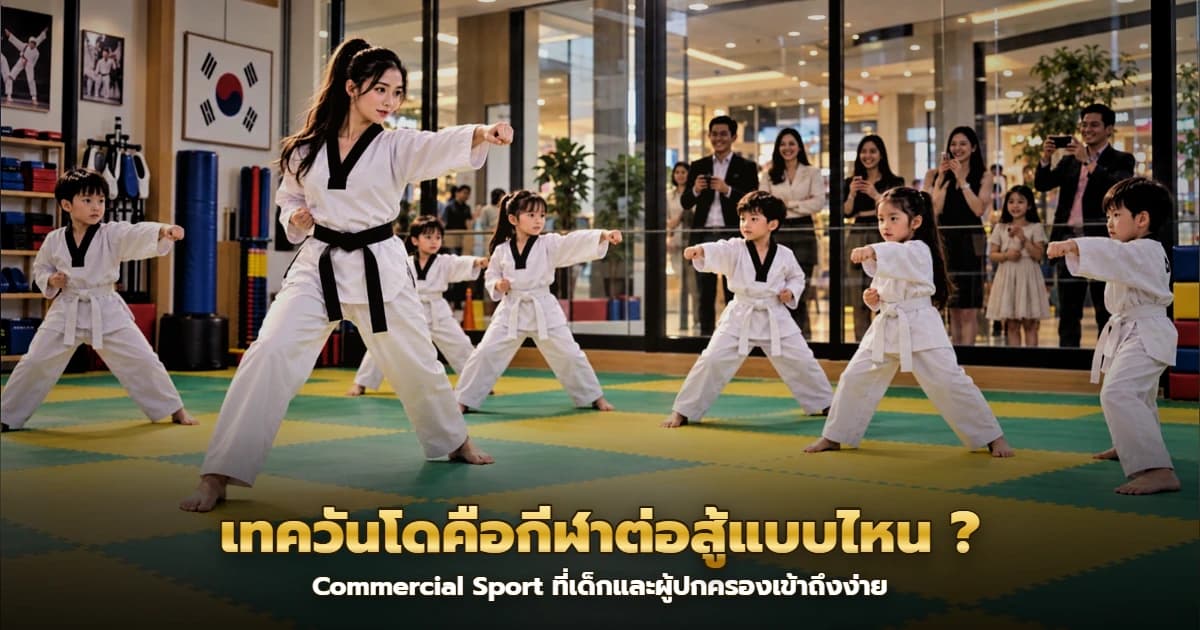
I said at the start that today's taekwondo is a commercial sport, a sport designed to keep schools running. There are convenient places to train in malls or air-conditioned schools, belt gradings that are not too hard and can be held often, children have fun, parents see regular progress, and instructors earn grading fees that keep the school going. I do not see that model as harmful, because it makes taekwondo for kids easier to start than many of the other martial arts I have trained in.
What I saw with my own eyes at competitions was a different matter. My eldest son, Khru Ken, loved taekwondo and trained for a while at the Sports Authority of Thailand. The instructors there taught well and focused on real fighting, not just pretty forms. What surprised me was a practice of holding back belts: building a child's skill while deliberately not letting them grade, so they stay in a division where they have the advantage in competition. I do not really agree with it, because it puts competition results ahead of the child's development. Today Khru Ken holds a 4th dan taekwondo black belt from Kukkiwon.
The problem I see more often is with parents. Taekwondo in Thailand has many competitions and a large number of athletes, and sometimes parents care more about winning than about sportsmanship or real self-defence skill. I have seen ringside crowds where parents cheered as if they wanted their child's opponent to fail or get hurt, which teaches children to win without thinking about the person in front of them, and more than once it turned into a confrontation between two sets of parents. That is part of the reason I gradually had all four of my children stop competing in taekwondo.
I want to be clear that this does not mean taekwondo has no value. Quality really depends on the instructor at each school, and you cannot generalise about the whole field. Many schools make children skilled and good sports at the same time. Parents looking for a school should watch a real class before deciding, and check whether the instructor treats discipline and etiquette as seriously as technique, rather than counting the trophies at the entrance. If you are still choosing between two arts, read Karate or Taekwondo: which should a child learn.
Taekwondo for Kids, Women and Adults, and How Many Belts There Are
The next question parents ask is what age a child can start. From what I have seen, many schools take taekwondo for kids from the last year of kindergarten, because basics like balance and light kicks need none of the impact of competition. A good instructor adjusts the load to young children's muscles and joints. Serious training for competition usually suits children a little older, who understand the rules and control their emotions better. There is no single age that fits every child.
As for taekwondo for women, I see it as a martial art that suits women very well, because it relies on speed and flexibility more than on force. The clearest example is Panipak Wongpattanakit, known as Tennis, the Thai taekwondo athlete who won Olympic gold at both Tokyo 2020 and Paris 2024, the first person from Thailand to win two. As for taekwondo for adults, I started after 40 myself and still enjoy it, with a clear gain in hip and ankle flexibility. You just need to warm up more than younger people and choose a load that suits your body rather than trying to beat anyone.
Another popular question is how many belts there are in taekwondo. Before black belt, most schools in Thailand use the taekwondo belt order white, yellow, green, blue, red, then black, and some add intermediate belts, because colour belts are set by each school or association. The meanings often given to the colours, such as white for a beginning and yellow for a seed taking root, are symbolism, not a rule. The black belt has 9 dan, and anyone who reaches black-belt level under the age of 15 receives a "Poom" from Kukkiwon instead of a dan, and 1st to 3rd Poom can be converted to dan from the age of 15. I think the system is psychologically sound, because children can see their progress, but it must not turn into a game of collecting colours with no attention to the quality of technique.
Conclusion
In my eyes, taekwondo is a martial art with deep history and remarkable body mechanics, and it has also been developed into a commercial sport that ordinary people can easily start. That is not wrong, as long as the instructor keeps up the quality of technique and discipline. Whether it is taekwondo for kids, for women or for adults, the real benefit lies in choosing an instructor who cares more about the learner's development than about competition results. If you are interested in another Korean martial art, read what hapkido is. And whatever you choose to train in, correct fundamentals and steady discipline will always take you further than the speed of your belt promotions.
Sources and further reading
- Taekkyeon, a traditional Korean martial art - UNESCO — UNESCOReferenceAccessed 28 Sept 2026
- General Choi Hong Hi - ITF — International Taekwon-Do FederationReferenceAccessed 28 Sept 2026
- Our history - International Taekwon-Do Federation — International Taekwon-Do FederationReferenceAccessed 28 Sept 2026
- History of Kukkiwon - Kukkiwon — KukkiwonReferenceAccessed 28 Sept 2026
- World Taekwondo and the Olympic Games - Olympedia — OlympediaReferenceAccessed 28 Sept 2026
- World Taekwondo Competition Rules and Interpretation (in force from 1 June 2026) — World TaekwondoReferenceAccessed 28 Sept 2026
- Panipak wins historic flyweight gold - Bangkok Post — Bangkok PostReferenceAccessed 28 Sept 2026
- Poom and Dan promotion regulations - Kukkiwon — KukkiwonReferenceAccessed 28 Sept 2026
Frequently Asked Questions
How is taekwondo different from karate?
Taekwondo uses the kick as its main weapon, and Olympic rules forbid punches to the head. The Shinkyokushin karate I train in uses both punches and kicks in full-contact fighting and emphasises physical toughness, while taekwondo emphasises speed and distance.
At what age can children start taekwondo?
Many schools take children from the last year of kindergarten, and a good instructor adjusts the load to young children's muscles and joints. Training for competition usually suits older children who already understand the rules. There is no single age that fits every child.
What are the benefits of taekwondo?
Besides self-defence skill and quick legs, taekwondo improves hip and ankle flexibility and trains discipline and emotional control through belt gradings and competition etiquette.
Why does taekwondo focus on kicks more than punches?
Legs are longer than arms and use larger muscles, so they create more power and reach, and World Taekwondo's rules score kicks at 2 to 6 points against 1 point for a punch, so athletes train their feet first.
How many belts are there in taekwondo before black belt?
Most schools in Thailand use white, yellow, green, blue, red, then black, and some add intermediate belts, because colour belts are set by each school. The black belt has 9 dan, and under-15s receive a Kukkiwon Poom instead of a dan.
Can adults still start taekwondo later in life?
Yes. I started after 40 myself and still enjoy it, with a clear gain in flexibility. You just need to warm up more than younger people and choose a load that suits your body.
Ready to start martial arts?
Message IMAC Dojo to ask which course fits your age, goals, and training background.
Ask on LINE Official