
Karma or Coincidence: A Buddhist View on the Kyokushin Master's Illness
A Kyokushin karate practitioner reflects on Mas Oyama's final illness and death through a Buddhist lens, examining the Godhand legend, the organizational split that followed, and the lessons applied at IMAC Dojo.
Short Answer
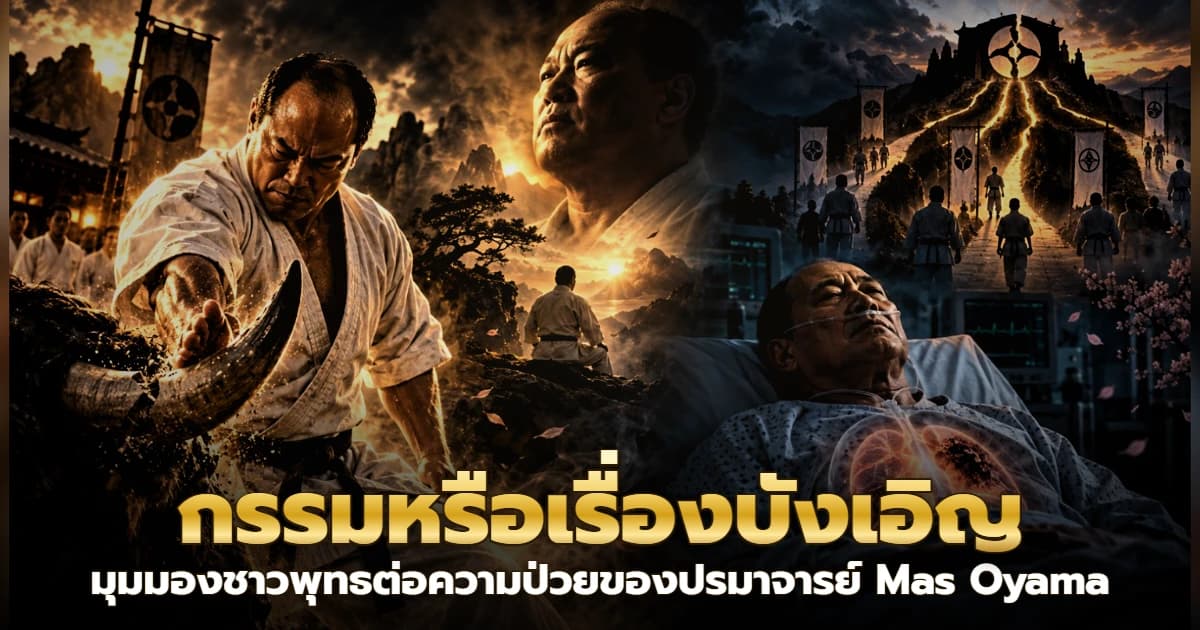
Mas Oyama died on April 26, 1994, of terminal lung cancer at the age of 70, having refused surgical treatment on the grounds that he was a samurai (サムライ — a warrior who upholds honor and discipline) who did not want a surgeon's blade to touch his body. From a Buddhist perspective, illness and death are natural aspects of the physical body (sankhara) that no one can escape, no matter how strong they may be. As for the legend that his illness was karma from killing bulls, this remains a story with no historical evidence confirming any connection to the cause of his sickness.
- Author
- Thaninpong Supapitakpong (Phoenix)
- Published
- Last updated
- Sources
- 0
- Reading time
- 11 min
Key Takeaways
- Mas Oyama died on April 26, 1994, of lung cancer at age 70, having refused surgery.
- The legend of fighting 52 bulls was part of what built the "Godhand" reputation for the Kyokushin school.
- Buddhism views illness as a natural part of the physical body (impermanence, or anicca), not necessarily always the result of past sins.
- After his death, the Kyokushin organization split into multiple lineages because no clear succession system had been put in place.
- The will and trademark disputes dragged on for more than 20 years, reaching intellectual property courts.
- The spirit of "Osu no Seishin" (押忍の精神 — the spirit of endurance and never giving up) still lives on in dojos around the world.
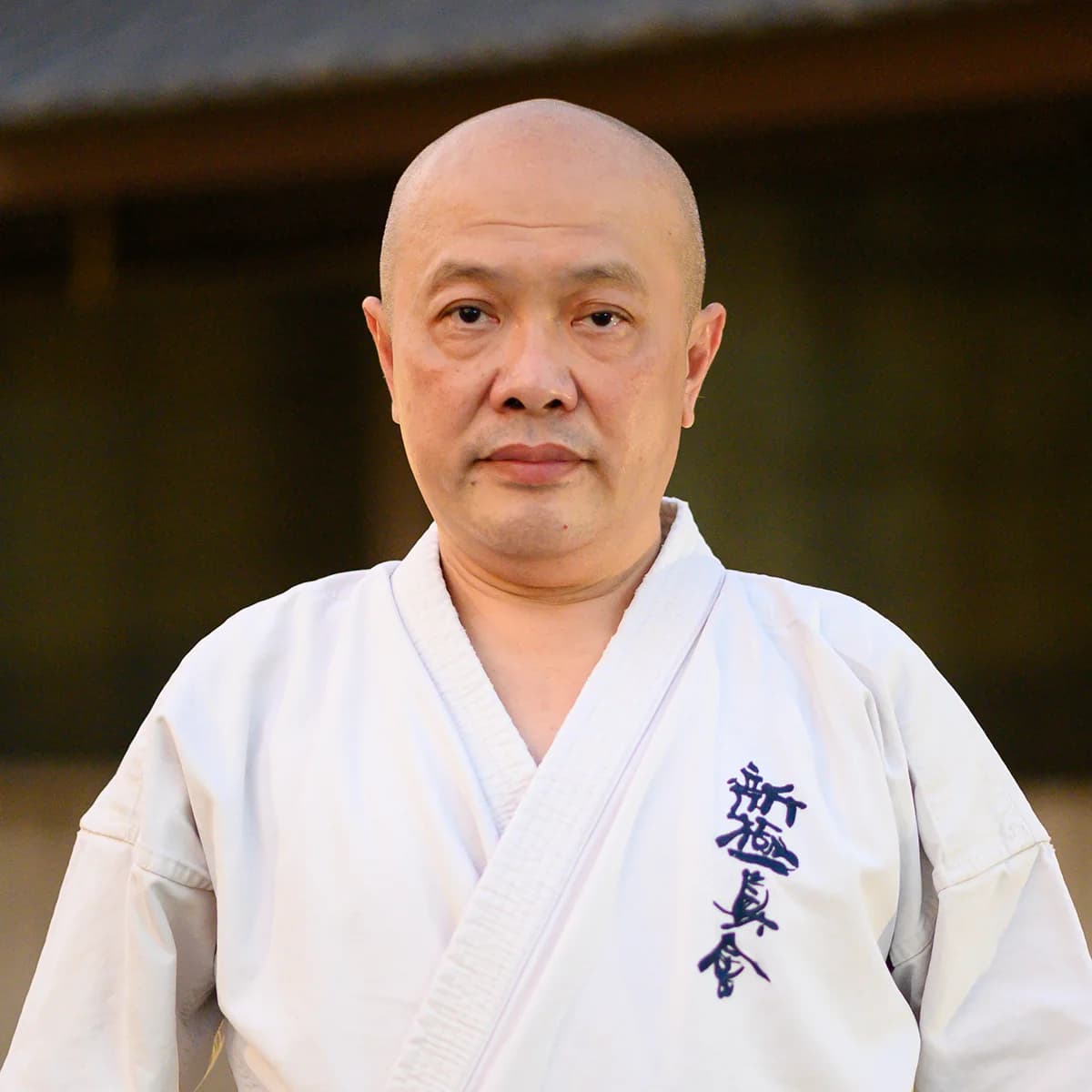
I am one of the people who have trained in Kyokushin karate (Kyokushin — the karate lineage known for full-contact, real-impact sparring) for many years, and I hold deep respect for Mas Oyama, the founder, as the master who laid the groundwork for all of us walking this path.
But something I have noticed is that people talk very little about the final chapter of his life, as if the legend stops at the image of an undefeated fighter, even though in reality he had to face lung cancer in his final years. This very fact is what makes many Thai people, who grew up with Buddhist beliefs, unable to resist asking whether this was karma or mere coincidence.
In this article
Who Was Mas Oyama, Before He Became the Godhand Legend
Before discussing his illness and passing, I want to invite you to go back to the beginning of this man's story. Mas Oyama's real name in Korean was 崔永宜 (Choi Yeong-eui), born in 1923 in North Jeolla Province, South Korea, at a time when it was still under Japanese rule. His family was reasonably well-off, but his father held strict Confucian views, which caused this young boy to grow up with feelings of both respect and rebellion simultaneously. He had a stutter since childhood and enjoyed reading biographies of warriors and generals, both Western figures such as Napoleon and Japanese figures such as Oda Nobunaga.
What I find interesting is that this very inner conflict shaped him into the iron-willed fighter he later became. He entered Japan illegally in the postwar period and officially received Japanese citizenship in 1968, using the name "Mas Oyama" from that point onward. As a Kyokushin karate instructor myself, I believe this period of his life teaches us many things, particularly the lesson that a person can transform inner turmoil into an unstoppable force for self-training.
The Bull-Fighting Legend and the Origin of the Godhand Nickname
When people speak of Mas Oyama, most probably think first of the bull-fighting legend. According to recorded accounts, he fought a total of 52 bulls throughout his life. Of these, 3 were killed instantly by a single bare-handed strike, while the other 49 had their horns cut or broken using the technique known as Shuto Uchi (a knife-hand strike), a fundamental technique we still practice in dojos today. These stories are the origin of the nickname "Godhand," which I have translated in this section's heading as "Hat Thewada" (Godhand), a symbol of superhuman power that stayed with him forever.
But as someone who has been immersed in the martial arts world for a long time, I want to invite a fairer, alternative view as well, because current research and records suggest that these stories are seen as part of a legend-building strategy to promote the school, and that most of the bulls of that era already came from slaughterhouses, not wild, ferocious bulls as many people imagine. I am not saying this to diminish his credibility, but I want students and readers alike to distinguish between legends that inspire and historical facts, both of which hold different value in their own context.
The Final Period of His Life: An Illness Rarely Discussed
According to in-depth information I have read, he had a habit of undergoing an annual health checkup at St. Luke's International Hospital (聖路加国際病院) in Tokyo every March, but in 1994, flu-like symptoms that lingered forced him to be admitted on March 17, and detailed test results on March 23 revealed terminal lung cancer. The hospital offered the option of surgery, but he refused firmly, saying the line everyone remembers well: "I am a samurai. I don't want to live with a surgeon's blade touching my body."
What impresses me most as a karate practitioner is that he faced the severe pain of terminal cancer without using any painkillers whatsoever, and he never became bedridden to the point of needing help with basic bodily functions. He once said, "I am a martial artist. I cannot die on a tatami mat. If possible, I would rather die while training in the dojo." The last night of his life was April 25; after receiving saline solution at nine in the evening, his condition deteriorated rapidly, and he passed away on the morning of April 26 at eight o'clock, from respiratory failure caused by lung cancer. The lawyer who was present described the scene as "like a great tree slowly falling."
Rumors and Conspiracy Theories in the Karate World
What is interesting is that even though the official cause of death is clearly lung cancer, the karate world has been full of rumors reflecting people's reluctance to believe that such a strong man could be defeated by an ordinary illness. Some believe it was the result of secondhand smoke in the dojo, since he himself was not a heavy smoker. Others link it to asbestos toxins present in buildings of that era, and the most extreme theory claims he was poisoned by a rival school. I see these rumors as reflecting a human psychological mechanism that does not want to accept that a legendary hero must also die from the same biological limitations as any ordinary person.
How Buddhist Karma Views Illness
This is the heart of the article that I really want to discuss. As a Thai person who follows Buddhism, many people, upon seeing that this master who fought bulls throughout his life later became ill with lung cancer in his final years, tend to link it to sin and karma from committing panatipata (the killing of living beings), viewing it as the reason he had to bear the karmic consequences of both his illness and the later organizational split. I understand this feeling well, having grown up in a society that connects moral cause and effect with every story in life, but as someone who has tried to study both dharma and the martial way side by side, I want to invite a deeper look at this.
The fundamental Buddhist teaching of the three characteristics of existence — anicca (impermanence), dukkha (suffering), and anatta (non-self) — teaches clearly that all physical bodies, whether of an ordinary person or the greatest master, are equally subject to the law of decay. Illness is therefore not a mark exclusive to those who have sinned, but a natural condition every life must face, no matter how much one has trained one's body to be strong. I once heard a monk explain that karma comes in many types and produces results at different times: some ripen instantly, some ripen in a future life, and some are simply the result of purely physical causes and conditions, such as genetics, environment, or lifestyle behavior. To declare definitively that a particular illness is the result of one specific karmic act is something the Buddha himself did not encourage, as it falls under what is called acinteyya (matters that should not be pondered excessively).
What I consider more important than judging whether it was karma or not is looking at how Mas Oyama responded to his illness. He did not wail or deny reality, but faced it with the same mindfulness and discipline he had trained throughout his entire life. This, I believe, is closer to Buddhist teaching than any talk of sin and karma — namely, the acceptance of the truth of the physical body with a calm mind, neither struggling to flee from death nor surrendering to pain to the point of losing one's human dignity. I see this as a lesson far more profound than the question of who committed what karmic act.
The Organization's Karma: Division After the Master's Passing
Another issue people often link to karma is the fact that the Kyokushin organization split into multiple lineages after his death. Some see this as karma resulting from his having wielded absolute authority in managing the organization throughout his life. But from my perspective, having studied martial arts organizational structures reasonably closely, I believe this can be explained more by structural reasons than by any karmic retribution.
He never registered the organization as a modern legal entity in a systematic way; all authority was tied to his personal charisma alone. Without a clear, written succession plan accepted by all parties, his final will, which named a successor, was ruled invalid by a Japanese court in 1997 due to the lack of his own signature and doubts about the process by which it was drafted. The result was a trademark lawsuit that dragged on for more than two decades, with the intellectual property court repeatedly ruling that monopolizing the trademark by any one party constituted bad-faith use of rights.
I see this not as some mysterious karmic retribution, but as a straightforward lesson about management that lacked careful foresight, something that all of us who work in teaching martial arts should pay attention to, whether running a small dojo or a large global organization. Building a clear and transparent system is just as important as training one's skills.
Lessons from the Godhand Legend That I Apply in Teaching
As the founder of IMAC Dojo, I often share Mas Oyama's story with my students, not to glorify some superhuman prowess, but to point out that even a legendary master had to face the limitations of the physical body just like ordinary people. What I try to instill in every class, whether for children, adults, office workers who sit for long hours, or older adults, is training with an understanding of one's own body's potential, not forcing oneself beyond one's limits to prove something.
He taught us the importance of discipline and endurance, but I believe we must also learn from the final period of his life — namely, the importance of long-term health care, regular medical checkups, and knowing how to listen to warning signals from one's own body, rather than training so hard that we ignore those signals entirely. This is the approach I have held to throughout in designing the dojo's curriculum, both for Shinkyokushin Karate, which welcomes students from age 7 to 60, and Judo Thailand, which can be started from age 8 and up, without requiring prior experience or professional athletic background. Because what I believe, from studying Mas Oyama's life, is that true strength is not measured by who trains the hardest, but by who trains with the most mindfulness and awareness of their own limits. I therefore try to teach every student, whether young or old, to understand that good martial arts training must come together with an understanding of one's own body, not with recklessly overcoming it.
Conclusion
Looking back at the whole of Mas Oyama's life, from a childhood full of inner conflict, through the Godhand legend that built worldwide fame, to the final period of his life when he faced lung cancer with calm and dignity, I believe the question of whether this was karma or coincidence may not be the most important question at all. What matters more is that he taught us to see that every human being, no matter how strong, must equally face the impermanence of the physical body. As a martial arts instructor, I choose to embrace the inspiring aspects of this legend, while also learning the lesson of careful stewardship, both of the body and of an organization, in order to pass on a safe and sustainable path of training to every student at IMAC Dojo going forward.
Frequently Asked Questions
What illness did Mas Oyama die of, and when?
He died of terminal lung cancer on April 26, 1994, at the age of 70, after his condition was discovered on March 23 of that same year.
Why did Mas Oyama refuse surgical treatment for his cancer?
He explained that he was a samurai who did not want a surgeon's blade to touch his body, and so he chose to face his illness with mindfulness rather than modern medical treatment.
Is the legend of Mas Oyama fighting bulls entirely true?
There are records confirming he really did fight 52 bulls, but some details are seen as part of a strategy to build the school's reputation, and most of the bulls came from slaughterhouses, not wild, ferocious bulls as commonly understood.
Does Buddhism always view illness as the result of karma?
Not necessarily. The teaching of the three characteristics of existence holds that illness is a natural aspect of the impermanent physical body, and the Buddha classified the definitive attribution of specific karmic causes as belonging to the category of acinteyya, matters that should not be pondered excessively.
Why did the Kyokushin organization split apart after Mas Oyama's death?
Because he never established a clear, written succession system. His final will was ruled invalid by the court, leading to a trademark lawsuit that dragged on for more than 20 years.
How does Mas Oyama's story relate to the teaching approach at IMAC Dojo?
I apply the lessons of discipline, endurance, and listening to one's body in designing the curriculum, so that practitioners of all ages at [Shinkyokushin Karate](/en/courses/karate) and [Judo Thailand](/en/courses/judo) can train safely according to their own potential.
Ready to start martial arts?
Message IMAC Dojo to ask which course fits your age, goals, and training background.
Ask on LINE Official