Jujitsu vs BJJ: What's the Difference? A Watcher's View of How Both Arts Grew
A historical account of how ancient Japanese jujitsu split into Kodokan judo and Brazilian Jiu-Jitsu, tracing Kosen Judo's parallel triangle-choke discovery and BJJ's return to Japan through Yuki Nakai, before comparing BJJ with modern sport Ju-Jitsu.
By
 Thaninpong Supapitakpong (Phoenix)Founder and instructor at IMAC Dojo
Updated 22 Sept 2026
- Author
- Thaninpong Supapitakpong (Phoenix)
- Published
- Last updated
- Sources
- 5
- Reading time
- 12 min
Short Answer
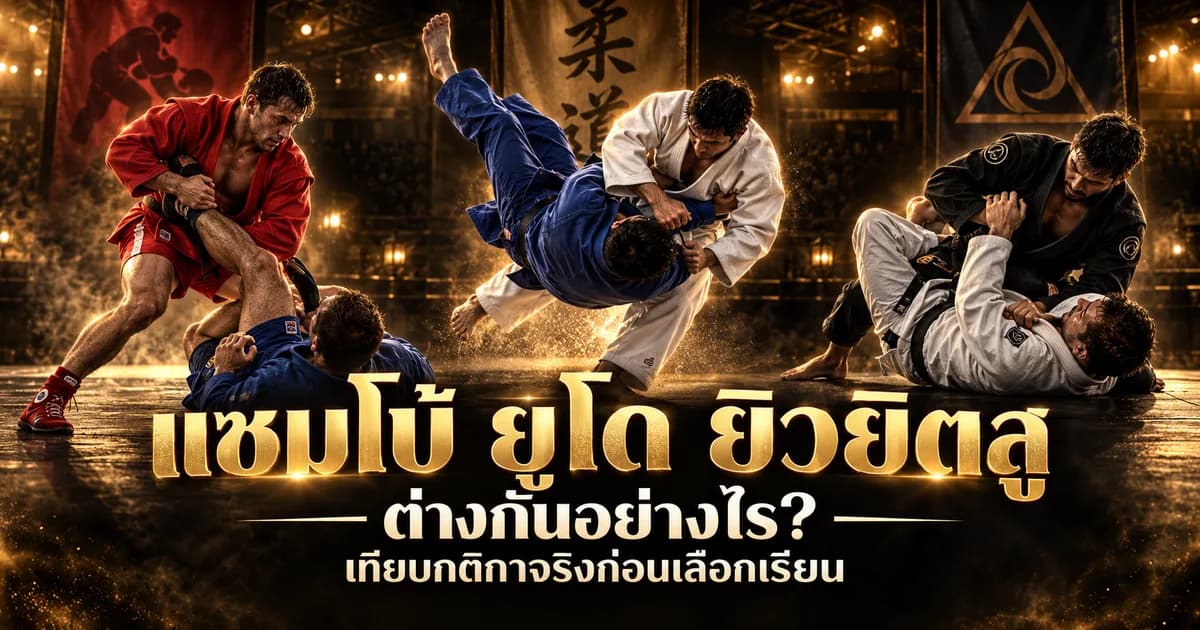
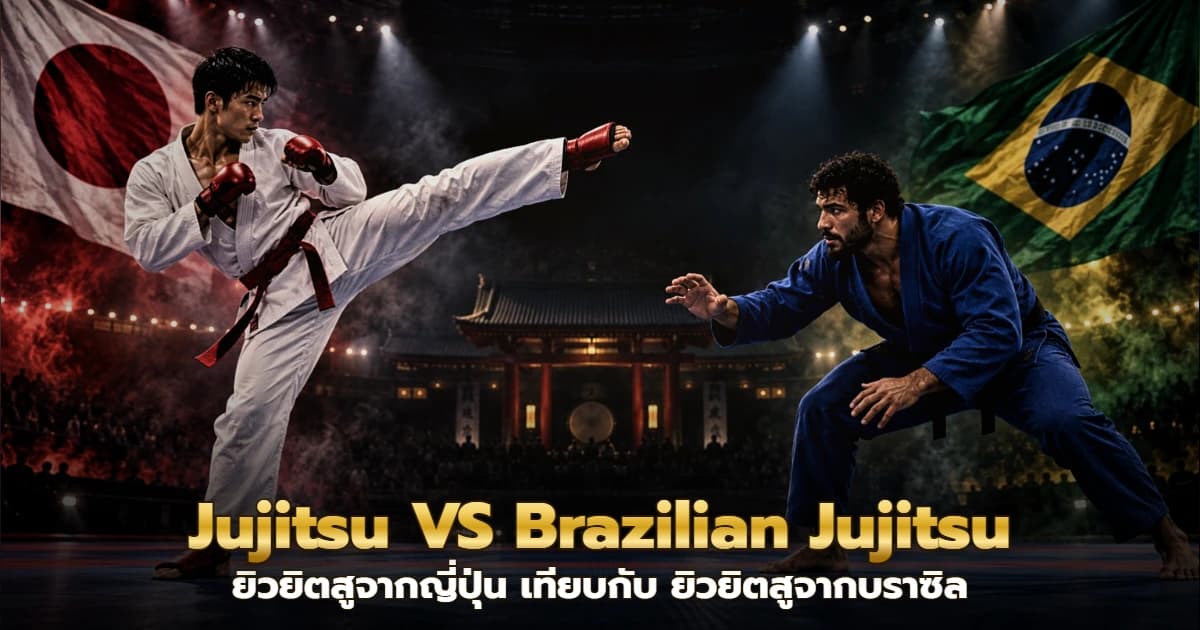
To put it as clearly as possible, 柔術 (jujitsu — an ancient Japanese unarmed combat art) and Brazilian Jiu-Jitsu, or BJJ, share the same root but evolved down separate paths. Traditional Japanese jujitsu was designed for war and for facing multiple armed opponents at once, so it emphasises standing combat, throws, joint locks, and lethal finishes. BJJ, on the other hand, was refined out of Kodokan judo through Mitsuyo Maeda and then developed in Brazil until it became the deepest ground-fighting system in the world. If you want to know which one suits you, the answer depends on whether you want the versatility of modern sport Ju-Jitsu or the specialised depth of BJJ.
Key Takeaways
- 竹内流 (Takenouchi-ryu — Japan's oldest recorded jujitsu school) was founded in 1532 for use on the battlefield while wearing armour.
- Mitsuyo Maeda, a Japanese Kodokan judoka, was the one who carried the art to the Gracie family in Brazil — not the other way around, as many people mistakenly believe.
- 高専柔道 (Kosen Judo — the judo of Japan's preparatory high schools) developed a parallel triangle choke independently, with no knowledge of what was happening in Brazil.
- Yuki Nakai, a fighter who lost sight in his right eye during a bout at VTJ 1995, was the one who systematically brought BJJ back into Japan.
- A BJJ black belt takes at least 31 years of cumulative time to earn under IBJJF/JBJJF standards, while judo takes roughly 1–2 years.
- Modern sport Ju-Jitsu (the Ju-Jitsu Fighting System) combines all three fighting ranges into a single ruleset, unlike BJJ, which focuses purely on the ground.
Every time someone asks me how Jujitsu and BJJ differ, I tend to smile before answering, because the question looks simple but actually hides a story spanning more than four hundred years. As someone who has been immersed in many martial arts throughout my life, I see this misunderstanding come up constantly, both among parents choosing a class for their children and among athletes who want to know what to train next.
In this article
The Roots of Ancient Japanese 柔術, Before It Branched into Judo and BJJ
Going back to the Sengoku era (Japan's period of civil war), heavily armoured warriors fought at close range. Striking with the fists had almost no effect, because armour absorbed the impact well. What actually worked was unbalancing the opponent to make them fall, then driving a short blade through the gaps in the armour — at the neck, the armpit, or the groin. This is the origin of 組討 (kumiuchi — close-quarters grappling while wearing armour) and 小具足 (kogusoku — a set of close-range combat techniques using a short blade), which form the root of every school of jujitsu.
The oldest school with confirmed records is 竹内流 (Takenouchi-ryu), founded in 1532 by Takenouchi Nakatsukasa-no-Taifu Hisamori. Legend says he fasted and performed austerities for six days and six nights before receiving the art from a transformed deity, and from there developed a set of techniques known as the "twenty-five methods of body turning (koshi-mawari)" and the "five methods of arrest," which covered joint locks, short-blade use, and binding an opponent with rope. I think this point matters a great deal, because it shows that jujitsu was never a "sport" from the start — it was a survival system (source: research on Japanese jujitsu history).
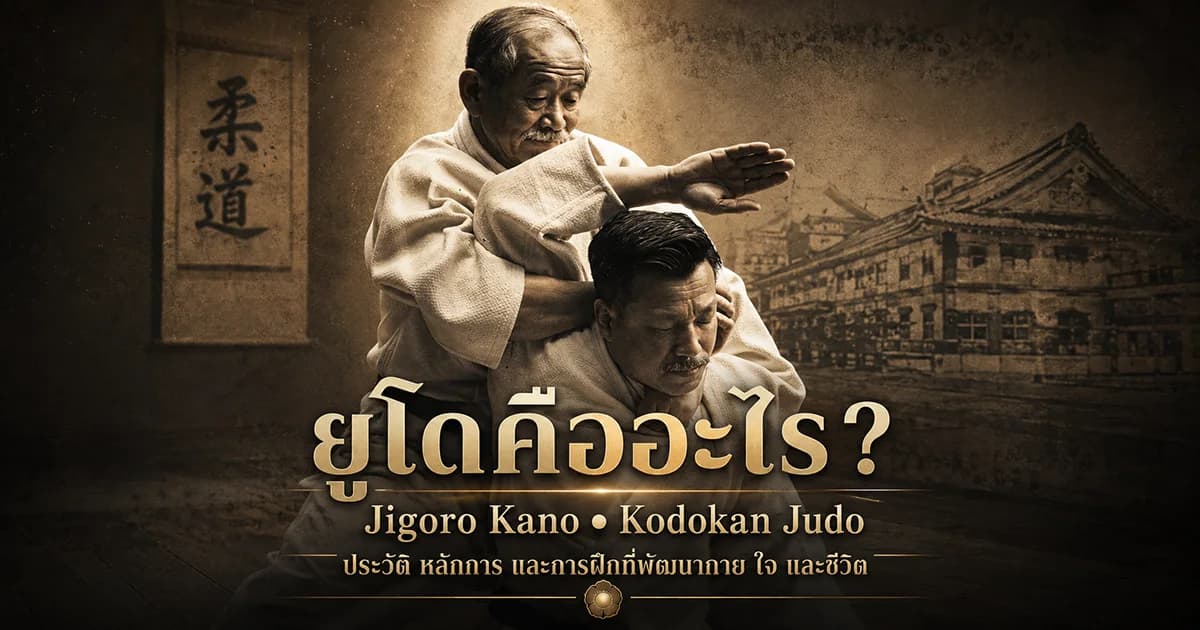
Once the Edo period arrived and the country settled into peace, samurai traded their armour for ordinary clothing, and the battlefield moved from open fields into reception rooms and city streets. Jujitsu had to adapt into a "jujitsu suited to ordinary clothing," giving rise to major schools such as 天神真楊流 (Tenjin Shin'yo-ryu), which blended striking vital points, throws, chokes, and joint locks, and 起倒流 (Kito-ryu), which emphasised throwing techniques that relied on gravity and angular momentum. It was these two schools that Master Jigoro Kano later synthesised into Kodokan judo in 1882. I've often explained to my students that Kano didn't invent an entirely new set of moves — he screened the old techniques to make them safe enough to practise for real without anyone dying. That is the kind of intelligence that has kept judo alive to this day.
The Path of Brazilian Jiu-Jitsu, From the Kodokan to Brazil
The story most often told incorrectly is about who actually brought 柔術 to Brazil. Many people assume Brazilians travelled to Japan to learn it, but the truth is the opposite. The one who carried the art there was 前田光世 (Maeda Mitsuyo — a Japanese Kodokan judoka), who earned the nickname "Conde Koma" while fighting professionally abroad. Maeda trained judo at the Kodokan until he reached fourth dan, then set out on Master Kano's orders to spread judo across the world starting in 1904.
What amazes me most is that Maeda didn't just teach techniques inside a dojo — he had to step into the ring against wrestlers and Western boxers far bigger than himself, in matches with almost no rules protecting him. Through hundreds of these fights he distilled a theory: "control the distance, wait for the moment to close in, throw the opponent to the ground to cut off their striking power, then finish with a joint lock or a choke." This later became the prototype for mixed martial arts. In 1916, Maeda settled in the city of Belém in northern Brazil and became friends with Gastão Gracie, an influential local figure, who then entrusted him to train his eldest son, Carlos Gracie, who was only 14 or 15 years old at the time (source: Cardiff University Press).
The most important turning point was Carlos's youngest brother, Hélio Gracie, who was small and physically weak and unable to rely on standing throws that required real power. Hélio stripped away the techniques that demanded strength and built an entirely new system in which he stayed on the bottom and used his legs to control his opponent — what came to be called the "guard" — letting the other person exhaust themselves before finishing with a joint lock or a choke using leverage. This is the true birthplace of BJJ. In my view, this wasn't simply repeating judo's newaza (ground fighting) — it was inventing an entirely new system out of physical limitation, which is genuinely remarkable.
Parallel Evolution: 高専柔道 and the Triangle Choke That Emerged Without Either Side Knowing the Other Existed
One of the stories I most enjoy telling my students is that, while Hélio Gracie was developing the guard in Brazil, a group of preparatory high school students in Japan was developing a strikingly similar system without any knowledge of each other at all. This was 高専柔道 (Kosen Judo), which began as a competition between the first and second preparatory high schools starting in 1898. Kosen rules allowed a competitor to pull their opponent to the ground without penalty, and there was no scoring by points — only "ippon" (an outright win) or a draw, unlike Kodokan judo, which treated deliberately pulling an opponent to the ground as forbidden.
As a result of this rule, students who were small or not suited to standing techniques turned seriously toward developing ground techniques. By 1921–1922, the "triangle choke" technique emerged at the sixth preparatory high school, credited to Hayakawa Masaru and ninth-dan instructor Kanemitsu Yaihei, who named the technique 松葉固 (Matsubagatame). Meanwhile, a group of students in Tokyo called the same technique 三角緘 (Sankaku-garami — triangle strangle). I see this as the most beautiful piece of evidence for "parallel evolution," because no one copied anyone. A group of Japanese students training under rules that allowed pulling an opponent down discovered the exact same solution that Hélio Gracie discovered on the other side of the world: using both legs to lock the opponent's neck and arm into a triangle shape, cutting off blood flow to the brain without relying on strength at all. Later, in 1937, Kimura Masahiko, a student at Takushoku University, further developed the "side triangle," making Kosen Judo a repository of ground techniques every bit as deep as the Brazilian lineage. What kept the two paths from ever meeting at the time was simply distance and an era that lacked international communication.
The Turning Point That Brought BJJ Back to Japan, Through a Ring With No Rules to Protect the Fighters
There's one event I tell my students about with a particularly serious tone, and that's what happened in 1995, because it marks the moment BJJ fully returned to its country of origin. That year saw the staging of VTJ (Vale Tudo Japan — a no-holds-barred fighting event held in Japan), which invited Hickson Gracie, Hélio's third son, whose legend held that he had never lost in four hundred fights, to face off against the strongest Japanese fighters of that era.
The most significant fighter on the Japanese side was Yuki Nakai, a former judoka from Hokkaido University who had trained in 七帝柔道 (Shichitei Judo — the judo of Japan's seven leading universities, which carries on the rules of Kosen Judo). In the first round, Nakai faced Gerard Gordeau, a much larger fighter who kicked and gouged his eye, leaving Nakai permanently blind in his right eye. But with sheer force of will, Nakai kept fighting and broke his opponent's ankle to turn the match around and win, even while seeing only half of the world in front of him. Although Nakai ultimately lost to Hickson in the final by a choke, his endurance inspired the entire country of Japan to take BJJ seriously. I think that if that night had never happened, BJJ might not have become popular in Japan nearly as quickly as it did.
After retiring from professional fighting because one eye had gone completely blind, Yuki Nakai devoted his time to training BJJ systematically until he earned his black belt, and then opened his own dojo called Paraestra Tokyo in 1997, while also taking on the role of president of the Japanese Brazilian Jiu-Jitsu Federation (JBJJF), organising a belt and competition system to the same standard as other countries. I see Nakai's story as an important lesson, because it shows that the strength of a martial art doesn't lie in any single killer technique alone, but in the spirit of the person training, who refuses to give up no matter how disadvantaged their body may be.
Comparing the Technical Structure of Ancient Jujitsu, Kosen Judo, and BJJ
To make this clearer, let me summarise it in a table comparing three systems that share the same root but arrived at entirely different destinations.
| Point of Comparison | Ancient Japanese Jujitsu | Kosen Judo | BJJ |
|---|---|---|---|
| Environment it was designed for | Battlefield, wearing armour, multiple opponents | School competition arena, one-on-one | Ring or competition mat, one-on-one |
| Strikes and kicks | Present as part of the system | Not present in competition | Not present in general competition rules |
| Deliberately pulling opponent to the ground | Avoided, due to risk of being stabbed by another opponent | Fully allowed, not considered a disadvantage | Allowed, and a core strategy |
| How a match ends | Killing or restraining with rope | Ippon only, no scoring by points | Cumulative points by position, or ippon |
From this table, I want to point out that the real difference isn't about "which technique is stronger," but about "what problem the system was built to solve." Ancient jujitsu solved the problem of war. Kosen Judo solved the problem of team-based competition within schools. BJJ solved the problem of overcoming a larger opponent through leverage alone. Once you understand the problem each system was built to solve, the question of how Jujitsu and BJJ differ becomes much easier to answer.
Modern Sport Ju-Jitsu in Thailand, and Finding the Right Approach for Yourself
Within the context of Thailand itself, I see modern sport Ju-Jitsu growing in a clearly defined direction, particularly through a group of instructors with a solid judo foundation from government agencies who have pushed to establish associations and competition platforms at both youth and adult levels, with more of these appearing every year. The sport I'm referring to is known internationally as the Ju-Jitsu Fighting System, organised by the JJIF (Ju-Jitsu International Federation). This competition format combines three ranges into a single ruleset: a controlled striking phase, a throwing phase, and a ground-fighting phase using pins and joint locks. It therefore differs from BJJ, which focuses purely on the ground with no striking or kicking at all throughout the match. I see the strength of modern sport Ju-Jitsu as training practitioners to feel comfortable in every range of combat, which suits people who want a well-rounded foundation rather than deep specialisation in just one direction (JJIF Fighting System rules).
But from another angle, I also want to caution every parent and practitioner that training too broadly without depth in any one direction can leave your skills too thin to apply for real. If anyone asks me directly whether they should choose modern sport Ju-Jitsu or BJJ, I always ask back what their goal is first. If you want fun, variety, and a competition format that covers every range, modern sport Ju-Jitsu answers that well. But if you want to become a genuine expert in ground fighting, to the point of being able to control an opponent much larger than yourself through leverage, BJJ goes far deeper into the details of position and guard.
For adults who have spent the whole day sitting at a desk and want something to train both mind and body, I usually suggest looking into both paths and experiencing them firsthand before deciding, because both modern sport Ju-Jitsu and BJJ each have strengths that answer different needs — neither one is categorically better than the other. The most important thing, in my opinion, is finding an instructor who teaches the fundamentals correctly and safely, and who understands that every student has different physical potential.
Conclusion
Coming back to the question posed at the very start — how Jujitsu and BJJ differ — I think the most honest answer is that both share the same root in ancient Japanese jujitsu, but travelled through entirely different historical, social, and physical contexts for the people involved, until they became systems that clearly answer different needs. What I want to leave readers with is this: no single martial art is "the best" in isolation — there is only the art that fits the goals, the body, and the mindset of the practitioner at that particular point in time. And just as important as choosing the discipline is choosing a dojo and an instructor who put correct fundamentals and student safety first. I hope everything I've shared here helps readers understand both arts more deeply, and gives you the confidence to choose the path that's right for you.
Sources and further reading
- Research on Japanese Jujitsu History — Cardiff University PressPrimaryAccessed 22 Sept 2026
- The Fighting System — JJIF (Ju-Jitsu International Federation)PrimaryAccessed 22 Sept 2026
- Brazilian Jiu-Jitsu — WikipediaCommunityAccessed 22 Sept 2026
- Jujutsu — WikipediaCommunityAccessed 22 Sept 2026
- Mixed Martial Arts — WikipediaCommunityAccessed 22 Sept 2026
Frequently Asked Questions
Which is better, Jujitsu or BJJ?
There is no absolute answer as to which one is better — it depends on the practitioner's goal. If you want variety across every range of combat, modern sport Ju-Jitsu answers that well. But if you want deep expertise on the ground, BJJ will give you far more detail.
What's the difference between Japanese jujitsu and Brazilian jiu-jitsu?
Traditional Japanese jujitsu was designed for war and for facing multiple opponents while wearing armour, so it emphasises standing combat and avoids going to the ground. BJJ, on the other hand, developed out of Hélio Gracie's physical limitations until it became a system specialised specifically in ground fighting.
Why does BJJ prefer fighting on the ground?
Because BJJ was designed to let a smaller person defeat a larger one through leverage. Fighting on the ground requires less strength than standing and stri king, and it lets you control your opponent far more effectively.
Who brought 柔術 to Brazil?
Mitsuyo Maeda, a Japanese Kodokan judoka, was the one who travelled to Brazil and passed the art on to the Gracie family — not a Brazilian who travelled to Japan to learn it, as many people mistakenly believe.
Should a child study jiu-jitsu or karate?
Both disciplines offer different benefits. Karate emphasises discipline, standing posture, and body control, starting from age 7 and up. Jiu-jitsu emphasises body control and the use of leverage. Parents should consider the child's personality and interests as the main factors.
How should someone start learning BJJ or jiu-jitsu in Bangkok?
Beginners should look for a dojo that teaches the fundamentals correctly, has instructors with clear expertise, and trains according to each person's own potential. Anyone interested can find the class schedule and pricing details on the [schedule and pricing page](/en/schedule-pricing).
Ready to start martial arts?
Message IMAC Dojo to ask which course fits your age, goals, and training background.
Ask on LINE Official