Choosing a Karate Gym That Warms Up the Body According to Sports Science
A Shinkyokushin Karate black belt explains the sports-science principles behind a proper warm-up, covering dynamic versus static stretching, hip and knee mechanics, the dangers of forcing a full split, and breathing techniques, with criteria for choosing a karate gym that applies them correctly.
By
 Thaninpong Supapitakpong (Phoenix)Founder and instructor at IMAC Dojo
Updated 15 Sept 2026
- Author
- Thaninpong Supapitakpong (Phoenix)
- Published
- Last updated
- Sources
- 5
- Reading time
- 12 min
Short Answer
A good karate gym must separate stretching into two types and apply each at the right time: Dynamic Stretching before training to activate the nervous system and muscles, and Static Stretching after training to release tension in the muscle. This principle is grounded in the mechanics of muscle spindles and Golgi tendon organs within neurophysiology, which is why holding a stretch for longer than 20-30 seconds before training can actually reduce kicking power instead of increasing it.
Key Takeaways
- Dynamic Stretching before training activates the muscle spindles, while Static Stretching is suited only to the cool-down period.
- Holding a stretch for more than 20-30 seconds before intense training stimulates the Golgi Tendon Organ, causing the muscle to relax and lose explosive power.
- Students should arrive at the dojo at least 30 minutes before class to stretch and warm up properly.
- Forcing the body into a full split with the traditional Mata-wari technique (a technique that forces the legs into a 180-degree split) carries significant risk to the hip joint's cartilage.
- Kokyu-ho breathing (the science of breath control) helps make stretching safer and more effective.
- A good karate gym should keep its warm-up programme to no more than 15-20 minutes, moving from the core of the body outward to the extremities (arms, legs, hands and fingers).
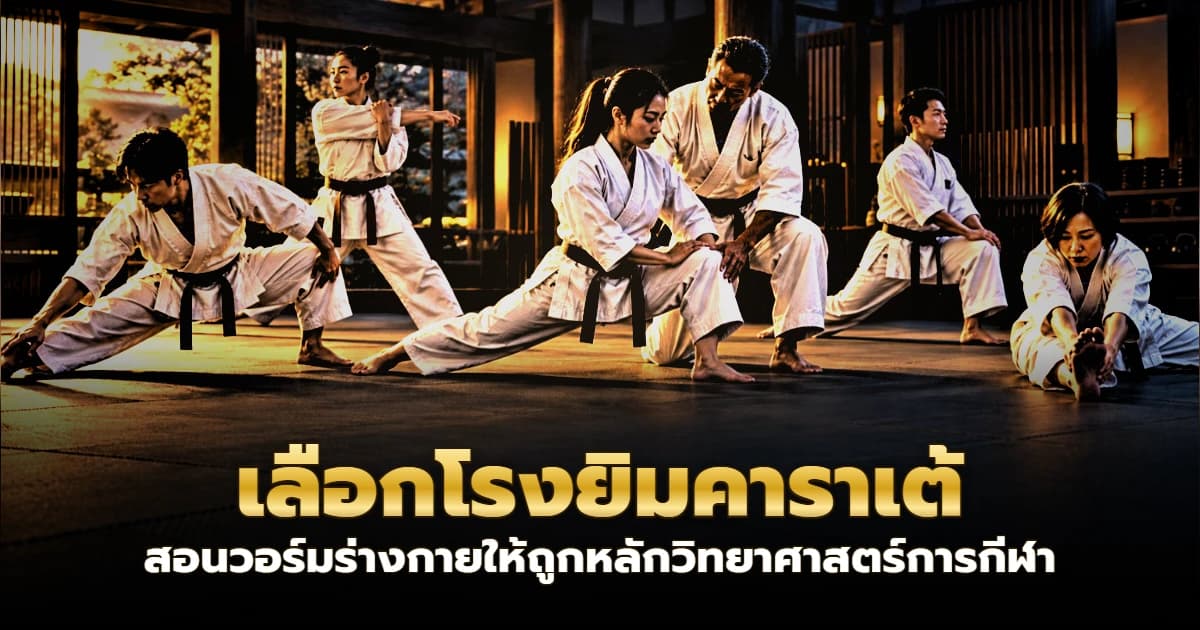
Many people see warming up as just a ritual before class starts. But for me, choosing a karate gym that warms up the body according to the science of sport is what determines whether a student can train safely and actually progress. Karate is full of high kicks, sudden hip rotations, and explosive bursts of power in split seconds. If the muscles and joints are not ready, the risk of injury rises immediately. As someone who holds a 2nd dan black belt in Shinkyokushinkai Karate (a full-contact style of karate that emphasises real sparring) and who has trained in Full Contact Karate (karate practiced with genuine full-power contact) for many years, I have seen a clear difference between dojos that treat systematic muscle stretching seriously and those that let students jump straight into practice.
In this article
Why the Order of Stretching Matters More Than You Think
I have met many students who mistakenly believe that holding a stretch longer is always better, when in reality the body has a far more complex self-protective mechanism than that. Research in neurophysiology explains that within muscles there are two main types of receptors: muscle spindles, which detect the speed and length of a stretch, and Golgi Tendon Organs (GTO), located at the muscle tendons, which detect accumulated tension. When a muscle is stretched too quickly, when a muscle is stretched too quickly, the sensors within it automatically trigger the muscle to contract and resist immediately — the Stretch Reflex — in order to prevent the muscle from tearing.
By contrast, if a stretch is held for longer than 20-30 seconds, the GTO triggers a mechanism called Autogenic Inhibition (the inhibition of the muscle's own contraction), causing the muscle to relax and give in to the stretch. This is the clear scientific reason why holding a stretch before intense training or before competition is a risk — it over-stimulates the parasympathetic nervous system, causing a significant drop in kicking speed and explosive power. From my own experience during my Aikido training days, I would often arrive at the dojo an hour before class to stretch gradually rather than forcing my body into held stretches, and the result was a genuine increase in flexibility without injury.
The Stretch-Shortening Cycle Behind Powerful Kicks
High-speed kicking techniques in karate rely on a biomechanical principle called the Stretch-Shortening Cycle (SSC — the cycle of muscle stretching and shortening), which is comparable to pulling back a slingshot before releasing it. This cycle has three phases: the stretching phase under resistance, a brief transition phase, and the shortening phase that releases power. When a student lowers their centre of gravity before a jumping kick, or pulls the hips and shoulders backward before throwing a straight punch, that is a direct application of the SSC.
Dynamic stretching before training helps raise muscle temperature, reducing the viscosity of elastin and collagen fibres, which allows the muscle to enter the stretch phase faster and deeper without injury. I always notice with students at IMAC Dojo that those who warm up correctly open their hips better and are able to kick noticeably higher within just a few weeks. This is not only about safety — it is a key factor that allows skills to develop faster and lets the body reach its full potential.
The Anatomy of a Kick: The Iliopsoas Muscle and a Locked Hip
One of the most important muscles in a karate kick is the Iliopsoas (a deep muscle connecting the lumbar spine to the femur), which is responsible for flexing the hip joint at the moment the knee is raised in preparation for a kick, whether a high kick or a roundhouse. If this muscle is chronically tight from long periods of sitting — a common problem for the many office workers who come to train with me — the student will not be able to raise the knee high enough quickly enough, and the speed and power of the kicking technique will decrease as a result.
An even more complex issue is the Lack of Pelvic-Hip Dissociation, a condition where the pelvis and hip joint cannot move independently of each other, which often arises from tight hamstrings pulling the pelvis into a posterior tilt. I always emphasise to my students that stretching the front of the thigh and training the pelvis to sit in a neutral position is the first foundation that a dojo must teach, because when the hip can move freely without pulling on the lower back, kicks become fluid and powerful without needing to be forced.
The Standing Leg and Knee Risk in the Roundhouse Kick
The technique known as the cutting kick or roundhouse kick — familiar to us in training as Mawashi-geri (a kick that travels in an arc from the side) — requires external rotation of the standing leg planted on the ground. If the muscle group responsible for external hip rotation is not flexible enough, the standing leg will fail to rotate along with the movement, and the torque generated by the torso will be transferred directly into the knee joint instead of passing through the hip. This is a primary mechanism behind anterior cruciate ligament tears in many combat-sport athletes. I therefore always tell the parents of children training at IMAC Dojo that stretching the muscles around the hip is not a trivial matter — it is protection against long-term injury that could stay with someone for the rest of their life.
The Dangers of Forcing a Traditional Full Split
In traditional Japanese karate schools there is a technique called 股割り (Mata-wari — forcing the legs apart to 180 degrees and folding the torso down flat against the floor), which is often performed with a training partner applying pressure to the back. Although the intention is to increase flexibility in the groin muscles and hamstrings, if the pelvis has not first been set into a neutral position, the neck of the femur will be squeezed against the rim of the hip socket, and the pressure applied by the training partner will crush the cartilage structures, the labrum, and the lumbar spine, leading to serious injury ranging from muscle pain to a herniated disc. I generally do not recommend that training partners press down on each other's backs in this way. A safer method is to allow one's own body weight to gradually settle downward, combined with long, controlled exhalations, so that the muscles relax naturally on their own rather than being forced by an external force that cannot properly gauge the limits of our own bodies.
An even more complex issue is Femoroacetabular Impingement (FAI — a condition in which the bone structures of the hip joint are misshapen and collide with one another), which comes in two types: Cam type, where the neck of the femur is abnormally thick and impinges into the hip socket during high kicks, and Pincer type, where the rim of the hip socket protrudes and pinches the soft tissue like a pair of forceps. Both types can lead to a Labral Tear (a tear of the cartilage rim of the hip socket), which functions somewhat like a rubber seal that helps maintain the stability of the joint. This is why I always stress that forcing a high kick beyond one's own body's limits is not bravery — it is needlessly risking damage to the hip joint.
The Science of Breathing: The Key Many Dojos Overlook
Many people warm up and stretch their muscles correctly but forget another crucial element: breathing. In my dojo, I always teach a discipline called 呼吸法 (Kokyu-ho — the science of breath control in Japanese martial arts) alongside stretching, because exhaling slowly while stretching a muscle stimulates the parasympathetic nervous system to work in a targeted way, allowing that particular muscle to relax more deeply without needing to force it with external pressure.
I teach my students that when stretching the legs or hips, they should breathe in slowly through the nose before entering the position, then exhale for a long breath while gradually moving deeper into the stretch, rather than holding their breath and forcing the body immediately. This technique looks simple but produces very different results, especially for the adult and older students at IMAC Dojo whose bodies are not as flexible as those of young children. Breathing at the correct rhythm helps them stretch safely and feel more relaxed, rather than forcing themselves to match a training partner's pace.
A Comparison Table of the Two Types of Stretching That Must Be Timed Correctly
To make this clearer, I have summarised the differences between Dynamic Stretching and Static Stretching in a short table below.
| Topic | Dynamic Stretching | Static Stretching |
|---|---|---|
| Appropriate timing | Before training or before competition | After training or during the cool-down |
| Main mechanism | Activates the muscle spindles to increase alertness | Stimulates the GTO to relax the muscle |
| Effect on explosive power | Increases speed and kicking power | Temporarily reduces explosive power if done before training |
| Duration per position | Continuous movement, not held for long | Held for 20-30 seconds or more |
This table is what I use most often to explain things to parents, because many people mistakenly believe that any type of stretching produces the same result, when in fact it is the timing that determines whether you gain or lose benefit from that stretch.
Criteria for Confidently Choosing a Karate Gym for Yourself and Your Child
Based on all the principles I have explained, I want parents and anyone interested in learning karate in Bangkok to use these as real criteria for choosing a karate gym, rather than judging solely by promotions or how attractive the facility looks. The first thing to look for is whether the instructor can explain the reasoning behind each step of the warm-up, rather than simply commanding students to follow along without explanation.
The second thing is that the warm-up programme should take around 15-20 minutes, moving from activating the core of the body outward to the limbs, rather than jumping straight into technique practice after just a few laps around the room. The third thing is that the instructor must never force students to push into a full split or press down on each other's bodies in the traditional manner described above, because that is a warning sign that the dojo does not yet understand modern sports science.
- Notice whether the instructor separates Dynamic and Static Stretching at the correct times.
- You can ask why this particular position is warmed up before that one.
- Check whether there is teaching on keeping the pelvis and hips in a neutral position.
- Notice whether students are forced into a split through pressure from a training partner.
If the gym you are considering can answer these questions clearly and systematically, that is a good sign that the instructor genuinely prioritises student safety, rather than simply reciting a curriculum handed down by tradition without ever reviewing it. For anyone looking for a place to study karate in Bangkok for themselves or their children, I recommend asking about or observing a warm-up class before making a decision, because it is these small details that reveal how much importance a dojo places on correct fundamental posture. At IMAC Dojo, I hold this principle at the centre of every class, whether for young children, adults, office workers who sit at a desk all day, or older adults who are just beginning to train in a martial art for the first time.
Training in Shinkyokushin Karate, which emphasises genuine contact, makes this matter even more important than in an ordinary dojo, because students must absorb real impact at certain points during training. A body that has been properly prepared will absorb impact better and recover faster than a body whose joints are still stiff and whose muscles are not yet activated. I therefore see warming up not merely as a step before class, but as an inseparable part of the curriculum itself. Whether a white belt just starting out or a black belt who has trained for many years, everyone must go through the same body-preparation process according to scientific principles — there are no exceptions for anyone.
Anyone interested in an overview of the curriculum and class schedule can find more details on the schedule and pricing page. Those interested in learning more specifically about the Shinkyokushinkai Karate lineage can find course information on the Shinkyokushin Karate page, which explains the training approach from beginner level all the way to genuine full-contact sparring, in the style I have upheld throughout my career.
Conclusion
Throughout this article, I have tried to show that warming up before karate training is not simply following a routine passed down without reason, but is grounded in neurophysiology and biomechanics that can be explained systematically — from the mechanics of the muscle spindle and the Golgi tendon organ, to the Stretch-Shortening Cycle that gives kicks their power, to the science of Kokyu-ho breathing that makes stretching safer. Choosing a karate gym should therefore not be based solely on outward appearance, but on whether the instructor genuinely understands and can explain these principles. For me and the team at IMAC Dojo, these principles are not merely theories memorised to recite — they are things we practise in every single class, whether for a young child just beginning their first lesson in 空手道 (karatedo — the way of the empty hand), to office workers whose hip muscles have become chronically tight from sitting at a desk all day, to older adults who need to train with special care. Everyone deserves to be looked after under the same principles of sports science, not merely according to tradition handed down without anyone ever questioning it. I believe that safe training and progressive training are not two separate things, but one and the same — and it all begins with warming up the body correctly from the very first minute you step into the dojo.
Sources and further reading
- Stretching — WikipediaCommunityAccessed 15 Sept 2026
- Muscle spindle — WikipediaCommunityAccessed 15 Sept 2026
- Golgi tendon organ — WikipediaCommunityAccessed 15 Sept 2026
- Stretch-shortening cycle — WikipediaCommunityAccessed 15 Sept 2026
- Iliopsoas — WikipediaCommunityAccessed 15 Sept 2026
Frequently Asked Questions
How long should you warm up before starting karate training?
Generally you should spend around 15-20 minutes, moving from activating the core of the body out to the arms and legs, and you should arrive at the dojo at least 30 minutes before class so the body can gradually adjust without rushing.
What is the difference between Dynamic Stretching and Static Stretching?
Dynamic Stretching involves continuous movement and is suited to the period before training, while Static Stretching involves holding a position for 20-30 seconds or more, which is suitable only for the cool-down period after training.
Why should you avoid holding a stretch before intense training?
Because holding a stretch for too long stimulates the Golgi Tendon Organ, causing the muscle to relax, which temporarily reduces explosive power and kicking speed at exactly the moment when the highest level of alertness is needed.
Is training the Mata-wari full split really dangerous?
If the pelvis has not been set into a neutral position and a training partner applies pressure to the back, there is a genuine risk to the hip joint's cartilage and the lumbar spine according to orthopaedic principles, so forcing the position with external pressure should be avoided.
Should children and older adults warm up differently from typical adults?
The basic principle is the same — separating Dynamic and Static Stretching at the correct times — but the intensity and duration should be adjusted to suit the physical capacity appropriate to each stage of life.
Does breathing really affect muscle stretching?
Yes, it genuinely does, according to the principle of Kokyu-ho, because exhaling slowly while stretching stimulates the parasympathetic nervous system in a targeted way, allowing the muscle to relax more deeply without needing to force it with external pressure.
Ready to start martial arts?
Message IMAC Dojo to ask which course fits your age, goals, and training background.
Ask on LINE Official