
Garyu Crouching Dragon Kata
An in-depth look at the Garyu kata's origin from Mas Oyama's home village, its crouching-dragon philosophy, technical structure, and its role as the mandatory kata for first-degree black belt in Shinkyokushin karate.
Short Answer
Garyu (臥龍 or 臥竜 — Garyu, meaning "crouching dragon" or "reclining dragon") is a kata that Master Mas Oyama created himself for Kyokushin karate, carried forward into Shinkyokushin (新極真会 — Shinkyokushin, the karate lineage that emphasises full-contact fighting). It was not inherited from any Okinawan karate lineage at all. The name traces its roots to the master's home village in South Korea, called Waryong-ri (臥龍里), and it is the mandatory kata for anyone testing for first-degree black belt (Shodan) in every dojo of the Kyokushin lineage. The technical highlight is the cat stance, Neko-ashi-dachi (猫足立ち), which shifts about 90 percent of body weight onto the rear leg, combined with high kicks and the Ibuki (息吹) breathing system.
- Author
- Thaninpong Supapitakpong (Phoenix)
- Published
- Last updated
- Sources
- 6
- Reading time
- 11 min
Key Takeaways
- Garyu means "crouching dragon," from the kanji 臥 (lying down/crouching) and 竜 or 龍 (dragon).
- It is a kata that Kyokushinkaikan created on its own, not inherited from Okinawan karate.
- The kata's name is linked to Mas Oyama's home village, Waryong-ri, in South Korea.
- The primary stance is Neko-ashi-dachi, which stores power like a compressed spring.
- Garyu is the mandatory kata for testing for first-degree black belt in the Shinkyokushin lineage.
- The core philosophy is that "opportunity comes only once," so one must always remain prepared.
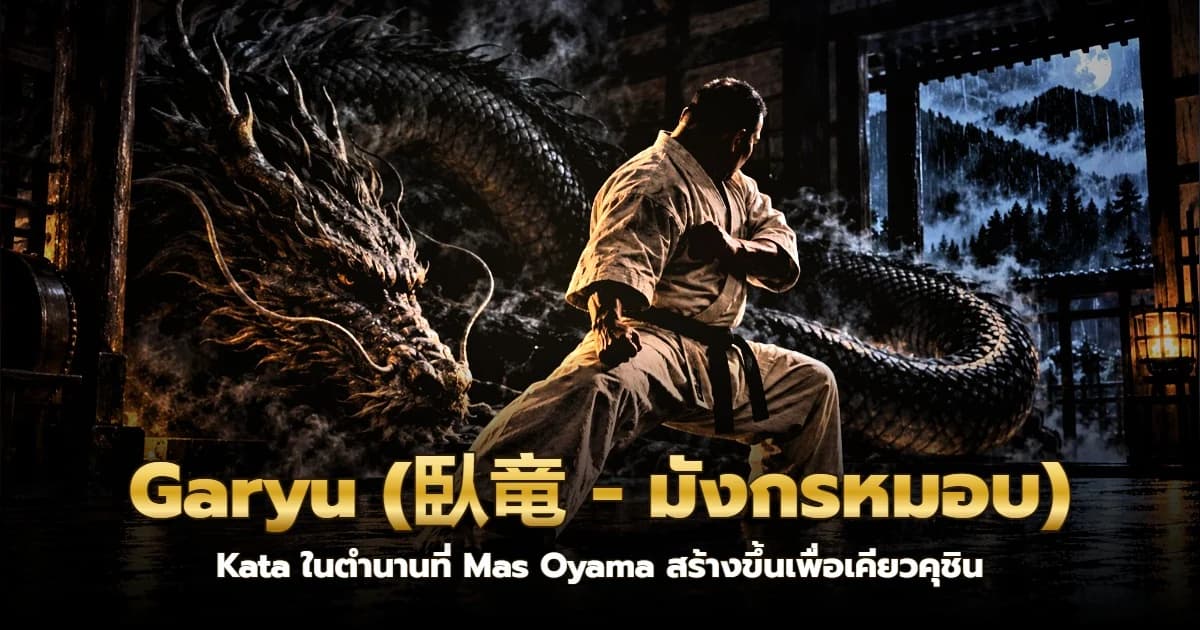
Every time I teach a student who is about to test for black belt, I always ask the same question: "Now that you've finished performing Garyu, does your mind feel calmer?" The history of the Garyu kata in Kyokushin is not merely a historical anecdote. It is the key that helps a practitioner understand why this particular sequence of movements was chosen as the critical gateway to black belt — because Garyu was not inherited from Okinawan kata the way other forms in the system were. It is something Mas Oyama created entirely on his own.
In this article
The Origin of the Name Garyu: More Than a Literal Translation
When I first read that the name Garyu comes from the village of Waryong-ri (臥龍里 — Waryong-ri) in Ryongchi-myeon district, Kimje city, Jeollabuk-do province, South Korea, I was stunned for a while. Before that, I had only understood it symbolically — that a crouching dragon represents power held in stillness. But the truth runs much deeper. The word "Waryong" in Korean, when read in the Japanese manner, is pronounced exactly as "Garyu." This was Mas Oyama — born under the name Choi Bae-dal — planting the roots of his own home village into the highest curriculum of the art he created in Japan.
I often tell my students that this is the same feeling as someone who has travelled far from home yet still wants to leave the name of their hometown embedded in the greatest thing they ever create in life. Research on this subject indicates that people past the age of forty often yearn to return to their roots, and Mas Oyama did exactly that — through a karate kata rather than words. For me, this is what sets Garyu apart from every other kata in Kyokushin: it is not merely fighting technique, but a personal life record of the founder, encoded into movement.
There is another layer of meaning here. In ancient Chinese literature, the term 臥竜 was also used to describe a person of great ability who had not yet revealed themselves — like a hero waiting for the right moment. This meaning aligns closely with the principle of Budo (武道 — the way of the warrior), which teaches quiet, patient training without boasting, before revealing one's true potential when the moment truly arrives. I believe that anyone who grasps this point will train Garyu differently from someone who has merely memorised the sequence of movements, because they will understand that they are training "stillness," not merely "power."
The Philosophy of the Sleeping Dragon: The Lake, the Cloud, and the Claw
Mas Oyama often told this story to his senior students. He preferred the image of "a dragon crouching at the bottom of a dark and freezing lake" over a dragon already flying in the sky from the outset — because the lake symbolises the dojo (道場), the place where one must endure the monotony of Kihon (基本 — basic movements) repeated over and over. I always teach my students that the word "Kyokushin" (極真 — truth taken to the utmost) itself carries a hidden meaning about time. The way of "Kyokushin" (極真) is the grand philosophy of Japanese martial arts, passed down from masters such as Miyamoto Musashi and Masutatsu Oyama, concerning "a thousand days of training to forge, ten thousand days of polishing to attain mastery." In other words, a practitioner must spend three years to discover "shin" (真 — essence), the foundation and starting point of the art, but must dedicate as long as thirty years to polish themselves toward "kyoku" (極 — the utmost) of true mastery. Understanding the fundamentals may take only a matter of years, but mastering the highest level demands a lifetime of dedication. Mas Oyama once declared that he was prepared to sit on a rock for as long as ten years — far exceeding the ancient proverb which speaks of only three.
The cloud in this philosophy represents an opportunity that passes only once. The teaching that "opportunity often comes only once in a lifetime" (チャンスは一回切り) is something I apply directly to teaching real kumite. When a student misses a counter-attack timing and feels disappointed, I tell them: that, right there, is the lesson of Garyu. A dragon that fails to seize the cloud in time must return and wait a long while again. But more important than the waiting itself is "keeping the claws sharp at all times" — meaning daily discipline, training without a single day off. Because even if the cloud does eventually drift by, dull claws will fail to seize it.
I see this as a philosophy applicable to real life, far beyond just the training hall. Many working adults who come to study karate with me never intend to compete. Yet they take the idea of "waiting with discipline" and apply it to their work and family life. This is why I believe Garyu is not merely a sequence for people heading into competition, but a life lesson that IMAC Dojo wants to pass on to everyone who walks through our doors — whether children, adults, or seniors.
The Technical Structure of Garyu
The Cat Stance and Storing Power
The heart of movement in Garyu is Neko-ashi-dachi, a stance that Mas Oyama particularly favoured. Nearly all of the body's weight, around 90 percent, rests on the rear leg, while the front foot lightly touches the ground with only about 10 percent, resting on the ball of the foot. Biomechanically, this stance functions like a spring compressed in the thigh and hip muscles, ready to release kinetic energy the instant it is needed. I teach my students not to view this stance as merely "a way of standing," but as the state of a dragon crouching motionless beneath the water — the body calm, yet ready to erupt at any second.
Deflection and High Kicks
Garyu employs curved deflecting techniques such as Koken-uke (弧拳受け — receiving with a curved wrist) and Kake-uke (掛け受け — hooking receive), rather than rigid straight-line blocks. This hooking technique does more than merely defend; it also breaks the opponent's balance, known as Kuzushi (崩し), opening a path for a counter-attack. The kata then builds toward its climax: the kick Jodan Mawashi Geri (上段回し蹴り — high roundhouse kick) and Jodan Ushiro Mawashi Geri (上段後ろ回し蹴り — high spinning back kick, often called by Thai practitioners the "crocodile tail-whip" move). This shift from the lowest possible stance to a sudden strike toward the head is a genuine visual re-creation of a dragon bursting through the surface of the water toward the sky.
Breath and Concentration
Every beat of Garyu is governed by breathing — Ibuki and Nogare (残り — relaxed breathing). A practitioner must begin in the seated position Seiza (正座 — traditional Japanese kneeling posture) to calm the mind before beginning the form. Throughout the performance there are moments of deep inhalation through the nose, tensing the muscles around the Tanden (丹田 — the point of gathered energy below the navel), distributing power throughout the body, before releasing the breath rhythmically in coordination with each movement. I always tell my students that if the breath becomes broken or rushed into panting, that is a sign the mind is not calm enough — and the dragon within is panicking rather than awakening. Performing Garyu correctly, then, is not about performing it as fast or as forcefully as possible, but about making the breath and the movement become one, from beginning to end.
The point I most often emphasise to those about to test for black belt is the transition from a still stance into a high kick, because that is the moment when the breath is most likely to lose its rhythm. If this section is practised in isolation without linking it to the breath, the body will tense excessively and lose fluidity. I therefore recommend practising short segments first, then gradually assembling the whole kata once the body has truly internalised the breathing rhythm. This method has allowed many of my students at IMAC Dojo to pass their black-belt examinations with confidence — not because their form looked beautiful alone, but because they understood the essence of concentration that Garyu is meant to convey.
Garyu and the Black Belt Examination: Why This Kata
Garyu has been designated as the mandatory kata for anyone testing for first-degree black belt within the Shinkyokushin system, in every dojo, regardless of country. The reason this particular kata was chosen as the culmination of the white-belt journey is not simply because of its technical difficulty, but because it consolidates skills accumulated over years of training into a single sequence — from stability in the cat stance, to curved deflections, to high kicks, all the way through breath control. Examiners therefore often regard this kata as a measure of whether a practitioner is ready to move beyond being a beginner toward becoming someone responsible for the art they have trained in.
I have seen many students perform every movement of Garyu in correct sequence, yet examiners still pass them with reservations — because their gaze lacked an imagined opponent, their base was not stable enough, or after finishing the form they had not returned to a state of combat readiness known as Zanshin (残心 — the mind that remains vigilant after an action ends). I therefore remind everyone that testing for black belt with this kata is not about memorising the order of movements, but about demonstrating whether we truly understand the crouching-dragon philosophy behind every movement.
The table below summarises the core components of Garyu against what examiners commonly emphasise during a black-belt test, to give practitioners a clearer overview.
| Component | Technical Detail | What Examiners Commonly Assess |
|---|---|---|
| Stance | Neko-ashi-dachi, 90/10 weight distribution | Stability of the base throughout the kata |
| Defence | Koken-uke, Kake-uke | Deflecting force and breaking the opponent's balance |
| Kicks | Jodan Mawashi Geri, Ushiro Mawashi Geri | Height, speed, and balance after the kick |
| Breath | Alternating Ibuki and Nogare | Continuity without interruption |
| Mind | Zanshin after finishing the form | Gaze and readiness to fight |
Studying Kyokushin Karate at IMAC Dojo: The Path from Fundamentals to Black Belt
At IMAC Dojo, I have designed a training approach to Shinkyokushin Karate that is genuinely accessible to ordinary people. There is no need to have been an athlete beforehand or to have any prior karate background — from children aged 7 all the way up to adults aged 60 — because I believe karate is not a sport reserved for any particular group of people, but a tool for discipline and confidence that everyone should have the opportunity to access. New students begin with basic movements like Kihon, simple breath control, and correct stances, before gradually progressing into more complex kata according to each person's own potential.
Many people ask me why one must wait until black belt to train Garyu. The answer is that this kata requires a certain level of joint and muscular strength in the body, along with an understanding of breath and concentration accumulated from training in earlier, more foundational kata. If someone practises it too soon without a proper foundation, they may only acquire the outward shape of the movements without grasping the essence of the philosophy Mas Oyama intended to pass on. I therefore hold firmly to the principle that everyone must progress through the stages systematically, with no shortcuts, for the sake of safety and genuine understanding.
For anyone interested in beginning this path, you can view course details and the schedule on the Schedule and Pricing page, or see an overview of the Shinkyokushin Karate programme that IMAC Dojo offers for every age group. I believe that the journey from white belt to performing Garyu on the day of the black-belt test is a journey that teaches us to know ourselves far more than we ever expected.
Conclusion
For me, Garyu is not merely a black-belt kata to be memorised in order to pass an examination. It is a life lesson that Mas Oyama intended to pass on through the image of a dragon crouching motionless beneath the water, waiting with discipline until the moment of opportunity arrives. Every time I see a student finish performing Garyu and stand still with eyes still holding that watchful readiness of Zanshin, I know that they have not merely memorised the movements — they have understood the true essence of Kyokushin karate. Whether children, adults, or seniors who train with me at IMAC Dojo, I believe everyone can walk the path from white belt to the day they perform Garyu with genuine meaning — provided they train systematically, take no shortcuts, and understand that true power must always remain under control. This is what I want everyone who walks into our dojo to experience for themselves.
Sources and further reading
- Mas Oyama — WikipediaCommunityAccessed 15 Sept 2026
- Kyokushin — WikipediaCommunityAccessed 15 Sept 2026
- Karate kata — WikipediaCommunityAccessed 15 Sept 2026
- Neko ashi dachi — WikipediaCommunityAccessed 15 Sept 2026
- Miyamoto Musashi — WikipediaCommunityAccessed 15 Sept 2026
- Budo — WikipediaCommunityAccessed 15 Sept 2026
Frequently Asked Questions
What exactly is Garyu within the Shinkyokushin lineage?
Garyu is a kata that Mas Oyama created himself for the Shinkyokushin school. It was not inherited from Okinawan karate the way other kata were, and it is the mandatory kata for anyone testing for first-degree black belt in every dojo of the Shinkyokushin lineage worldwide.
Why did Mas Oyama name the kata Garyu?
Because the word "Garyu" is the Japanese-style reading of "Waryong," the name of his home village in South Korea. By choosing this name, he embedded his own roots into the highest curriculum of the art he created.
Is the Garyu kata difficult for someone about to test for black belt?
Garyu is demanding both technically and mentally, requiring stability in the cat stance, controlled breathing, and continuous high kicks. However, for someone who has trained systematically through the fundamentals beforehand, it will not be overly difficult to learn.
How long must one train karate before learning Garyu?
Generally, a practitioner learns Garyu when nearing the first-degree black-belt examination, because this kata requires physical strength and an understanding of breathing accumulated through earlier, more foundational kata.
Who is Kyokushin karate at IMAC Dojo suitable for?
It is suitable for everyone, from children aged 7 up to adults aged 60. No prior background is required, as the training is designed to begin with correct fundamentals tailored to each person's own potential.
How do I enrol my child in karate near me at IMAC Dojo?
You can view course details and the class schedule on the [Schedule and Pricing](/en/schedule-pricing) page, or see an overview of the [Shinkyokushin Karate](/en/courses/shinkyokushin-karate-thailand) programme before deciding to begin training.
Ready to start martial arts?
Message IMAC Dojo to ask which course fits your age, goals, and training background.
Ask on LINE Official