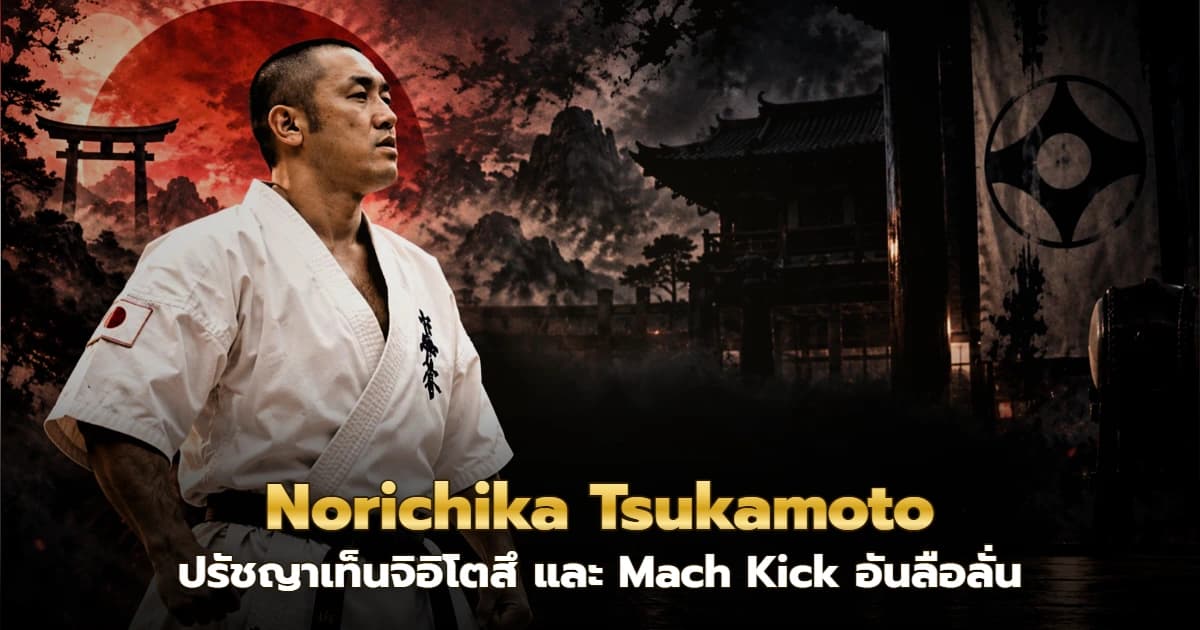
Norichika Tsukamoto and the Philosophy of Tenchi Itsu, and the Mach Kick That Changed Shinkyokushin Karate
A Shinkyokushin instructor who trained with Norichika Tsukamoto in Singapore traces the fighter's two world titles, his invention of the Mach Kick, and the Tenchi Itsu philosophy that revived his career at 37.
- Author
- Thaninpong Supapitakpong (Phoenix)
- Published
- Last updated
- Sources
- 1
- Reading time
- 12 min
Short Answer
Norichika Tsukamoto is a two-time Open World Championship champion of the World Karate Organization (WKO) Shinkyokushinkai (新極真会). He won his first title in 1996 at age 21, making him the youngest champion in the organisation's history, and his second in 2011 at age 37, making him the oldest champion at the same time. He is the inventor of the Mach Kick (マッハ蹴り), a close-range kicking technique that permanently changed thinking around blocking and countering in the ring, and he is the one who brought the philosophy of 天地一つ (Tenchi Hitotsu — heaven and earth as one) into use to revive his fighting career late in life and reclaim a world title once again.
Key Takeaways
- Tsukamoto was WKO Shinkyokushinkai world champion both at the 6th tournament (1996) and the 10th tournament (2011), many years apart
- He invented the Mach Kick, a technique that raises the knee vertically before snapping the leg down in a vertical arc, usable at close range where a standard roundhouse kick cannot work
- The philosophy of Tenchi Itsu comes from stories about Kamiizumi Ise-no-Kami Nobutsuna, founder of 新陰流 (Shinkage-ryu), which teaches the letting go of ego
- He currently holds the position of Branch Chief of the Tokyo Setagaya-Suginami Branch at the rank of 6th Dan Shihan
- The author trained one-on-one with Tsukamoto at a Shinkyokushinkai Singapore seminar several years ago
- IMAC Dojo teaches the Shinkyokushin Karate course with correct fundamental form and discipline as its core focus, no different from the approach Tsukamoto himself holds to
Anyone who has been in the world of Shinkyokushin karate for any length of time will know 塚本徳臣 (Tsukamoto Norichika), often referred to respectfully as Shihan Tsukamoto. He is a fighter I had the chance to train under personally in Singapore over a decade ago, and one of the figures I consider to have genuinely changed the course of this discipline's history.
In this article
A Shy Child's Beginnings in Nagasaki
Tsukamoto was born on 4 February 1974 in the city of Isahaya, Nagasaki Prefecture. As a child his father saw him as too shy and withdrawn, and so sent him to train in 空手道 (karate-do) in the Kyokushinkaikan lineage at the Nagasaki branch from the age of 8. This reflects something I have always believed as someone who teaches martial arts to children at IMAC Dojo: karate is not only for children who are already strong and confident. It also helps build discipline and confidence in children who do not yet fully know themselves.
After finishing high school, he moved to Tokyo and joined the Jonan Kawasaki branch under the guidance of Tsuyoshi Hiroshige, who was known for heavy low-kick training and relentless close-range engagement. What is interesting is that although Tsukamoto fully absorbed the power-generation principles of the Jonan lineage, with his height of 186 centimetres and flexibility far above average, he chose to diverge from the straightforward heavy-contact approach and instead explored how his own height and kicking angles could create unexpected lines of attack. I see this as an important lesson for anyone training in martial arts anywhere: everyone's body is different, and copying a skilled fighter word for word is not always a shortcut. You need to understand the underlying principle and then genuinely adapt it to yourself.
A Championship Path Years Apart
In 1994, after the founder of Kyokushin, 大山倍達 (Masutatsu Oyama), passed away, the discipline entered a period of fragmentation into multiple organisations. Tsukamoto, then 20 years old, placed 6th at the 26th All Japan Open, the last major tournament before the split. He subsequently chose to join the group of branches that would later unite as WKO Shinkyokushinkai under the leadership of Kenji Midori (緑健児), and quickly became a leading technical fighter for the organisation.
Legend has it that in January 1996, at Yokohama Arena, Tsukamoto won his first world title at the 6th World Open Championship at just 21 years old. What shocked the scene was that he won while barely relying on traditional low kicks at all, partly due to a foot injury, and partly because he chose to use unpredictable head-level attacks instead. It is said that in the final he defeated Kunihiro Suzuki, a fellow student from the Jonan lineage. Over the following decade he went on to win several more All Japan Open titles and built a 33-match winning streak, but his second world title kept slipping further away as fighters from Eastern Europe, particularly Russia, Lithuania and Bulgaria, began bringing size advantages and boxing-style combinations into the Kyokushin ring more and more.
His lowest point came at the 9th World Championship, where he was eliminated in the quarterfinals on a tameshiwari (board-breaking) tiebreak decision after drawing with Roman Nesterenko of Russia in overtime. Rather than accept that his era had passed, Tsukamoto used that defeat as the starting point for a major overhaul of both technique and mindset, going on to win the All Japan Open in consecutive years, before reaching the summit once again at Tokyo Metropolitan Gymnasium at age 37. He fought through a bracket of many competitors, met Nesterenko again in the semifinal, and in the final seconds of regulation time, he created an opening with a feint and launched a 胴回し回転蹴り (do mawashi kaiten geri — a spinning wheel kick) into Nesterenko's jaw, knocking him out instantly and bringing the entire arena to its feet in applause. He then defeated fellow Japanese fighter Tsutomu Murayama by unanimous decision in the final, and took home the Technical Award (ginō-shō).
The Mach Kick: The Finishing Move That Changed Close-Range Fighting
Before Tsukamoto's era, the standard strategy in the Kyokushin ring was uke-kaeshi (block then counter): two fighters standing close together, absorbing punches and low kicks with tensed muscles, then immediately countering. Tsukamoto identified the weakness in this approach: every time you absorb an impact, you give your opponent the chance to gauge your range and rhythm. He therefore combined the principle of tai-sabaki (evasive body movement) with close-range fighting, stepping aside or pivoting the instant his opponent launched an attack so that the punch or kick struck empty air, opening a physical and mental gap he could immediately exploit with a counter. This principle aligns exactly with what I always try to teach students at IMAC Dojo: speed does not come from rushing, it comes from reading your opponent's rhythm clearly before you move.
At the heart of this arsenal is the Mach Kick, a modified roundhouse kick usable at extremely close range where a standard roundhouse kick cannot work because it requires distance and a wide arcing path. Tsukamoto solved this by raising the knee rapidly along the body's centreline, making it look as though he were about to throw a front kick, a knee strike to the midsection, or an ordinary low kick. Once the knee passed the opponent's shoulder level, he would lean his torso slightly backward, using the raised knee as a pivot point, then snap the lower leg down in a nearly vertical line, almost like an axe chop. Because the trajectory of the strike does not travel horizontally the way most guards are trained to defend, it frequently slips past the forearms or over the shoulder and lands squarely on the jaw or temple with enough force to knock the opponent out instantly. I believe the cleverness of this technique lies not in its power but in its unexpected angle, a principle I always try to instil in students at IMAC Dojo: a good technique does not need to be the strongest, it needs to be one the opponent cannot see coming until it lands.
Beyond this, Tsukamoto also expanded the use of high-risk acrobatic techniques into reliable scoring weapons, not merely occasional gambles the way earlier generations of fighters used them. The 胴回し回転蹴り he used to knock out Nesterenko in the 2011 semifinal was also thrown without any visible telegraphing, typically released at the tail end of a combination just as the opponent stepped in to close the distance. He also used an axe-chop strike from above (kakato otoshi) that crossed over the shoulder to target the collarbone or head, a hooking inside kick to evade an opponent's hand checks (uchi mawashi geri), and a low spinning back kick aimed at the calf and ankle (gedan ushiro mawashi geri). Simultaneous attacks at high, middle, and low levels at close range in this way overwhelmed an opponent's ability to process what was happening, making it far easier for the fight to end suddenly.
The Philosophy of Tenchi Itsu and Reviving a Career at an Age Others Had Already Retired
The key turning point that brought Tsukamoto back to the summit after his painful defeat in the past was not merely a technical adjustment. It was a complete shift in perspective through the philosophy of 天地一つ (Tenchi Hitotsu — heaven and earth as one). This concept traces back to stories about Kamiizumi Ise-no-Kami Nobutsuna (上泉伊勢守信綱), founder of the sword school 新陰流 (Shinkage-ryu — the New Shadow School) during Japan's Sengoku period, who is believed to have taught the letting go of ego and attachment to victory or defeat, so that a swordsman's mind would merge with the surrounding environment until there was no seam between the fighter and the situation before him. It must be stressed that accounts from that era are traditions passed down through generations, not records that can be verified in every detail, but the core teaching has been carried forward into many Japanese martial arts, including karate, in later times.
What Tsukamoto took from this idea was to stop seeing himself as "fighting against advancing age" or "fighting against a younger, bigger generation of fighters," and instead to see his body, mind, and the situation in front of him as one and the same thing. There was nothing to resist or push against, only a flow following the correct rhythm. I see this as a valuable lesson for office workers who sit at a desk all day or for older adults who come to train at IMAC Dojo, because many worry that being older means they cannot keep up with others, when in fact training in martial arts is not always measured by who is faster or stronger. It is measured by who understands their own rhythm and the situation in front of them better. The fact that Tsukamoto won a world title again at 37, surrounded by fighters nearly all younger than him, is tangible proof that this idea works in practice, not just a beautiful-sounding phrase.
From the Ring to the Classroom
Today, Tsukamoto holds the position of Branch Chief of the Tokyo Setagaya-Suginami Branch at the rank of 6th Dan Shihan, and he continues to pass on both the technique and the philosophy accumulated over a lifetime to a new generation of students. This is no different from the opportunity I had to train directly under him at the Shinkyokushinkai Singapore seminar several years ago. That day he taught primarily about countering, and what I remember most clearly was not the power behind his techniques but his stillness and economy of motion. Every movement had a reason behind it, with nothing wasted, reflecting the essence of the Tenchi Itsu philosophy without needing to be explained in words at all.
At IMAC Dojo, I try to apply this same thinking to teaching Shinkyokushin Karate to students of every age, whether a child who has just started training at age 7, a working adult whose back aches from sitting too long, or an older adult who wants to move their body safely. Correct fundamentals, discipline in practice, and understanding one's own rhythm are, I believe, more important than emphasising power or speed from day one, because someone who starts off on the right foundation can build toward advanced technique far more solidly than someone who rushes. Whether it is Ken, Ryu, Rain, or Michelle, the instructors I trust most for teaching Shinkyokushin, every one of them holds to this same principle with every student at our dojo: safety must always come first, and ability will follow naturally with time and consistent practice. Tsukamoto's story is therefore not merely the history of one fighter. It is a path that confirms training in kyokushin the right way can take anyone further than they imagined, no matter how slowly or quickly they begin.
Lessons That Can Truly Be Applied
What I want every student at IMAC Dojo to take away from Tsukamoto's story is not simply the coolness of the Mach Kick or the excitement of winning two world titles. It is the attitude behind that success. His willingness to accept defeat in 2007 and analyse it honestly instead of blaming fate is what allowed him to return to the top at an age when most people choose to retire. I believe this mindset applies to ordinary people's lives as well, whether it is a child who loses their first competition or an adult who feels they started training too late. Defeat is not an ending. It is always information that can be used to improve. Understanding this essence can make training in karate, or any martial art, something far more enjoyable and sustainable than constantly feeling you must win every time.
Conclusion
The story of Norichika Tsukamoto is valuable not only as a piece of Shinkyokushin karate history, but as a lesson that genuinely applies to anyone training in martial arts, anywhere. From making full use of your own body instead of copying someone else, to turning defeat into the starting point for growth, through to the philosophy of Tenchi Itsu, which teaches us to accept the situation in front of us rather than resist it. As someone who had the chance to train with him personally in Singapore, I continue to carry these lessons into teaching every student at IMAC Dojo. Whether you are a child just starting out, a working adult who wants to exercise in a structured way, or an older adult who wants to move their body safely, the same principles apply to everyone. All that is needed is to start from correct fundamentals and keep at it with consistency.
Sources and further reading
- 塚本徳臣 (Tsukamoto Norichika) profile — Web HidenPrimaryAccessed 8 Oct 2026
Frequently Asked Questions
How does the Mach Kick differ from a normal roundhouse kick?
The Mach Kick raises the knee vertically before snapping the leg downward at close range, where a standard roundhouse kick cannot work because it requires distance and a wide arcing path that the Mach Kick does not need.
Why was Tsukamoto both the youngest and the oldest champion of WKO Shinkyokushinkai?
Because he won his first world title at age 21 in 1996, and then returned to win again at age 37 in 2011, 15 years apart, something no one else in the organisation's history has achieved.
How can the philosophy of Tenchi Itsu be applied to ordinary training?
This concept teaches a practitioner to stop resisting the situation in front of them and instead read the rhythm of their body and their environment so the two merge together, which can be very helpful for anyone worried about age or physical limitations.
Does IMAC Dojo teach the same karate that Tsukamoto trained in?
IMAC Dojo teaches the Shinkyokushin Karate course with correct fundamental form and discipline as its core focus, the same approach that Kyokushin lineages worldwide place importance on.
What age can children start learning Shinkyokushin Karate at IMAC Dojo?
The Shinkyokushin Karate course accepts students from age 7 to 60. Anyone interested can view more schedule details on the schedule and pricing page.
What is the 胴回し回転蹴り technique Tsukamoto used to knock out his opponent?
It is a spinning wheel kick used to knock out Roman Nesterenko in the 2011 semifinal, thrown without any visible telegraphing, leaving his opponent unable to defend in time.
Ready to start martial arts?
Message IMAC Dojo to ask which course fits your age, goals, and training background.
Ask on LINE Official