How Many Karate Schools Are There in Thailand? Karate-do Styles and Full Contact Karate
Karate in Thailand splits cleanly into two groups by contact rule. This walks the documented timeline, compares traditional and full contact, and shows how to read which body a dojo answers to.
- Author
- Thaninpong Supapitakpong (Phoenix)
- Published
- Last updated
- Sources
- 6
- Reading time
- 7 min
Short Answer
No body in Thailand publishes a central count of karate schools, and reciting a number does not actually help anyone decide. The workable frame is to divide by contact rule into two groups. The first is traditional Karate-do, which uses the sundome rule to stop a strike before real contact and follows the WKF points path. The second is Full Contact karate in the Kyokushin lineage, where strikes land on the body and legs. The question worth asking is therefore not how many styles exist, but which organisation a dojo belongs to and whose grading standard it uses.
Key Takeaways
- No Thai body publishes a central count, so citing an organisation's list beats reciting a number.
- The dividing line that actually works is the contact rule, not the style name.
- Karate reached Thailand around 1957, and a national body first appeared in 1976.
- What decides quality is affiliation, grading standards, and whether you can come and watch training.
People who want to start karate often wonder how many schools of it Thailand actually has, because walking around different dojos turns up names that do not match at all: Shotokan, Goju-ryu, and sometimes Full Contact karate, which sounds more alarming than expected.
Having taught martial arts for a long time at IMAC Dojo, I think that confusion is normal, because no central body in Thailand publishes an official figure. So this page does not try to hand you a number. It gives you a frame you can actually decide with, along with the timeline as far as it is documented.
In this article
How Karate Reached Thailand
According to the record collected on the history of karate in Thailand, karate began to spread here around 1957 through tourists and foreign residents. Between 1963 and 1964 there were Muay Thai versus karate matches, which is what first brought the art to wide attention.
The moment usually treated as a landmark came in 1965, when a karate demonstration was given during a judo competition at Gymnasium 1 of the National Stadium, before the Crown Prince, with Seiichi Murakami demonstrating. Teaching began afterwards at a private residence, with only four or five students in the first group.
In 1966 Tetsuo Sadahiro arrived to teach in earnest, and in 1970 the first university karate club in Thailand was formed at the University of the Thai Chamber of Commerce. I often tell students at IMAC Dojo that every martial art begins from a small group like that. The perseverance of those pioneering teachers is what carried Thai karate to where it is now.
So How Many Schools Are There?
The honest answer is that there is no single official number. In Japan itself, the Japan Karatedo Federation brings several style organisations together, while people commonly speak of four major styles, and the full-contact lineage sits outside that count altogether. In Thailand no body publishes a summary figure at all.
The origin of the name 空手, the Kyu and Dan belt system, and the detailed count of styles are all covered in what karate is and how many styles there are. This page stays on what you can actually decide with, in a Thai context.
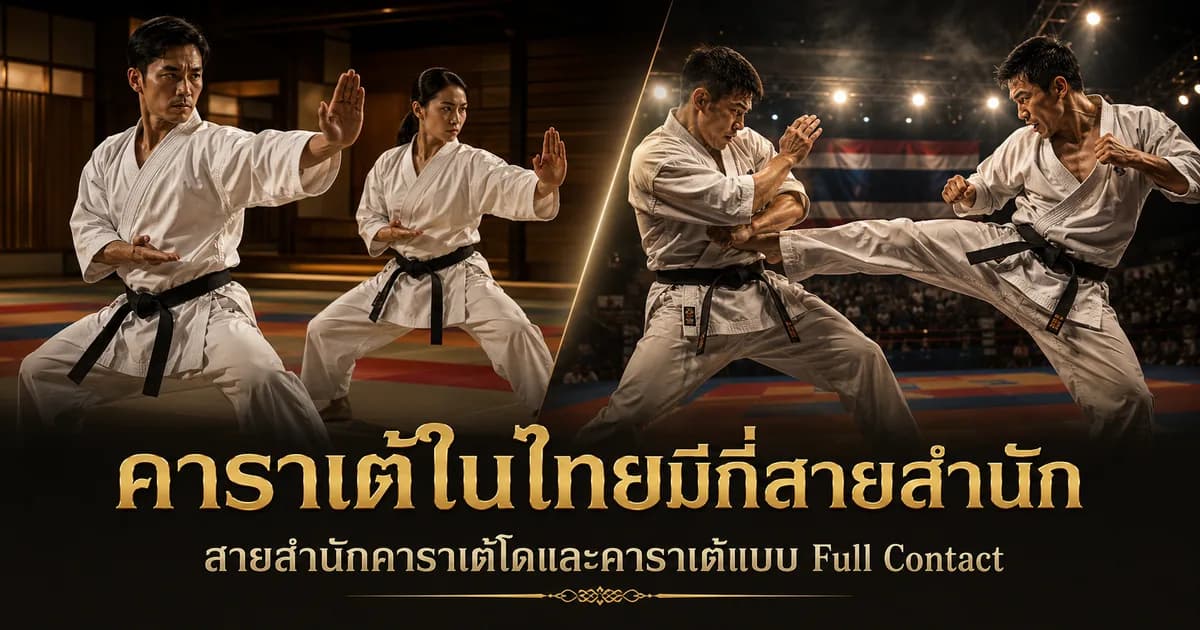
That frame is to divide by contact rule into two groups. The first is traditional Karate-do, which uses the sundome rule, holding the strike back before real contact. The second is Full Contact karate, where strikes land on the body and legs. Once you know which group a dojo sits in, you can predict what the training, the equipment, and the grading will look like.
The Traditional Karate-do Styles Found in Thailand
The traditional styles commonly met in Thailand are the ones gathered under the Japan Karatedo Federation. All of them use the same sundome rule, and differ in body structure and in how they generate power.
| Style | Technical emphasis | Common stances |
|---|---|---|
| Shotokan | Linear power at longer range, finishing in one beat, after the idea of 一撃必殺 | Zenkutsu-dachi, Kiba-dachi |
| Goju-ryu | Hard and soft blended at close range, using 息吹 breathing | Sanchin-dachi, Neko-ashi-dachi |
| Shito-ryu | Inherits both Shuri-te and Naha-te | Neko-ashi-dachi, Shiko-dachi |
| Wado-ryu | Brings in jujutsu thinking, favouring evasion over meeting force with force | Shizentai, tai sabaki |
None of this makes one style stronger than another. It means each conditions the body differently. Goju-ryu also has supplementary conditioning called 補助運動 (hojo undo), which uses a range of traditional implements such as the 鎚石 (chi-ishi, a weighted stone on a handle), as a Goju-ryu organisation in Japan describes it.
What Full Contact Karate Is
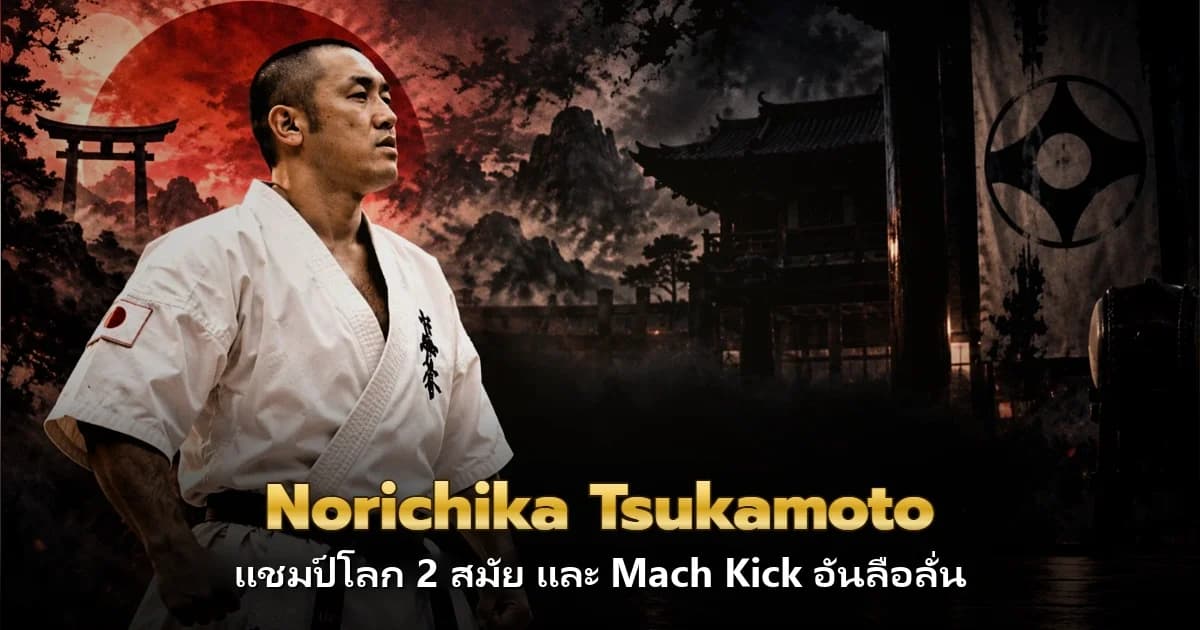
Full Contact karate is the form where strikes land for real, with bare hands and bare feet. Its origin is the Kyokushin Kaikan school founded by Grandmaster Oyama Masutatsu. The lineage later branched into several organisations, the internationally known one being Shinkyokushin (新極真会) under WKO.
The rules that earn it the name are these: strikes to the body land at full force, kicks to the head are allowed, and bare-hand strikes to the face, or anywhere from the throat up, are not. That is the competition rule set. A class is a different context, where the instructor sets the drills, the equipment, and the level of force according to each student's experience.
What this format gives that a points rule set cannot is that the technique is tested under real impact. A practitioner has to develop kicks and body strikes with genuine power behind them, rather than a light touch that registers a score, and has to learn to keep going while tired and hurting — which no points system measures.
The other side of that is real: an art with contact carries an injury risk that cannot be reduced to zero, and we do not say there is none. What can be done is to place the risk deliberately. The rules and the kind of pain that actually occurs are covered in whether Kyokushin karate hurts.
The Governing Bodies and the Competition Rules
Thailand's national competitive path runs on point-scoring rules under the Thailand Karate Federation, which connects to the international system of the World Karate Federation. That body began in 1976 as FATKO and was renamed several times under sports law; the full timeline is in the Olympic path of Thai karate.
Under WKF rules a scoring technique is worth one of three values: 一本 (ippon) for three points, 技あり (waza-ari) for two, and 有効 (yuko) for one. A competitor who builds a lead of eight points wins. Full-contact karate follows its own path, with its Japanese parent body setting grading and competition standards separately.
How to Read Which Lineage a Dojo Belongs To
Before deciding, three questions help more than any photo gallery. Which organisation does this dojo belong to, and whose grading criteria does it use? What level of certification do the instructors hold from that organisation? And can you come and watch training during a group class, to see the real atmosphere before you decide?
The first question matters especially around the word Kyokushin, because several organisations run their own networks under that name today. Seeing the words full contact on a sign does not yet tell you how a dojo connects to a parent body in Japan.
At IMAC Dojo we teach Shinkyokushin Karate, a full-contact style within the Kyokushin lineage. Training and grading run under Shihan Fumiaki Frank Nagashima, Branch Chief Thailand for WKO, so the standard applied to one student is the standard used across the whole lineage rather than one the school invented for itself. On 18 September 2026 the Shihan taught at IMAC Dojo in person; the record of that day is in Shihan Nagashima at IMAC Dojo.
And for beginners worried by the phrase full contact: the programme opens with stances, punching, kicking, blocking, balance, and basic movement. Instructors adjust the drills, the training partner, and the level of intensity to each student's age, size, and goal. Nobody is pushed into contact on day one.
See the Shinkyokushin Karate course at IMAC DojoTo see how grading works, there is the grading preparation course, and for how this lineage travelled from Japan to Thailand, read Shinkyokushin Karate from Japan to Thailand.
Sources and further reading
- Karate in Thailand — Thai WikipediaCommunityAccessed 5 Sept 2026
- Basic rules of Karate-do — Japan Karatedo FederationReferenceAccessed 5 Sept 2026
- Thailand Karate Federation — Thailand Karate FederationReferenceAccessed 5 Sept 2026
- World Karate Federation — World Karate FederationReferenceAccessed 5 Sept 2026
- About Shito-kai — All Japan Karatedo Federation Shito-kaiReferenceAccessed 1 Oct 2026
- Goju-ryu training — Goju-ryu BujutsukanReferenceAccessed 1 Oct 2026
Frequently Asked Questions
How are Shotokan and Goju-ryu different?
Shotokan emphasises linear power and low, wide stances to build a base for delivering force at longer range, while Goju-ryu emphasises circular movement and close range together with 息吹 breathing. Both sit in the group that uses the sundome rule.
Is Full Contact karate dangerous?
An art with contact carries a risk that cannot be reduced to zero, so we do not claim there is none. What to look at is how a school pairs students for partner work, whether an instructor controls intensity pair by pair, and whether beginners are given time to build a base before contact.
How do I start Full Contact karate in Bangkok?
Start by checking a school's affiliation and whose grading standard it uses, then ask to watch training during a group class before deciding. At IMAC Dojo near Ladprao 101 we teach Shinkyokushin Karate under WKO, and beginners always start from fundamentals.
So how many karate schools does Thailand have?
No Thai body publishes a central count, and a number would not help you decide anyway. The workable frame is two groups divided by contact rule: traditional Karate-do using the sundome rule, and the full-contact lineage where strikes land. From there, look at which organisation the dojo belongs to.
Ready to start martial arts?
Message IMAC Dojo to ask which course fits your age, goals, and training background.
Ask on LINE Official