
Years of Kung Fu Training: From Shaolin to the Wushu Federation
An IMAC Dojo instructor recounts a family journey from private Shaolin kung fu lessons to training with the Wushu Federation of Thailand, comparing the two approaches and explaining why neither is currently offered as a public course at the dojo.
By
 Thaninpong Supapitakpong (Phoenix)Founder and instructor at IMAC Dojo
Updated 25 Sept 2026
- Author
- Thaninpong Supapitakpong (Phoenix)
- Published
- Last updated
- Sources
- 0
- Reading time
- 11 min
Short Answer
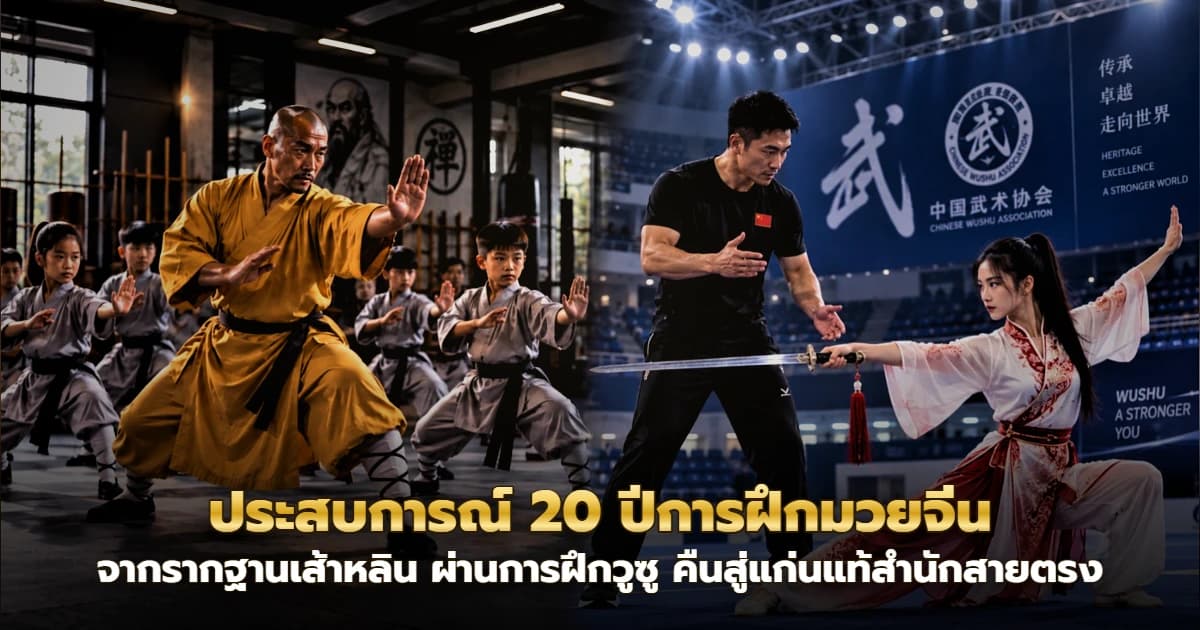
Learning kung fu comes in at least two distinctly different tracks with clearly different outcomes: a private-lesson approach focused on health and culture with no competitive stage behind it, and an approach trained through a sporting organization with a genuine competition system, such as the Wushu Federation of Thailand, an organization listed in the Thailand Sports Almanac database maintained by the Ministry of Tourism and Sports. From my own direct experience, training with a competitive goal in mind shows a far clearer difference in precision and discipline than training purely as an activity.
Key Takeaways
- Our family began learning kung fu with a Shaolin lay-disciple teacher several years ago, training privately and continuously for many years.
- Each session lasted a fair amount of time, focused on stretching and warm-up, actual technique practice for a while, then closed with a warm-down.
- In 2011, Khru Ken, Khru Ryu, and Khru Rain trained under Ajarn Bul Dissayabutr, then Secretary-General of the Wushu Federation of Thailand.
- The federation has evidence tracing the origin of modern wushu in Thailand back to 1969, through Ajarn Bul's Wushu-Kung Fu Institute.
- Khru Michelle, Khru Ryu, and Khru Rain later trained with Khru Tee (Suchinda Yangrungrawin) and Khru Lee, senior figures in the Thai wushu community.
- The clearest difference is that training for competition builds discipline and precision that activity-based training cannot provide.
If anyone asks me where to start when they want to learn kung fu, I almost always tell the story of the Supapitakpong family (the Ng lineage) first, because our family's path did not begin in a classroom built around competition or medals. It began with training under a teacher who was a lay disciple of a Shaolin temple, many years ago, before life eventually led us to the world of the Wushu Federation of Thailand. These two paths differ far more than most people would imagine, and that is what I want to share in this article.
In this article
The Beginning: Learning Kung Fu Privately with a Shaolin Disciple
Looking back many years ago, our family began learning kung fu with a teacher who had once been a lay disciple of 少林寺 (Shaolin Si — the Shaolin Temple, the birthplace of the legendary Chinese Buddhist martial arts). At first I trained in group classes like everyone else, but before long I decided to switch to private lessons, which continued for many years. Even though the cost was considerably higher compared to group classes, I felt it was worthwhile because of the one-on-one attention and the flexibility to arrange convenient timing.
Each session lasted a fair amount of time, starting with thorough stretching and warm-up of basic Chinese martial arts postures, followed by only a short stretch of actual technique practice, before closing with a warm-down to relax the muscles. This time ratio made me feel that progress was fairly slow, since most of the time went into repeatedly preparing the body rather than practicing techniques, and it did not directly teach the practical application of the techniques.
What I want to emphasize, as someone who went through this experience myself, is that this style of training is like a private class with no competitive stage behind it. It is an activity for health and self-cultivation, not a path designed for excellence or athlete-level precision. Most students train in order to perform in various events. When there is no competitive stage to measure results against, neither teacher nor student feels intense pressure to reach any particular standard. This is not wrong — it is simply the nature of this kind of training, and something students should understand from the outset.
The Turning Point: Training with the Wushu Federation of Thailand
I remember it clearly because it was early 2011. At that time, Khru Ken, Khru Ryu, and Khru Rain had the opportunity to train with Ajarn Bul Dissayabutr, whom the federation's history identifies as the founder of the "Wushu-Kung Fu Institute" since 1969, with the goal of teaching and spreading the art of 武术 (wushu — the modern Chinese martial art developed from many traditional Chinese boxing lineages, commonly transliterated in Thai as "wushu") throughout Thailand. This is the point I consider the key milestone that clearly divides our family's kung fu journey into two distinct chapters.
That training took place at the Sports Authority of Thailand, Ramkhamhaeng, where Ajarn Bul had senior athletes teach directly. The training continued for many months. What Khru Ken, Khru Ryu, and Khru Rain felt immediately was the difference between training for competition and the more casual training they had experienced before. This was not a vague impression, because the Wushu Federation of Thailand is an organization with a genuine governing-body structure, not a single independent school. It runs ongoing competitions such as the Wushu Thailand Open, which had reached numerous editions at the Chao Fa Multipurpose Building, Royal Thai Air Force, and it also conducts serious national-level coach and referee training.
Unfortunately, in late 2011 Thailand faced a major flood disaster that lasted for months, forcing training at that time to come to a halt. But those few short months of experience were enough to permanently broaden their outlook on the world of martial training. I see this as an important lesson for anyone considering kung fu: try to experience both approaches if you have the chance, because each one offers a completely different kind of experience.
Returning to Train Again with Khru Tee and Khru Lee
After a pause, and after training with several other teachers along the way, several years ago Khru Michelle had the opportunity to train with Khru Tee and Khru Lee, teachers who had previously been senior figures teaching the older brothers among Khru Ken, Khru Ryu, and Khru Rain. In the world of Thai wushu, Khru Tee is a name with the clearest publicly verifiable record. The program Kho Khayap Family on Thai PBS/ALTV once featured "Coach Tee Suchinda Yangrungrawin" in an episode specifically about wushu, explaining that his training emphasizes developing both physical discipline, breath training, and precision of movement.
Khru Tee's path is a clear example of just how far serious wushu training can take a person. He was once a Thai national team athlete who competed at the Asian Games in the men's staff routine, or 棍术 (gunshu — staff-based combat forms in the modern wushu system), and placed 7th. From there, his path transitioned from athlete to manager of the Thai wushu team ahead of the Hangzhou Asian Games, when the Thai team sent a number of athletes, men and women, with a target of a silver medal. He later appeared as a coach announcing the team's goal for the SEA Games as gold medals from several events.
After Khru Michelle trained with Khru Tee and Khru Lee for many years, Khru Ryu and Khru Rain also had the opportunity to train with both of them, together with Phi Meme. I feel glad every time I see the Wushu Federation of Thailand systematically carrying forward the many branches of Chinese martial arts, whether through organizing competitions like the Wushu Thailand Open, which has continued for many editions, or through training national-level coaches and referees, ensuring that the standard of wushu instruction in Thailand does not rest on any single teacher alone. These are the differences I consider most significant between private kung fu instruction and training through an organization with genuine structure behind it. Even though both kinds of teachers teach with equal passion, the systems supporting them are completely different.
Shaolin versus Wushu: The Difference, from Someone Who Has Experienced Both
Many people who come to me for advice about wanting their children to learn kung fu always ask the same question: what is the difference between Shaolin and wushu? I usually answer directly that it is not simply a matter of the name of the school or organization, but of the "destination" set from the very first day one begins training. Training with a Shaolin lay disciple, as I once did, is training to preserve culture and health, with no standardized stage to systematically measure results. Training through the Wushu Federation of Thailand, on the other hand, includes domestic competitive stages, a connection to the Wushu Federation of Asia at the continental level, and competition within the system of the International Wushu Federation (IWUF — the international federation overseeing world-level Taolu and Sanda competition).
Comparison Table of the Two Kung Fu Training Approaches
| Aspect | Private Training with a Shaolin Disciple | Training through the Wushu Federation of Thailand |
|---|---|---|
| Main goal | Health and culture | Precision and competition |
| Competitive stage | None | Yes, e.g. the Wushu Thailand Open |
| Organizational structure | A single teacher | A national-level governing body |
| Clearest outcome | Relaxation, personal discipline | Discipline, athlete-level precision |
I want to stress that this table is not saying one approach is better than the other, because both paths have value in their own right — they simply produce different results. Someone who wants to train for relaxation and to experience Chinese culture may be satisfied with the first approach. Someone who wants to see clear, measurable progress, and who wants their child to develop the discipline and determination of an athlete, will find a much clearer answer through training with an organization that has a genuine competition system.
Lessons I Apply to Teaching at IMAC Dojo
The many years of experience described above are not simply stories told for entertainment; they have directly shaped my teaching approach at IMAC Dojo (International Martial Art Center). I believe that good training must blend both sides together: the gentleness of training for health, and the intensity of training with a clear goal. Whether it is children, adults, working people who sit all day, or older adults who want to move their bodies correctly, the same principle applies to all of them.
At IMAC Dojo, we always prioritize correct fundamental posture first, because from direct experience I have seen that people who rush into difficult techniques without a solid foundation tend to get injured or quit halfway. Discipline and safety are therefore what we place at the very top of our priorities — no different from what I observed while training under Ajarn Bul through Khru Ken, Khru Ryu, and Khru Rain at the Sports Authority of Thailand in 2011, where the senior athletes who taught them always emphasized correctness of form before speed or aesthetics.
For anyone interested in the martial arts training approach that IMAC Dojo offers, whether Shinkyokushin Karate, Judo Thailand, or Wingchun Sambo Thailand and Waikru Muaythai, you can find details of class schedules and course fees on the dojo's schedule and pricing page. As for the Shaolin and wushu kung fu I have described throughout this article, these are currently passed on as private instruction within our family and are not offered as public courses at IMAC Dojo. Still, these experiences form the foundation that has given us a deep understanding of discipline, precision, and training according to each individual's potential.
Conclusion
Looking back over these past many years, I am even more convinced that there is no single fixed formula for kung fu training. The path that began with a Shaolin lay disciple taught me the value of gentleness and cultural heritage, while the brief period training under Ajarn Bul through Khru Ken, Khru Ryu, and Khru Rain, along with the later return to training with Khru Tee and Khru Lee by Khru Michelle, Khru Ryu, and Khru Rain, taught our family the meaning of discipline and precision in a form backed by a genuine competitive stage. These two approaches do not conflict with each other; instead, they complement one another and have become the essential foundation I use to design the teaching at IMAC Dojo today, for young children, working adults, and older adults just starting out alike. Anyone interested in the martial arts training approaches we offer as public courses can find further details on the dojo's schedule and pricing page. I hope that the story of my own direct experience in this article will help readers make a clearer decision about which kung fu path suits them best.
Frequently Asked Questions
What is the biggest difference between learning Shaolin kung fu and modern wushu?
The clearest difference is the competitive stage. The Shaolin style I trained in was private instruction for health and culture with no competitive stage behind it, while wushu through the Wushu Federation of Thailand has genuine competitive stages such as the Wushu Thailand Open, with connections up to the Asian and world levels.
What kind of organization is the Wushu Federation of Thailand?
It is a national-level sporting organization listed in the Thailand Sports Almanac database maintained by the Ministry of Tourism and Sports. It organizes competitions, trains coaches and referees, and is connected to the Wushu Federation of Asia at the continental level.
How many years of kung fu training does it take to see a clear difference?
From my own direct experience, just a few months training with senior athletes under Ajarn Bul was enough to clearly feel the difference between training for competition and activity-based training. But if you want truly precise technique and athlete-level discipline, you should train continuously for at least a year or more under a teacher backed by a proper system.
Is wushu suitable for children?
Wushu is suitable for children in terms of building discipline, flexibility, and concentration, but parents should always choose a teacher who emphasizes correct fundamental posture first, rather than rushing to teach difficult techniques purely for aesthetic appeal.
Who are Khru Tee and Khru Lee mentioned in this article?
Khru Tee is Suchinda Yangrungrawin, a former Thai national wushu team athlete who transitioned into becoming a team manager and coach. Khru Lee is a senior figure in the Thai wushu community who had previously taught the older brothers of Khru Ken, Khru Ryu, and Khru Rain.
Does IMAC Dojo teach Shaolin kung fu or wushu as public courses?
No. The Shaolin and wushu kung fu described in this article is passed on privately within the teaching family. IMAC Dojo currently offers public courses only in Shinkyokushin Karate, Judo Thailand, Wingchun Sambo Thailand, and Waikru Muaythai.
Where is a good place to learn kung fu in Bangkok for someone with no background?
You should choose a place that emphasizes correct fundamental posture and safety before rushing into fast, difficult techniques, whether through private training or through a sporting organization with a proper system behind it. I recommend researching the teaching approach of the instructor thoroughly before making a decision.
Ready to start martial arts?
Message IMAC Dojo to ask which course fits your age, goals, and training background.
Ask on LINE OfficialRelated Articles
Related Topics and Courses
Chinese Wushu