
IMAC Dojo Judo Curriculum · Level 3
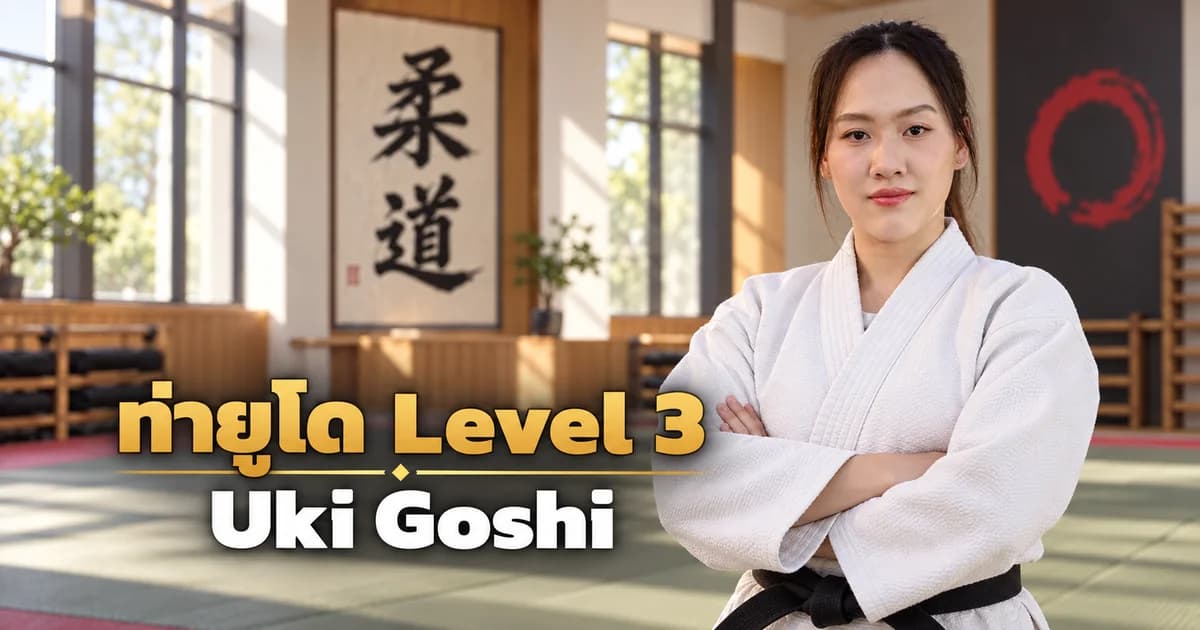
Judo Level 3: Uki Goshi — Use the hip as a pivot rather than a full lift
Uki Goshi turns a partner around a partially inserted hip, unlike O Goshi’s deeper loading and knee-extension lift. Watch contact distance and rotational direction.
Compiled by Phoenix — Co-founder of IMAC Dojo
 Thaninpong Supapitakpong (Phoenix)Co-founder of IMAC Dojo
Updated 29 Sept 2026
- Author
- Thaninpong Supapitakpong (Phoenix)
- Published
- Last updated
- Sources
- 1
- Reading time
- 3 min
Short Answer
Uki Goshi turns a partner around a partially inserted hip, unlike O Goshi’s deeper loading and knee-extension lift. Watch contact distance and rotational direction.
Key Takeaways
- Compare partial hip entry with O Goshi’s deeper loading.
- Distinguish torso rotation from a knee-extension lift.
- Follow the back-wrapping arm together with the sleeve-control hand.
If Uki Goshi resembles O Goshi, pause before the partner rises and compare hip placement and knee action. The distinction appears before the finished throw.
In this article
What the name tells us
浮腰, uki-goshi, means floating hip and belongs to the hip-technique group. Floating suggests the partner’s disrupted base; it does not tell the thrower to jump.
How the technique works
Kodokan distinguishes rotation around one rear-hip area. An arm passes under the armpit around the back, drawing the bodies together before rotation carries the partner around that contact. Observe angle rather than trying to carry someone high.
Uki-goshi uses the hip as a connection around which uke turns, rather than emphasizing full loading as in o-goshi. Kodokan describes shallow hip engagement and twisting. Follow when uke's torso starts rotating instead of measuring how high it rises.
What to watch in the clips
- Compare partial hip entry with O Goshi’s deeper loading.
- Distinguish torso rotation from a knee-extension lift.
- Follow the back-wrapping arm together with the sleeve-control hand.
A distinction worth noticing
Kodokan notes that Uki Goshi and O Goshi can look similar despite different mechanisms. A deep entry followed by lifting may be closer to O Goshi, so a spoken label alone is not enough to identify the action.
With similar waist wraps, a beginner may mistake uki-goshi for an unfinished o-goshi. Kodokan distinguishes their principles. Compare the depth of hip engagement and direction of rotation rather than the apparent force of the demonstration.
Taking the lesson back to practice
Ask your instructor to check the hip angle through slow entries without throwing. If you bend to carry the partner, revisit imbalance and pivot. Do not reduce contact so much that you merely pull an arm from a distance.
The Level here refers to the IMAC Dojo curriculum. Use the article and clips to prepare questions and review them with your instructor. Practical training needs a suitable partner, space and controlled conditions.
Ask your instructor to identify hip contact and the loss of uke's base, then explain the sequence in your own words before practising. If the explanation amounts only to lifting or twisting harder, revisit the relationship between hands and waist.
A story from Japan
Kodokan collects accounts of Kano’s skill in Uki Goshi, including recollections from people who received it. These are attributed memories: useful training context, not a guarantee of what the technique will achieve.
Connect this with your next lesson
Uki Goshi — Video lesson 1
An IMAC Dojo clip accompanying Uki Goshi. Use the observations and distinctions in this article to guide your viewing.
Video published
Sources and further reading
- 浮腰(うきごし)<腰技> — 講道館ReferenceAccessed 29 Sept 2026
Frequently Asked Questions
What distinguishes Uki Goshi from O Goshi?
Compare depth and mechanism: Uki Goshi rotates around partial hip contact; O Goshi loads more deeply and lifts through knee extension.
Does floating mean jumping?
No. Observe how the partner loses their base and is guided into rotation.
Why can the two throws look similar?
Both involve an arm around the back and hip contact. Watch the entry and lifting or turning action rather than only the fall.
Ready to start martial arts?
Message IMAC Dojo to ask which course fits your age, goals, and training background.
Ask on LINE OfficialRelated Articles
Related Topics and Courses
Judo Thailand