
IMAC Dojo Judo Curriculum · Level 4
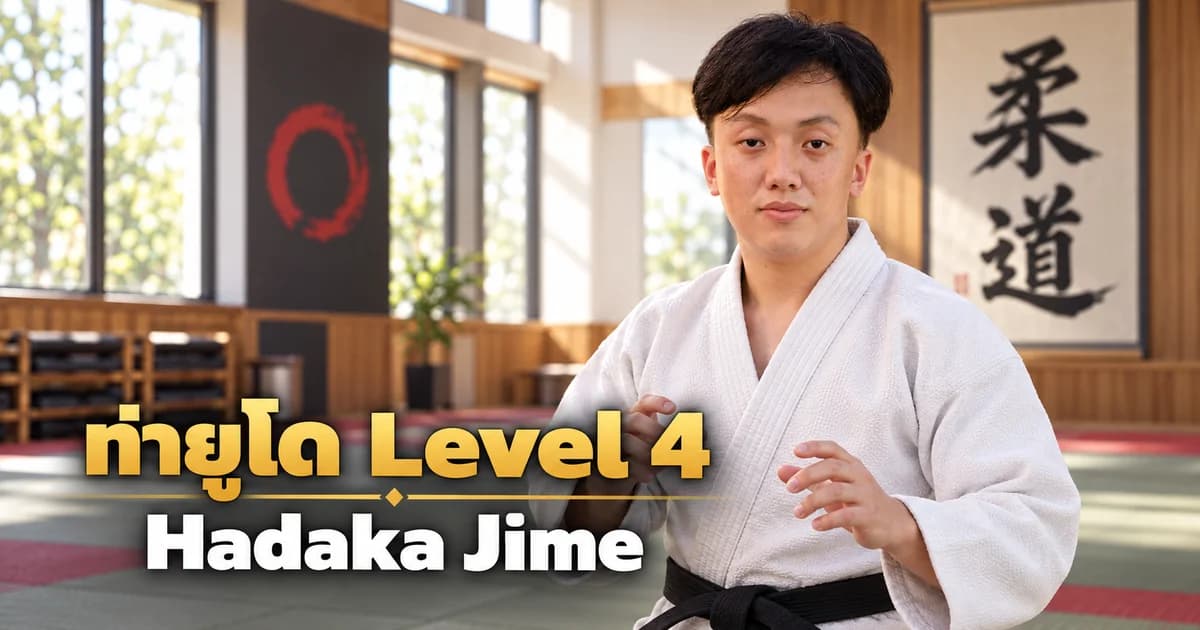
Judo Level 4: Hadaka Jime — Identify control without a collar grip
Hadaka Jime is a strangle technique that does not use judogi cloth for the strangle. View positioning and communication under instruction, not endurance testing.
Compiled by Phoenix — Co-founder of IMAC Dojo
 Thaninpong Supapitakpong (Phoenix)Co-founder of IMAC Dojo
Updated 29 Sept 2026
- Author
- Thaninpong Supapitakpong (Phoenix)
- Published
- Last updated
- Sources
- 1
- Reading time
- 2 min
Short Answer
Hadaka Jime is a strangle technique that does not use judogi cloth for the strangle. View positioning and communication under instruction, not endurance testing.
Key Takeaways
- Confirm the collar is not used for the strangle.
- Observe both bodies rather than hands alone.
- Watch immediate release at the partner’s signal.
Check whether the hands grip cloth or connect with the arms. This distinguishes it from collar-based techniques early in the clip.
In this article
What the name tells us
裸絞, hadaka-jime, belongs to strangle techniques. Hadaka here indicates not using the judogi, not an instruction to remove training clothing.
How the technique works
Kodokan describes control from behind using arms and hands rather than the collar. Read body alignment and connections without copying force or duration.
Hadaka indicates that Kodokan's definition does not use the judogi for the strangle; it does not instruct practitioners to remove clothing. Read how both arms establish control from behind and how the torsos relate, rather than memorizing an arm shape around the neck.
What to watch in the clips
- Confirm the collar is not used for the strangle.
- Observe both bodies rather than hands alone.
- Watch immediate release at the partner’s signal.
A distinction worth noticing
Okuri Eri Jime and Kata Ha Jime use a collar. Being behind the partner does not make every strangle Hadaka Jime; mechanism distinguishes the names.
Unlike okuri-eri-jime, the collar is not the working material. Do not mix in collar-pulling instructions. When hands are hidden, state that they are not visible instead of inferring pressure from uke's facial expression.
Taking the lesson back to practice
An instructor decides readiness and checks position without strangle pressure. Agree on a clear stop signal and release immediately. Unconsciousness or competing in endurance is not a training goal.
The Level here refers to the IMAC Dojo curriculum. Use the article and clips to prepare questions and review them with your instructor. Practical training needs a suitable partner, space and controlled conditions.
Study names, position and instructor-supervised control. There is no reason to practise until a partner cannot speak or loses consciousness. Agree on a non-verbal signal and release immediately at a signal or unusual response.
Connect this with your next lesson
Hadaka Jime — Video lesson 1
An IMAC Dojo clip accompanying Hadaka Jime. Use the observations and distinctions in this article to guide your viewing.
Video published
Sources and further reading
- 裸絞 — 講道館 柔道 技名称一覧 — 講道館ReferenceAccessed 29 Sept 2026
Frequently Asked Questions
Does hadaka mean removing the judogi?
No. It means the cloth is not used as part of the strangle.
Is every strangle from behind Hadaka Jime?
No. Check collar use and arm structure.
What matters when observing partner practice?
Position, communication and immediate release on signal, with actual practice supervised by an instructor.
Ready to start martial arts?
Message IMAC Dojo to ask which course fits your age, goals, and training background.
Ask on LINE OfficialRelated Articles
Related Topics and Courses
Judo Thailand