
IMAC Dojo Judo Curriculum · Level 4
Judo Level 4: Tai Otoshi — Hands guide the descent; legs organize the base
Tai Otoshi is a hand technique opening the body and guiding the partner down from forward-corner imbalance. The conspicuous extended leg should not reduce it to a simple trip.
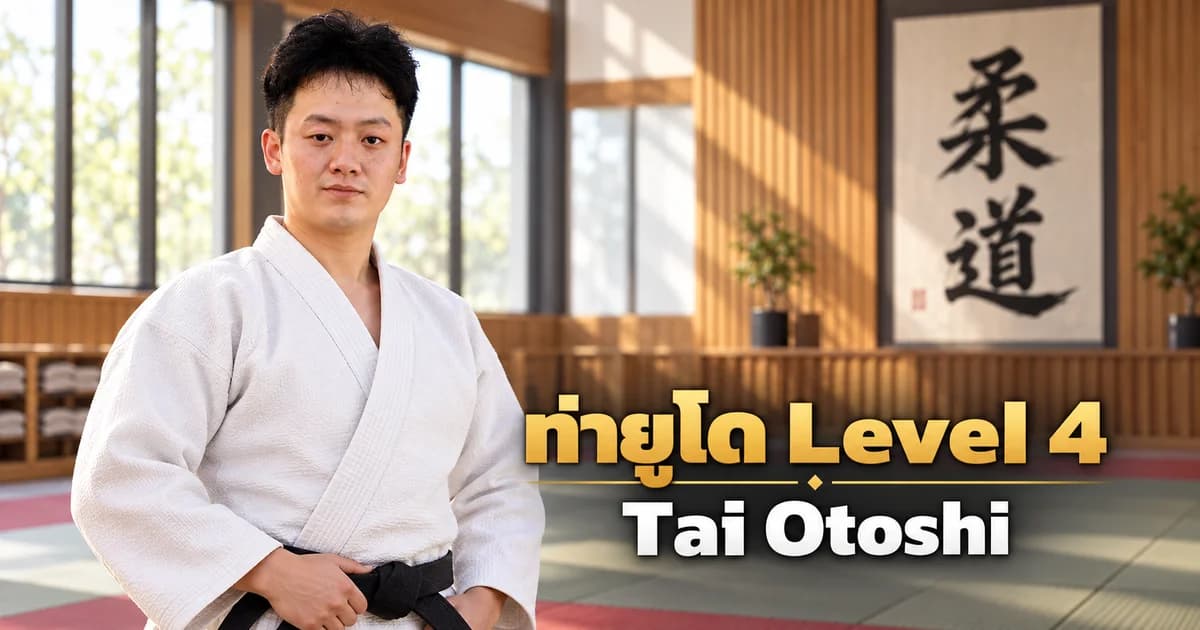
Compiled by Phoenix — Co-founder of IMAC Dojo
 Thaninpong Supapitakpong (Phoenix)Co-founder of IMAC Dojo
Updated 29 Sept 2026
- Author
- Thaninpong Supapitakpong (Phoenix)
- Published
- Last updated
- Sources
- 2
- Reading time
- 3 min
Short Answer
Tai Otoshi is a hand technique opening the body and guiding the partner down from forward-corner imbalance. The conspicuous extended leg should not reduce it to a simple trip.
Key Takeaways
- Read the imbalance direction before the body opens.
- Track both hands through stepping and descent.
- Compare leg base and torso line in all four clips without treating one still frame as a fixed formula.
The clip collection matches four clips to Tai Otoshi, all retained for comparing timing and viewpoints. Use hand action as your viewing anchor rather than the extended leg alone.
In this article
What the name tells us
体落, tai-otoshi, means body drop and belongs to Kodokan’s hand-technique group. The name is not an instruction to drop weight onto the partner’s leg.
How the technique works
Kodokan describes forward-corner imbalance, opening the body and drawing the partner down in front. Follow whether the hands continue through the opening step or stop, leaving only a leg obstructing the path.
Tai-otoshi shows why a visually prominent leg does not automatically make a throw ashi-waza. Kodokan classifies it as te-waza and describes opening the body while drawing uke forward and down. Read the leg with the pulling direction and the space tori opens. Stopping the hands and merely blocking with a leg may resemble the pose but changes the underlying action.
What to watch in the clips
- Read the imbalance direction before the body opens.
- Track both hands through stepping and descent.
- Compare leg base and torso line in all four clips without treating one still frame as a fixed formula.
A distinction worth noticing
Unlike a hip throw, this does not depend on loading the partner onto the hip. Turning one’s back does not make every throw O Goshi or Seoi Nage. Check attempts to lift or block while the hands stop working.
MEXT's teaching guide uses tai-otoshi to connect posture, gripping, movement, imbalance and receiving a throw. This explains how foundational skills contribute to one technique, not that a live throw should be broken into rigid pauses.
Taking the lesson back to practice
Have an instructor arrange feet, knees and distance before increasing speed. Stop and reset if pressure or twisting affects the partner’s knee. Maintain control through the finish with a receiver prepared for ukemi.
The Level here refers to the IMAC Dojo curriculum. Use the article and clips to prepare questions and review them with your instructor. Practical training needs a suitable partner, space and controlled conditions.
With four clips, first identify uke's direction, then revisit the hands, and finally examine feet and knees. Record only what is visible; short footage does not reveal force directly. If the camera hides a leg, turn that uncertainty into a question for your instructor rather than copying a guessed foot position.
Connect this with your next lesson
Tai Otoshi — Video lesson 1
An IMAC Dojo clip accompanying Tai Otoshi. Use the observations and distinctions in this article to guide your viewing.
Video published
Tai Otoshi — Video lesson 2
An IMAC Dojo clip accompanying Tai Otoshi. Use the observations and distinctions in this article to guide your viewing.
Video published
Tai Otoshi — Short demonstration 3
An IMAC Dojo clip accompanying Tai Otoshi. Use the observations and distinctions in this article to guide your viewing.
Video published
Tai Otoshi — Short demonstration 4
An IMAC Dojo clip accompanying Tai Otoshi. Use the observations and distinctions in this article to guide your viewing.
Video published
Sources and further reading
- 体落(たいおとし)<手技> — 講道館ReferenceAccessed 29 Sept 2026
- 柔道指導の手引(三訂版)第4章・基本動作 — 文部科学省ReferenceAccessed 29 Sept 2026
Frequently Asked Questions
Why is Tai Otoshi a hand technique when the leg is prominent?
Classification follows mechanism: hand-guided descent and body opening matter more than which body part is visually prominent.
How should I compare four clips?
Choose one feature per viewing, such as hand direction or base, and compare it across clips rather than memorize final poses.
Should I lift the partner onto my hip?
Do not substitute a hip-throw mechanism for Tai Otoshi. Ask an instructor to check the opening and hand direction.
Ready to start martial arts?
Message IMAC Dojo to ask which course fits your age, goals, and training background.
Ask on LINE OfficialRelated Articles
Related Topics and Courses
Judo Thailand