How Many Wai Kru Muay Thai Poses Are There, and How Is Ram Muay Different?
A source-led guide to the popular eight-pose question, the difference between Wai Kru and Ram Muay, and the posture groups used in IFMA rules.
By
 PattyMuaythai specialist and instructor
Updated 6 Sept 2026
- Author
- Patty
- Published
- Last updated
- Sources
- 4
- Reading time
- 5 min
Short Answer
There is no single universal list requiring every Wai Kru Muay Thai tradition to use only eight poses. Forms vary with the teacher, lineage, purpose, and competition setting. Wai Kru centres on respect for teachers, while Ram Muay is the dance sequence that expresses rhythm, body control, and training identity. Dedicated IFMA Wai Kru competition rules use starting, sitting, standing, finishing, and connecting posture groups, so the number eight should not be treated as a rule for every ceremony.
Key Takeaways
- No one eight-pose list governs every teacher, camp, and setting.
- Wai Kru centres on paying respect; Ram Muay is the dance sequence that follows.
- IFMA's dedicated Wai Kru competition rules organize several posture groups, not one list of eight.
- Beginners should learn meaning, base positions, sequence, and rhythm with an instructor before collecting pose names.
The query “eight Wai Kru Muay Thai poses” can make the ritual sound like one universal checklist. World Muaythai Council explanations and International Federation of Muaythai Associations rules instead show forms that vary by lineage, bout context, and competition format.
This guide therefore does not manufacture an eight-item list. It first separates Wai Kru from Ram Muay, explains where IFMA's numbers apply, and shows how a beginner can learn without reducing a living tradition to a set of poses.
In this article
How is Wai Kru different from Ram Muay?
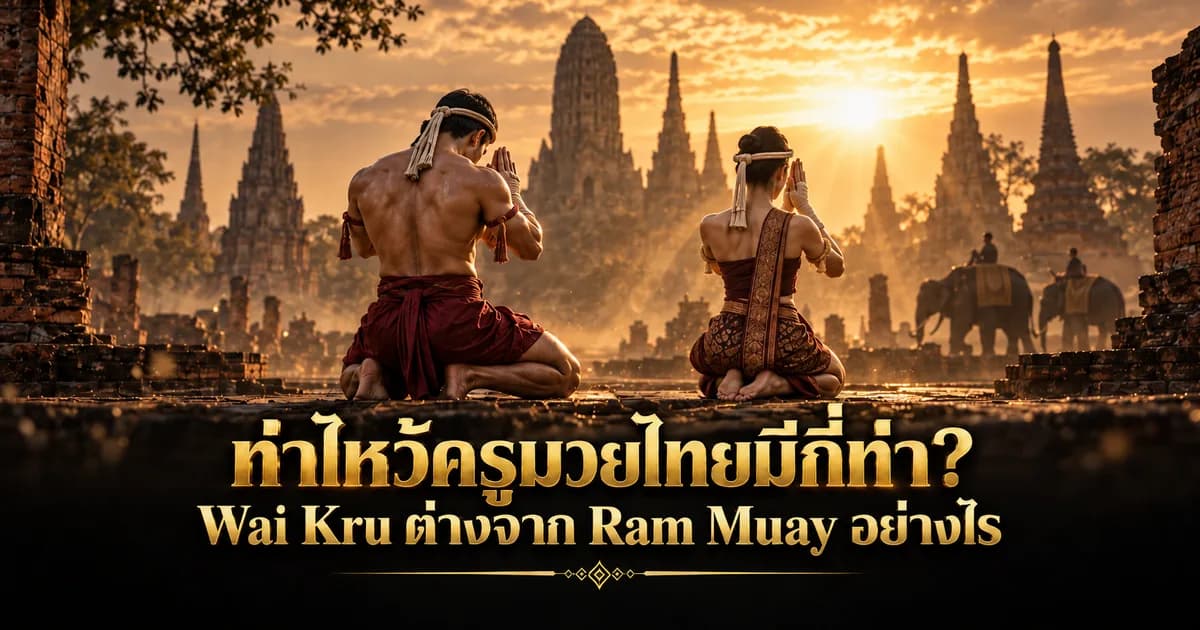
Wai refers to an expression of respect, while Khru means a teacher or the person who transmits knowledge. Wai Kru therefore centres on gratitude to teachers, benefactors, and the chain through which the art was passed down. Thailand's Department of Cultural Promotion describes Wai Kru Muay Thai as a culture of respect for parents, teachers, and benefactors.
Ram means a traditional dance and Muay means boxing. Ram Muay is the movement sequence that follows the act of paying respect, expressing body control, rhythm, and the practitioner's style. The World Muaythai Council describes it as a personal ritual that can range from simple to complex and may contain clues about the trainer or school.
In ordinary speech, the two are often combined as Wai Kru Ram Muay. The boundary need not be forced at every movement, but knowing the distinction makes clear that the ritual is not only a collection of attractive poses.
Are there exactly eight Wai Kru poses?
The short answer is no: eight is not a universal number for every lineage and setting. A school may organize its teaching into an eight-pose set, another lineage may use different names and sequences, and a pre-bout Ram Muay may be shorter or longer depending on tradition and the event's rules.
An “eight poses” label should therefore be read as a particular source's lesson structure, not proof that every Muaythai camp follows the same list. When an article or video does not name its teacher, lineage, or ruleset, it should not be presented as the sole standard for the whole art.
How does IFMA organize Wai Kru postures?
Rules for a Ram Muay before a Muaythai bout must be distinguished from rules for a dedicated Wai Kru competition. For a bout, IFMA's coach guide refers to starting, sitting, and standing postures and sets a maximum duration by competition division.
For its cultural Wai Kru competition, the IFMA Wai Kru & Mai Muay rules revised on 22 May 2025 require all six starting postures, four of seven sitting postures, four of seven standing postures, all five finishing movements, and permit additional connecting postures. This framework belongs to that competition format; it is not a declaration that every lineage worldwide must perform an identical sequence.
Accuracy, completion, rhythm, fluidity, and personality matter more than a raw count. IFMA's own judging categories reflect those qualities rather than rewarding the number of poses alone.
What can the dance communicate about a practitioner?
Ram Muay is a movement language of respect, mental preparation, rhythm, and relationship to a teacher. A knowledgeable observer may recognize clues to a training line in the sequence and transitions, but one pose alone is not enough to identify a lineage responsibly.
Mongkhon, Pra Jiad, and traditional music may accompany the ritual according to context. The World Muaythai Council calls music integral, while IFMA rules specify the pi, small cymbals, and a double-headed drum in its setting. These details show why Wai Kru is simultaneously ritual, culture, and embodied practice rather than a set of disconnected photo poses.
How should a beginner learn Wai Kru?
Begin with meaning and etiquette before memorizing pose names. Then learn base position, hand placement, weight transfer, gaze, and breathing in short sections. Once those foundations are stable, connect them to music and longer sequences.
Video can help with review, but a two-dimensional view cannot fully show weight transfer, joint angles, or the reason for a transition. An instructor should correct the details, and learners should not blend several lineages together and label the result as one traditional sequence.
The first goal is not to perform the greatest number of poses. It is to move attentively, understand whom the ritual honours, and maintain continuity without rushing past the foundations.
Learn Wai Kru Muay Thai at IMAC Dojo
If you want to study movement, meaning, rhythm, and respect for the teacher lineage together, see IMAC Dojo's Wai Kru Muay Thai course, taught by Khru Patty. In-person instruction lets the teacher adapt stance, timing, and sequence to the learner's purpose instead of teaching from pose names alone.
For a comparison with formal teacher acceptance in Chinese martial traditions, continue with What is Bai Shi? to see how cultures frame the teacher-student relationship differently.
Sources and further reading
- IFMA Wai Kru & Mai Muay Rules & Regulations, version 0.05 — International Federation of Muaythai AssociationsOfficialAccessed 15 Aug 2026
- A Coach and Manager's Guide — International Federation of Muaythai AssociationsOfficialAccessed 15 Aug 2026
- Wai Khru: Origins and Explanation of the Ritual — World Muaythai CouncilOfficialAccessed 15 Aug 2026
- Muay Thai Art, Episode 1: Wai Kru, the Boxer's First Lesson — Department of Cultural Promotion, Ministry of Culture, ThailandOfficialAccessed 15 Aug 2026
Frequently Asked Questions
Are there exactly eight Wai Kru Muay Thai poses?
No single eight-pose list governs every lineage, teacher, or setting. Eight may describe one teaching set, while IFMA's dedicated Wai Kru competition rules use several groups with different counts.
What is the difference between Wai Kru and Ram Muay?
Wai Kru centres on respect and gratitude to teachers and the training line. Ram Muay is the dance sequence expressing rhythm, body control, and training identity. They are often combined as Wai Kru Ram Muay.
Why do Muaythai athletes perform Wai Kru before a bout?
The ritual honours teachers, benefactors, the opponent, and tradition while helping the practitioner gather focus and prepare the body's rhythm for competition.
Can someone with no experience learn Wai Kru Muay Thai?
Yes. A beginner should first learn meaning, base positions, weight transfer, and a short sequence with an instructor, then add detail, music, and continuity gradually.
Ready to start martial arts?
Message IMAC Dojo to ask which course fits your age, goals, and training background.
Ask on LINE Official