
Wai Kru history and the full sequence — reading meaning alongside movement
Listen for context, then divide the performance into phases. Look beyond names and bring precise questions back to the instructor.
Compiled by Phoenix — Co-founder of IMAC Dojo
 Thaninpong Supapitakpong (Phoenix)Co-founder of IMAC Dojo
Updated 30 Sept 2026
Assigned content reviewer: Patty
- Author
- Thaninpong Supapitakpong (Phoenix)
- Published
- Last updated
- Sources
- 1
- Reading time
- 3 min
Short Answer
A DPE manual connects Wai Kru with remembering those who transmit knowledge and divides its example into seated and standing phases. This article pairs one history clip with one full-sequence clip, separating cultural meaning from sequence reading without assigning an unverified origin year.
Key Takeaways
- History and full-sequence clips answer different questions.
- Read broad phases before hand and foot details.
- The manual provides an example, not a universal order.
- Record uncertain names and transitions for instructor review.
A continuous Wai Kru can raise the question of whether every name must be memorized. Start instead by asking where respect is expressed, where support changes and how phases connect. This is a viewing guide to the history and compilation clips, distinct from an article cataloguing pose names.
In this article
History is more than finding an origin year
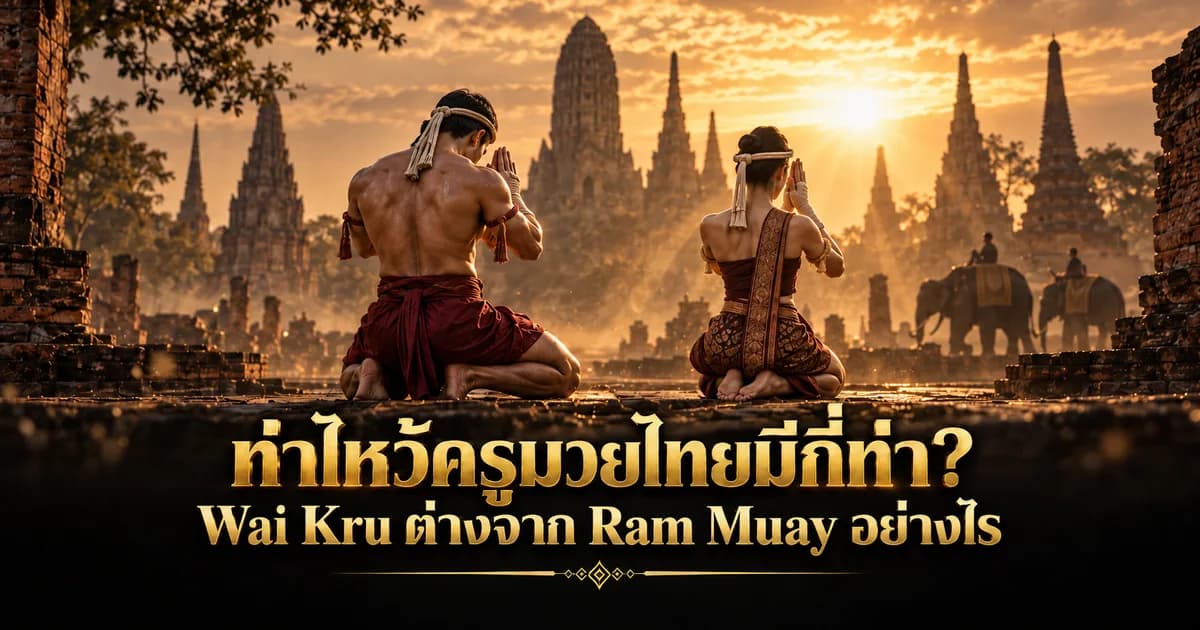
Printed page 55 of The Art of Muay Thai describes Wai Kru through remembrance of the teachers who transmitted the art. This supports discussion of the teacher–student relationship; traditional language is not proof of one inventor in a particular year.
The manual's discussion of mental steadiness belongs to its traditional outlook, not a guaranteed health outcome. In the history clip, separate narratives, meanings and facts that can be traced to sources.
Use seated and standing phases as an initial map
The manual divides the opening into seated forms and later standing/dancing forms, placing names such as Thep Phanom, Pathom, Phrom and Fon Long Choeng in different parts. This offers reference points for changes in support and movement through space.
Do not use the document's list to declare a differently ordered clip wrong. Ask which sequence is being taught, what the course selects and which phases are shortened or expanded. Specific forms require actual teaching context.
Listen with three kinds of question
The CSV history clip is IUNhPrt8FT4. Note what meaning the speaker explains, which person or period is mentioned and what source supports that information. This separates cultural understanding from matters needing further research.
The article does not verify every event in the clip from its title. If a year or detail lacks a located source, keep it as a question for the instructor or further reading rather than increasing its certainty.
Watch the compilation twice with different tasks
The compilation is TYbxZzXRiIk. First map broad phase changes; on a second pass choose a short passage to read hands, torso and support. This article does not invent timestamps for forms not yet verified.
Record each passage's starting form, ending form and unresolved questions. Transitions can reveal more than an end-position image. If a name is unclear, refer the instructor to its time in the clip rather than inventing a label.
Keep meaning and the taught sequence together
Bring questions from both clips together: which movement expresses a meaning discussed, or which course name differs from the manual? Connecting explanation to movement gives review a purpose beyond copying shapes.
Begin with the assigned phase and suitable space. Finishing the video does not establish performance ability or assessment completion. Review what can be explained and repeated under the instructor's guidance.
Return to the course for review
Read about Muaythai Anywhere and Khru Patty, the assigned content reviewer. Dance and ceremony are covered in the Wai Kru Muay Thai course.
Wai Kru Muay Thai history
Note meanings and transitions to discuss with the instructor, separating explanation from unverified conclusions.
Video published
Complete Wai Kru sequence
Note meanings and transitions to discuss with the instructor, separating explanation from unverified conclusions.
Video published
Sources and further reading
- The Art of Muay Thai: Wai Kru and sequence divisions, pages 55–56 — Department of Physical Education, Institute of Muay Thai ArtReferenceAccessed 29 Sept 2026
Frequently Asked Questions
Does this article date the origin of Wai Kru?
No single year or inventor is assigned. The sources describe context and forms without establishing that conclusion.
Do all schools use the same sequence?
This article does not make that claim. It uses a manual example and asks learners to confirm the taught sequence.
Which clip comes first?
Use the history clip to frame questions about meaning, then the compilation to locate phases and transitions.
What if I cannot name a form?
Record its time and start/end positions for the instructor rather than inventing a name from the image.
Does watching both clips complete the course?
Watching is not a skills assessment. Use the clips for review and receive guidance through the course.
Ready to start martial arts?
Message IMAC Dojo to ask which course fits your age, goals, and training background.
Ask on LINE OfficialRelated Articles


Related Topics and Courses
Muaythai