
Yang Sam Khum in Wai Kru — connecting Rama, Narai and Hong Hoen forms
Three clips share Yang Sam Khum but connect to different forms. Read the common part before comparing how hands and support change.
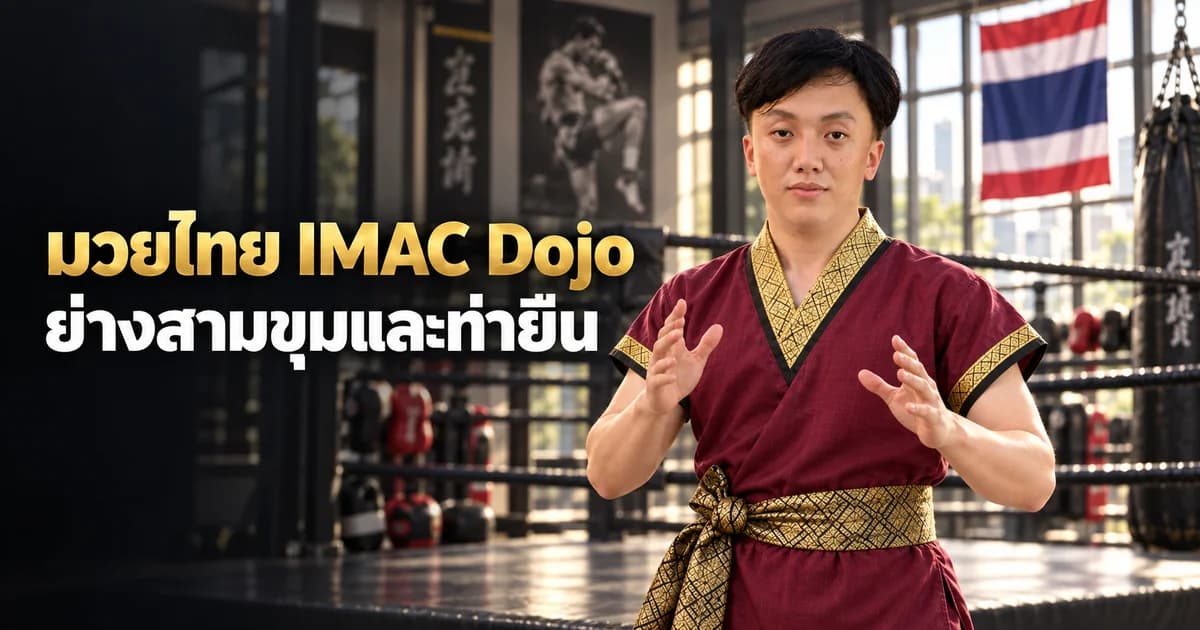
Compiled by Phoenix — Co-founder of IMAC Dojo
 Thaninpong Supapitakpong (Phoenix)Co-founder of IMAC Dojo
Updated 30 Sept 2026
Assigned content reviewer: Patty
- Author
- Thaninpong Supapitakpong (Phoenix)
- Published
- Last updated
- Sources
- 1
- Reading time
- 3 min
Short Answer
The three clips connect Yang Sam Khum with Phra Ram Phlaeng Son, Narai Kwang Chak and Hong Hoen in Wai Kru. Separate the connecting steps from the following symbolic form, using DPE references for context and instructor review for the clip's exact sequence.
Key Takeaways
- This is ceremonial Yang Sam Khum, distinct from the evasion article.
- The Rama source depicts preparing and drawing a bow.
- Hong Hoen combines wing-like arms with supporting-leg arrangements.
- Narai is documented by name in the sequence; complete movement details remain to be checked.
Seeing Yang Sam Khum in three titles might suggest choosing only one clip. The difference lies in what follows it. Clarifying the shared part helps identify the transition from stepping to a symbolic gesture without blending three sequences.
In this article
Read the whole body in the connecting steps
The Art of Muay Thai relates a raised knee, arms and alternating stepping in ceremonial Yang Sam Khum. For clip reading, follow how the upper body coordinates with the base as sides change, not only the path of the feet.
This article concerns connections in a dance sequence; Yang Sam Khum used for evasion belongs to the movement article. A shared label does not make the clips interchangeable. Identify the stepping portion and the start of the new form in each of these three videos.
Rama's bow: read the story through hands and support
Printed page 73 depicts preparing a bow, taking an arrow, drawing and following its imagined release, alongside changes in leg support. The name helps remember an action sequence; one extended arm does not complete the form.
In the combined clip, follow the change from walking rhythm into the bow image and how the body reorganizes afterward. Read the course demonstration rather than assuming that the number of book illustrations equals the video's beat count.
Narai's disc: know the documented name without filling gaps
The source names Narai Kwang Chak in its list and diagram, explaining it in English as Narai throwing a disc. The reviewed pages establish the name and example context, but do not justify a confirmed account of every hand-and-foot phase in this clip.
Ask the instructor where the form begins, how the arm movement relates to the torso, and where the return transition occurs. A similarly named dance or fighting form should not be substituted: a shared name does not establish an identical sequence.
Hong Hoen: compare wing-like arms and the supporting leg
The CSV spells the name หงส์เหิน while the document uses หงส์เหิร; both original labels are retained in the evidence. The source describes wing-like arm motion with leg support. Do not let fingertips or arm width draw attention away from the base.
Watch the arm opening, leg-position changes and return continuously. Do not infer one required leg height or arm range for everyone from an image. Ask the instructor to check the taught form and the learner's control.
Three clips, three destinations for the transition
All three URLs remain because each names a different following form. Begin with Yang Sam Khum and Rama to identify the transition, then compare the others with the same questions about where stepping ends and the new form begins.
Ask the instructor to check rushing through steps while anticipating the next pose, pausing to recall the order, or arranging the hands before the base is ready. Record unclear moments by timestamp instead of guessing the whole sequence from names.
Return to the course for review
Read about Muaythai Anywhere and Khru Patty, the assigned content reviewer. Dance and ceremony are covered in the Wai Kru Muay Thai course.
Yang Sam Khum + Phra Ram Phlaeng Son
Separate the stepping portion from the following form; observe the transition, hands and support for instructor review.
Video published
Yang Sam Khum + Narai Kwang Chak
Separate the stepping portion from the following form; observe the transition, hands and support for instructor review.
Video published
Yang Sam Khum + Hong Hoen
Separate the stepping portion from the following form; observe the transition, hands and support for instructor review.
Video published
Sources and further reading
- The Art of Muay Thai: Yang Sam Khum, Hong Hoen, Phra Ram Phlaeng Son and sequence diagram, printed pages 68, 70, 73 and 75 — Department of Physical Education, Institute of Muay Thai ArtReferenceAccessed 29 Sept 2026
Frequently Asked Questions
Can repeated Yang Sam Khum titles be reduced to one clip?
No: each clip connects to a different form, so the three URLs serve different purposes.
Is ceremonial Yang Sam Khum the same as the evasion clip?
This article reads it as dance, while evasion has a separate movement task. The shared name does not automatically make them substitutes.
Why are there two Thai spellings of Hong Hoen?
The CSV and reference use different spellings. This article retains the CSV label for matching and explicitly records the document's version rather than rewriting the source.
Has Narai Kwang Chak's complete sequence been established?
The reviewed material confirms its name and dance context, but not every phase of the course clip. Observations remain questions pending instructor review.
Must the three forms be danced in article order?
The article organizes comparison, not a mandatory dance sequence. Use the sequence set by the course instructor.
Ready to start martial arts?
Message IMAC Dojo to ask which course fits your age, goals, and training background.
Ask on LINE OfficialRelated Articles
Related Topics and Courses
Muaythai